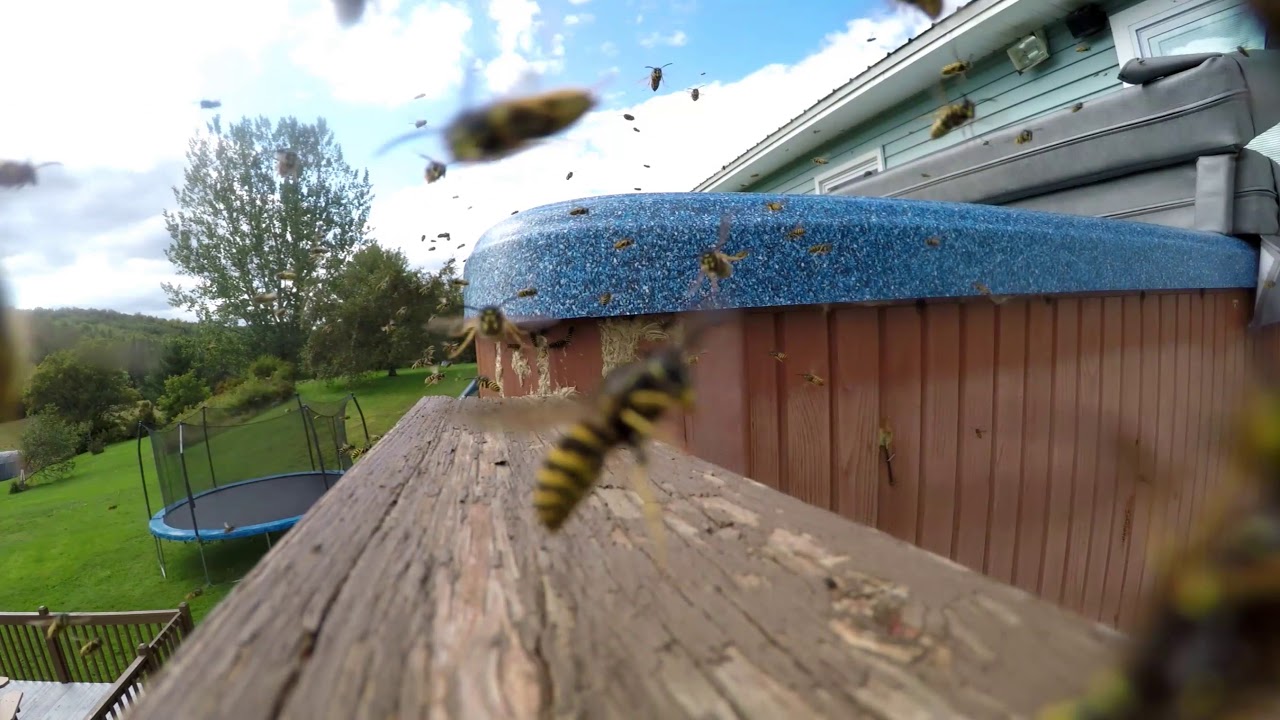
What more can I say. These little buggers are pretty vicious.
From Wikipedia, the free encyclopedia
Yellowjacket or yellow jacket is the common name in North America for predatory social wasps of the genera Vespula and Dolichovespula. Members of these genera are known simply as "wasps" in other English-speaking countries. Most of these are black and yellow like the eastern yellowjacket Vespula maculifrons and the aerial yellowjacket Dolichovespula arenaria; some are black and white like the bald-faced hornet, Dolichovespula maculata. Others may have the abdomen background color red instead of black. They can be identified by their distinctive markings, their occurrence only in colonies, and a characteristic, rapid, side-to-side flight pattern prior to landing. All females are capable of stinging. Yellowjackets are important predators of pest insects.
Yellowjackets are sometimes mistakenly called "bees" (as in "meat bees"), given that they are similar in size and sting, but yellowjackets are actually wasps. They may be confused with other wasps, such as hornets and paper wasps. Polistes dominula, a species of paper wasp, is very frequently misidentified as a yellowjacket. A typical yellowjacket worker is about 12 mm (0.5 in) long, with alternating bands on the abdomen; the queen is larger, about 19 mm (0.75 in) long (the different patterns on their abdomens help separate various species). Workers are sometimes confused with honey bees, especially when flying in and out of their nests. Yellowjackets, in contrast to honey bees, have yellow or white markings, are not covered with tan-brown dense hair on their bodies, do not carry pollen, and do not have the flattened hairy hind legs used to carry it.
These species have lance-like stingers with small barbs, and typically sting repeatedly,[1] though occasionally a stinger becomes lodged and pulls free of the wasp's body; the venom, like most bee and wasp venoms, is primarily only dangerous to humans who are allergic or are stung many times. All species have yellow or white on their faces. Their mouthparts are well-developed with strong mandibles for capturing and chewing insects, with probosces for sucking nectar, fruit, and other juices. Yellowjackets build nests in trees, shrubs, or in protected places such as inside man-made structures, or in soil cavities, tree stumps, mouse burrows, etc. They build them from wood fiber they chew into a paper-like pulp. Many other insects exhibit protective mimicry of aggressive, stinging yellowjackets; in addition to numerous bees and wasps (Müllerian mimicry), the list includes some flies, moths, and beetles (Batesian mimicry).
Yellowjackets' closest relatives, the hornets, closely resemble them, but have larger heads, seen especially in the large distance from the eyes to the back of the head.

Информация по комментариям в разработке