Just a couple of decades ago Philanthus triangulum was considered a very rare beastie in the UK. Since then it has becaome locally common in an increasing number of sites in the southern half of the UK.
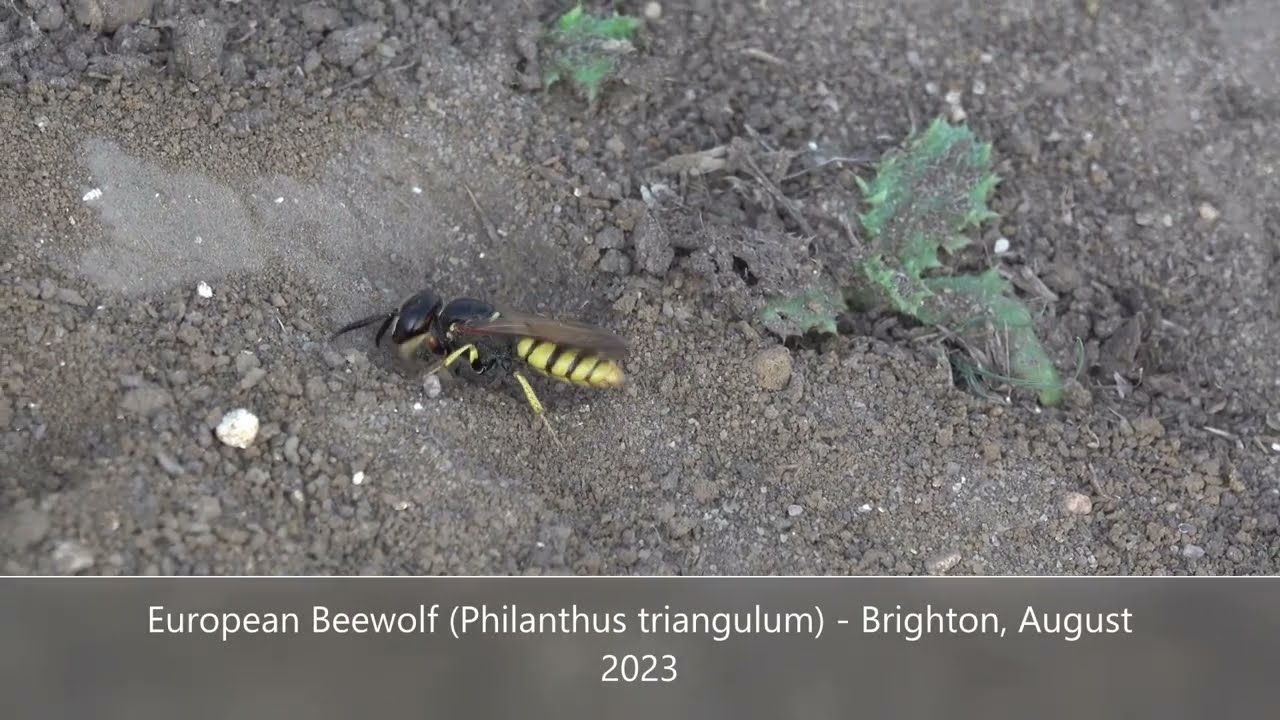
This solitary Digger is one of our largest wasps, measuring up to 17mm in length, so when I came across a number of large, slim wasps hovering low over a gentle sandy slope, stopping every now and then to do some frantic digging, I knew instantly what they were.
I knew also they were females, since the males make no contribution to the preparation and maintenance of nests.
Males are also distinguishable by a face marking in the shape of a Trident, absent on females, seen here in a video I posted in 2020: • European Bee Wolf (Philanthus Triangulum) ...
The role of males is to gather close by, protect a small individual territory, and waft phremones to attract a female with whom to mate.
The rest is down to her.
In this video, you can see various females beginning construction of their individual burrows, each up to a metre long with multiple (up to 30 or so) side burrows, into each one of which she will lay an egg beside a supply of previously hunted food, for when the egg hatches.
This process can take up to three days to complete, so good weather for that period of time is vital.
Simple enough? Not likely!
With the larvae encased in a closed, humid environment, they are vulnerable to mould growth which can both kill them and/or destroy their food source.
Clever mum has this sorted. Before laying the egg beside the food source, she covers the surface of the food with a secretion from a postpharyngeal gland which appears both to slow the growth of mould and help with water retention ensuring that the larvae has enough to survive the winter.
Equally remarkable is the method she uses to protect the larvae itself. Cultivated in the base of her antennae is a white paste that contains a bacteria called 'Candidatus Streptomyces philanthi’, a little of which she deposits near her egg for the hatched larva to find and incorporate into its cocoon to protect against a number of potential infections.
The food to which I refer, as the species name suggests, consists of bees, almost exclusively Honey bees.
She stalks, attacks, paralyses and then transports her prey back to the nest gripped between her legs,
In a further neat trick, given she's likely to need several attempts before succeeding in overpowering a similarly-sized victim (likely to have been distracted while nectaring) the female may suck nectar directly from her now paralyised prey, to give her enough energy to carry her booty home.
Of course, finding a specific tiny hole in what might be a large number of tiny entrances tightly aggregated on a sand bank requires more than just luck. Every time she leaves the nest, the female pauses to hover near the entrance, memorising its location.
Anything but simple!
PK
(There are 100's of short wildlife videos on this Channel, most of which are accompanied by written species information. To ensure you don't miss out on any new additions, please hit that 'Subscribe' button)

Информация по комментариям в разработке