AN GENERAL ELECTION RESULTS 1952-2025! भारतीय लोकसभा चुनाव परीणाम 1952- 2025
india have Seen Major Change in political Power since its independence
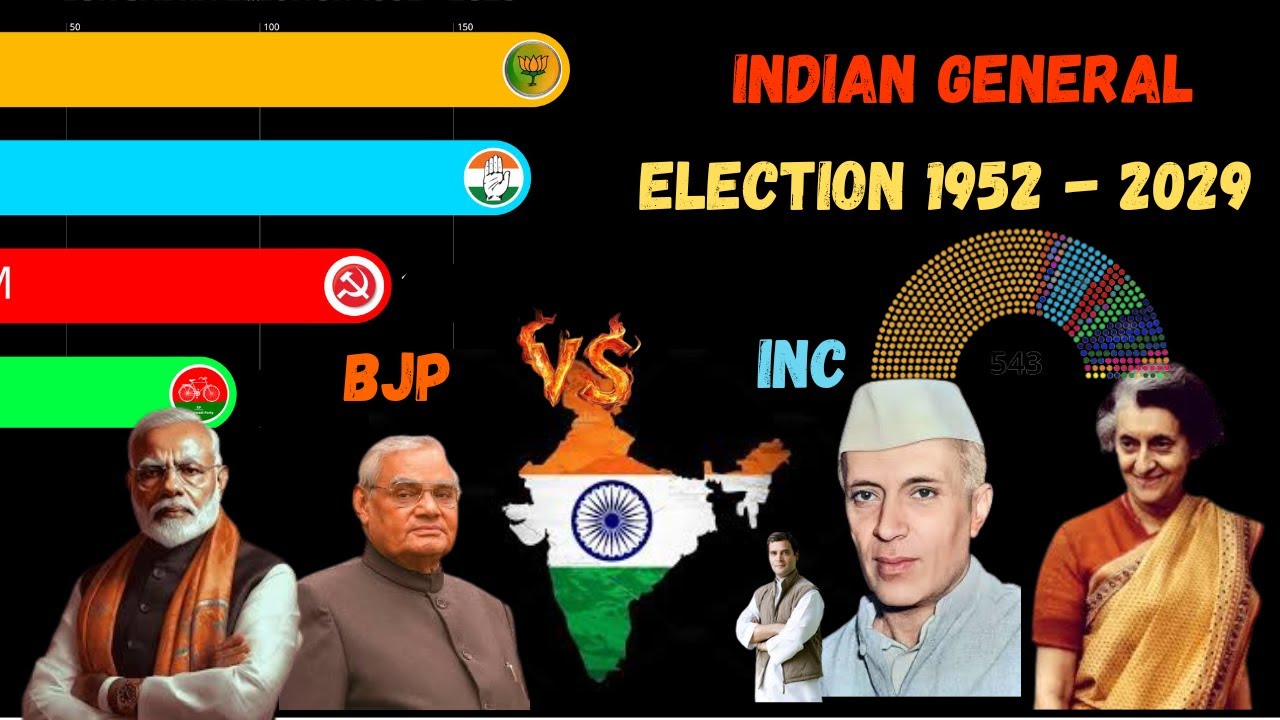
The Indian General Elections from 1951 to 2024 represent an extraordinary democratic journey, evolving from a postcolonial experiment into the world’s largest and most complex electoral exercise. In 1951-52, India held its first general election under the stewardship of the Indian National Congress (INC), led by Jawaharlal Nehru. With overwhelming support, the INC became synonymous with the freedom struggle, dominating Indian politics for the next two decades. However, by the 1967 election, signs of change emerged with regional parties gaining ground and Congress's dominance beginning to waver. The Emergency period (1975–77), imposed by Indira Gandhi, marked a turning point: in the 1977 election, the newly formed Janata Party—a coalition of anti-Congress forces—swept to power, signaling the first time Congress lost a general election. This brief disruption in Congress’s rule was followed by a Congress revival in 1980, but the political landscape was no longer unipolar. The 1989 elections brought the Janata Dal to power under V.P. Singh, with the BJP and Left parties supporting from outside, ushering in an era of coalition politics. The Bharatiya Janata Party (BJP), which had been a marginal player since its 1980 formation, emerged as a formidable force in the 1990s, capitalizing on the Ram Janmabhoomi movement and Hindu nationalist sentiment. The 1998 and 1999 elections saw the BJP, under Atal Bihari Vajpayee, successfully lead the National Democratic Alliance (NDA), institutionalizing coalition governance.
The early 2000s brought the Congress-led United Progressive Alliance (UPA) back to power in 2004 and again in 2009, under the quiet leadership of Dr. Manmohan Singh, even as Sonia Gandhi steered the party from behind the scenes. However, the UPA's second term was marred by corruption scandals and governance issues, creating fertile ground for the BJP’s resurgence. In 2014, Narendra Modi, with a powerful narrative of development and a strong central leadership image, led the BJP to its first single-party majority since 1984, marking the beginning of a new political era. The 2019 election reaffirmed this shift, with the BJP securing an even larger mandate, bolstered by nationalism, welfare delivery, and Modi’s personal popularity. Meanwhile, the Congress struggled to revive itself, facing leadership crises and declining public resonance. Regional parties like the Trinamool Congress, Aam Aadmi Party (AAP), DMK, and Shiv Sena increasingly shaped state politics, often becoming kingmakers at the national level. The 2024 general election, the 18th since independence, reflected deep political polarization but also the maturity of Indian democracy. The BJP, while still emerging as the single largest party, saw a dip in its seat tally compared to 2019, making room for a more assertive opposition, notably the INDIA bloc—a coalition of Congress and several regional heavyweights attempting to restore balance in national politics. This election highlighted key voter concerns ranging from economic inequality, unemployment, and civil liberties to national security and welfare politics. It also underscored the increasing use of digital media, artificial intelligence in campaigning, and the role of youth and first-time voters. From the towering dominance of the Congress in the 1950s to the ideological and organizational might of the BJP in the 21st century, Indian general elections have mirrored the nation’s transformation—socially, economically, and politically. Despite occasional turbulence, the democratic spirit has endured, making each election a unique reflection of India’s vast plurality and ever-evolving political consciousness.
#Narendramodi #india #Bjp
make more videos via using https://alienart.io/?referer=6818950e...

Информация по комментариям в разработке