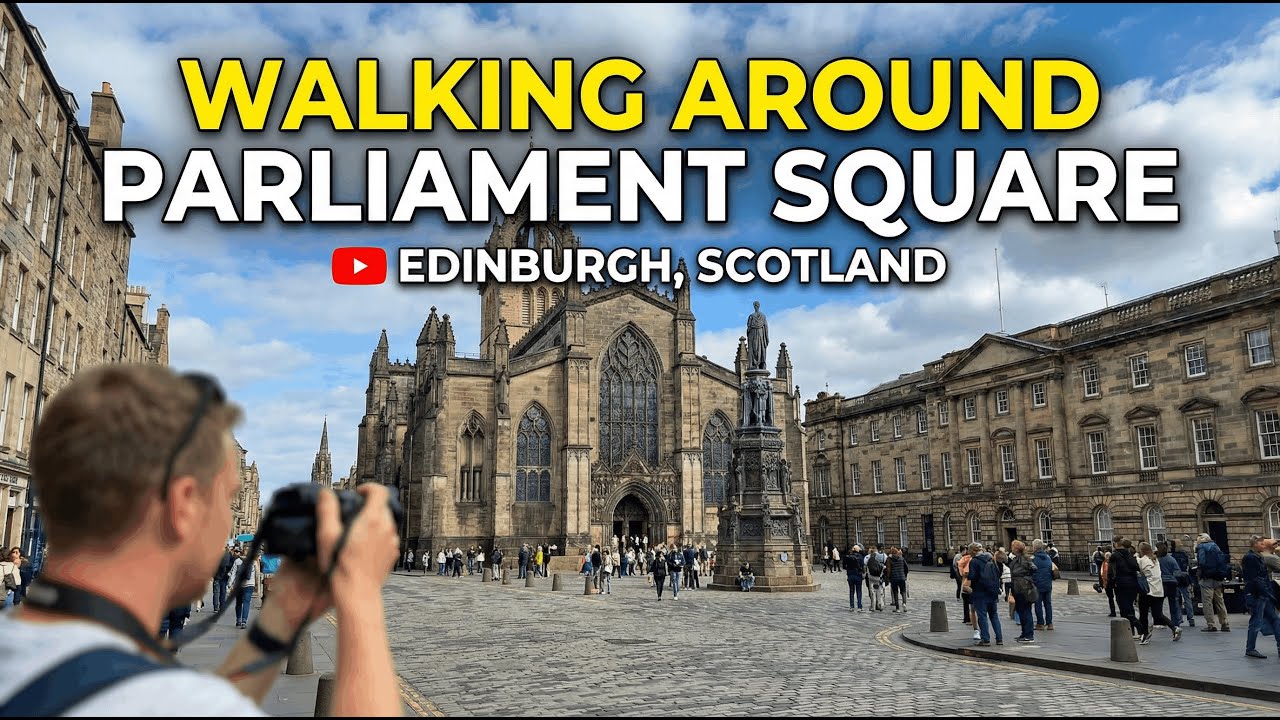
Parliament Square, located just off the High Street on Edinburgh's historic Royal Mile, is one of Scotland's most historically significant civic spaces, serving for centuries as a focal point for the nation's legal and political life. Although named a "square," it is not a formal quadrilateral but an L-shaped area wrapping around the east and south sides of St Giles' Kirk, with a further section on the west known as West Parliament Square. Its very location speaks to its ancient origins, having been created in 1632 as a forecourt to the newly built Parliament House, on the site of the old graveyard of St Giles Kirk.
This area's foundation as a public space was inextricably linked to the grand structure of Parliament House (completed 1640). This building was not only the seat of the pre-union Parliament of Scotland but also the home of the Court of Session, the supreme civil court. From its creation until the 1707 Act of Union dissolved the Scottish Parliament, the square—originally known as Parliament Close—bustled as a critical meeting place for politicians, lawyers, and the public before they entered the hall.
The Square is rich with significant landmarks and memorials. The Edinburgh Mercat Cross, a replica of the original medieval cross, stands prominently on the east side, a traditional site for royal proclamations, public announcements, and, historically, executions. It was here, in 1661, that those convicted of high treason following the Restoration were executed.
On the west side, in front of the entrance to the Supreme Courts of Scotland (which today occupy Parliament House), stands an impressive equestrian statue of Charles II of Scotland. This lead statue, dating from around 1685, is believed to be the oldest lead equestrian statue in Britain. Near this, in West Parliament Square, is the Queensberry Memorial to the 5th Duke of Buccleuch. Another notable figure commemorated here is James Braidwood, whose statue, erected in 2008, recognises his pivotal role in founding what is asserted to be the world's first municipal fire service in Edinburgh following the catastrophic Great Fire of 1824.
The history of the Close is also marked by its adjacency to the Old Tolbooth, which served multiple roles as the Town Council's meeting place, a tax office, law court, and prison before it was finally demolished in 1817. The gradual development of the area saw tenements and shops erected around the square, with tradesmen such as goldsmiths and booksellers occupying booths against the church walls, transforming the space into a vibrant commercial and social centre.
Despite the formality of its new name, Parliament Square's historical identity as Parliament Close was deeply rooted. The historian Henry Cockburn famously lamented the name change in the 1820s, attributing it to the "foppery" of fashion, underscoring the deep affection and historical memory tied to the older name. Furthermore, the square holds a poignant connection to one of Scotland's most transformative figures, John Knox, the minister chiefly responsible for introducing the Protestant Reformation. Although the graveyard was officially closed to burials in 1566, Knox was buried there by special permission in 1572. A simple stone engraved "IK 1572" near the Charles II statue marks the presumed site of his resting place, a subtle yet powerful reminder of the layers of history beneath the very stones trod by lawyers and citizens today.
Following the 1707 Union, Parliament House continued as the home of Scotland's highest courts, preserving its central role in the nation's legal infrastructure, and ensuring Parliament Square remains a deeply significant place where the threads of Scotland's political, legal, and civic history converge.

Информация по комментариям в разработке