Torch At The Organ – Memories Of Grieg Part 1
Sidney Torch (Sidney Torchinsky)
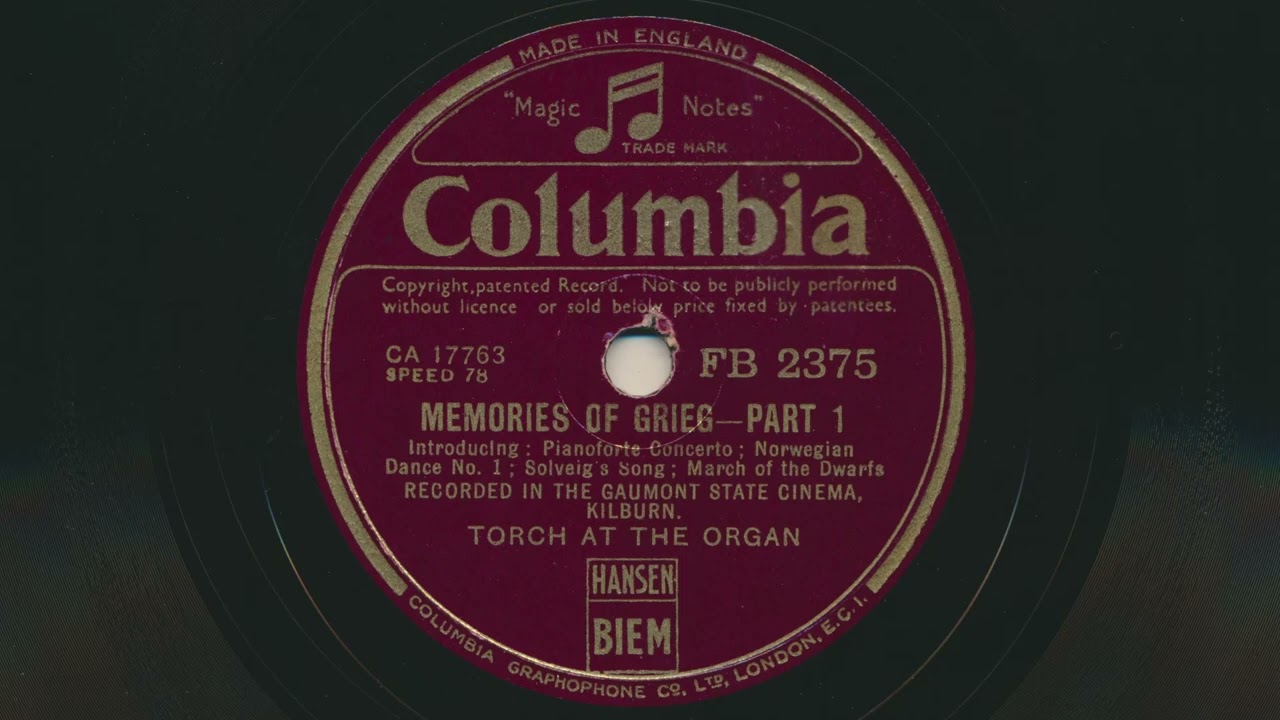
Memories Of Grieg – Part 1
Introducing : Pianoforte Concerto : Norwegian Dance No. 1 : Solveig's Song : March Of The Dwarfs
Raw 78 RPM audio transfer from the Bowness Arts collection of vintage records.
Label: Columbia – FB 2375
Title: Torch At The Organ – Memories Of Grieg
Format: Shellac, 10", 78 RPM
Country: UK
Released: 1940
Genre: Classical
Style: Organ
Sidney Torch MBE was a renowned British musician, composer, conductor, and pianist, born as Sidney Torchinsky on June 5, 1908, in London. His father was a trombonist, and Torch quickly developed a talent for music, studying piano at the Blackheath Conservatoire. He worked as an accompanist before being hired as a piano player at the Regal Cinema in London. After the installation of the Christie Theatre Organ, Torch became Assistant Organist, later becoming Chief Organist. Torch played the organ in various London cinemas and became Chief Organist of the new Gaumont State Cinema in Kilburn. During his time in the Royal Air Force, he conducted the RAF Concert Orchestra, learning to conduct and arrange music. After the Second World War, Torch focused on light orchestral music as a composer, arranger, and conductor, including creating the BBC Light Programme show Friday Night is Music Night. Torch also composed independently, with works such as "On A Spring Note" and "Concerto Incognito" for piano and orchestra, and made many recordings. Torch had a reputation as a disciplinarian, and singers and musicians under his leadership feared his glare if they did not meet his expectations. Torch died of suicide on July 16, 1990.
Note: The first 78 RPM record came into existence around 1894, and in 1912, the Gramophone Company established 78 rpm as their recording standard. The production of shellac records continued throughout the 78 rpm era, with "microgroove" 78 rpm vinyl records being introduced in the 1940s. The popularity of the 33 1/3 rpm "Long Play" record, initially released in 1948, caused the 78 rpm record to become obsolete before the end of the 1950s. As these 78 rpm recordings are quite old, they may contain derogatory language and/or negative stereotypes. It is important to evaluate such recordings within their historical context and consider them as a reflection of the attitudes prevalent at the time. These recordings form an integral part of the historical record and do not represent the views of this poster, channel, or Bowness Arts.

Информация по комментариям в разработке