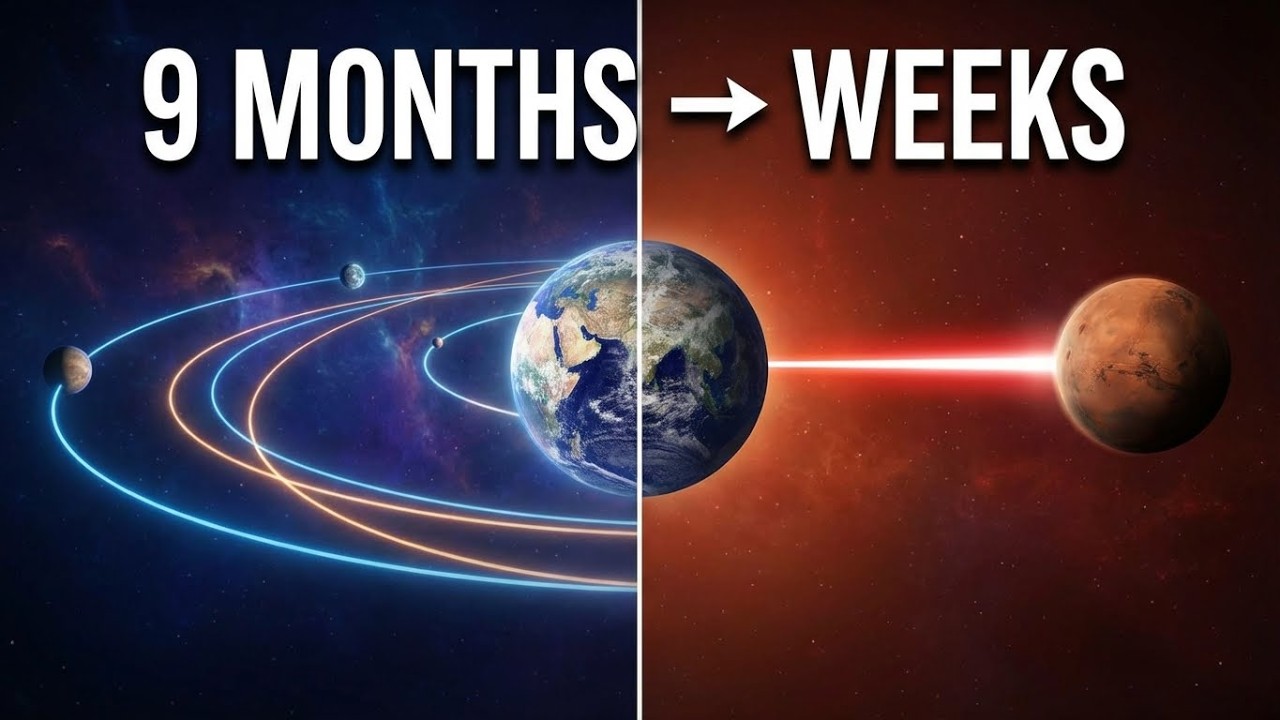
It’s the year 2200—and a trip to Mars is no longer a once-in-a-lifetime gamble.
The real question becomes: How fast could we make it?
Today, Mars often takes 6–9 months, not only because of distance, but because missions use fuel-saving arcs.
By 2200, the upgrade isn’t just “one super engine.”
It’s a faster Mars system.
What really limits a Mars trip?
Thrust (how hard you can accelerate)
Energy (how much power you can access)
Radiation (how long humans can safely stay exposed)
Logistics (depots, rescue, repeatable schedules)
Two realistic modes by 2200
✅ Routine Fast Transfer (advanced nuclear thermal + nuclear electric)
Mars trips could shrink to weeks
Less deep-space time → less radiation + lighter life-support loads
⚡ Express Windows (rare, expensive, emergency/VIP)
Higher-thrust ships, possibly early fusion-class or hybrid systems
Hard accelerate → flip → hard brake
If it exists: a couple of weeks or less (premium routes)
The fastest realistic timeline by 2200
Conservative (nuclear + infrastructure): ~3–6 weeks on common routes
Fusion flagship ships (limited): ~2–3 weeks on premium routes
But the real revolution isn’t top speed.
It’s reliability: predictable departures, safe hubs, refueling depots, and rescue capability.
When Mars becomes a route, humanity becomes a true two-planet civilization.
#Mars #SpaceTravel #Future #2200 #Science #Space
how fast mars trip by 2200, mars travel time 2200, mars in weeks, fastest mars trip, realistic mars mission, nuclear propulsion mars, nuclear thermal propulsion, nuclear electric propulsion, fusion propulsion mars, fusion spaceship, express mars transfer, fast transfer trajectory, thrust energy radiation logistics, space radiation exposure, micro meteoroids, mars highway, space refueling depot, orbital fuel depot, rescue capability space, repeatable mars schedules, two planet civilization, mars colonization logistics, mars transport system, hard sci fi, realistic future space, space infrastructure, earth to mars weeks, mars mission timeline
Информация по комментариям в разработке