A Schoolteacher's Intimate Investigation Into The Problem Of Modern Schooling
https://thedukereport.substack.com/p/...
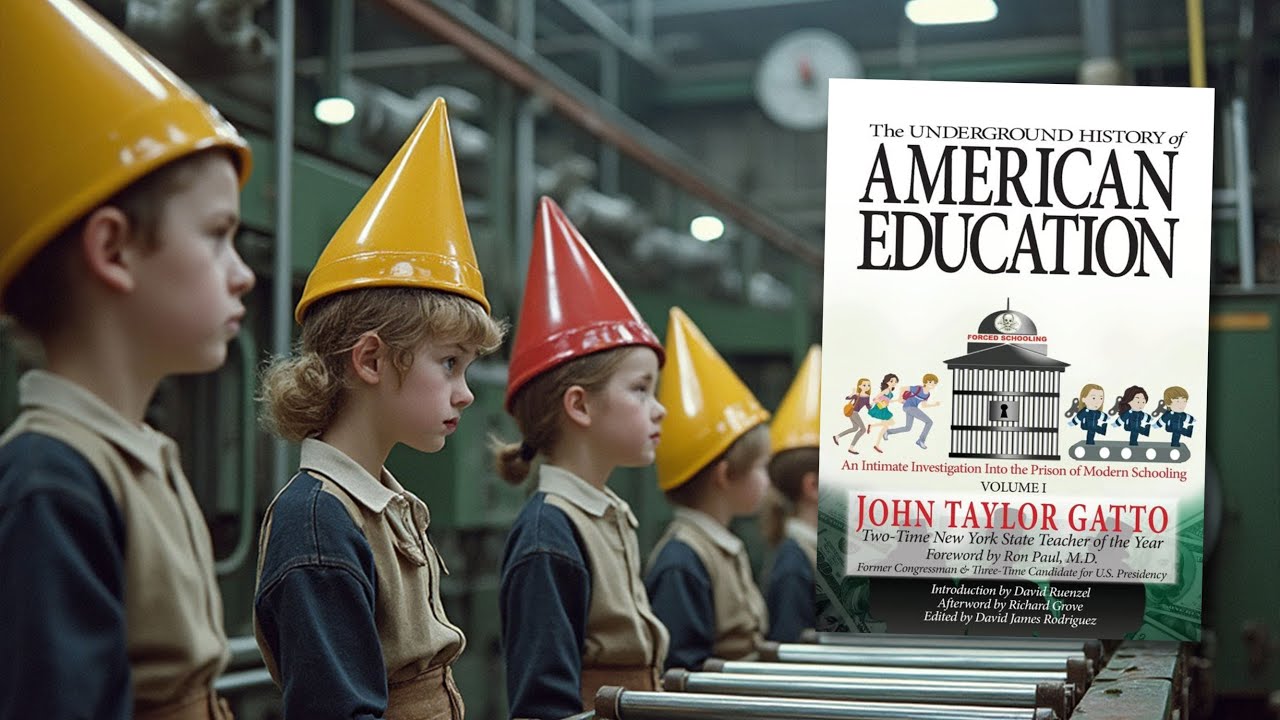
The Underground History of American Education, produced from the work of John Taylor Gatto, presents a decisive critique of American schooling by an acclaimed insider who abandoned the institution he once championed.
Gatto taught in New York City schools for 30 years. He earned the highest honors available to public school teachers, including New York State Teacher of the Year. He directed students into real-world apprenticeships, built fundraising systems, and gained recognition from NASA and Columbia Business School. From this position of authority, Gatto submitted a resignation letter to the Wall Street Journal titled “I Quit, I Think.” In it, he condemned the school system as a mechanism of obedience, fragmentation, and suppression.
Gatto traces the system’s architecture to 19th-century Prussia, where education operated as a tool of militarization. The state engineered schools to produce compliant soldiers, predictable workers, and a docile public. Americans adapted this model in the 1800s to ensure social stability, not personal growth. Gatto emphasizes that the structure never served democratic or intellectual goals.
He invokes Harvard educator Alexander Inglis, whose 1918 book outlines six core functions of schooling. These are not curriculum goals but systemic objectives: adjustive (condition obedience), integrating (enforce social uniformity), diagnostic (assign social roles), differentiating (train for those roles), selective (remove non-conforming individuals), and propedeutic (prepare elite managers). These categories define behavior management, not learning.
Institutional education isolates children from adults, separates intellectual development from real-world responsibility, and replaces curiosity with procedure. Gatto describes how simple requests—like repairing a floor hole—require multi-step bureaucratic responses that model compliance over initiative. The system teaches helplessness.
Gatto references a 1993 National Adult Literacy Survey showing that 96.5% of American adults could not interpret complex texts after completing school. He interprets this as proof that the system produces dependence, not literacy. Schools produce individuals who cannot navigate complexity without experts.
Gatto distinguishes schooling from education. Schools use standardized instruction, fragmented time blocks, and assessment tools to enforce conformity. Education, in his vision, occurs in libraries—spaces of silence, focus, and direct engagement with thinkers. Real learning requires autonomy, solitude, and the willingness to struggle with ideas without mediation.
He calls for an end to institutional control over intellectual development. Genuine education arises when individuals claim responsibility for their own learning. This reorientation requires dismantling not only policy but the assumptions underpinning institutional schooling.
The system maintains power by reinforcing its structure through grades, age-based progression, and standardized testing. These elements appear to reward merit but serve to restrict movement and classify children by perceived utility. The purpose is efficient management, not discovery.
Gatto’s analysis culminates in a fundamental question: Is the school system designed to liberate human potential, or to manage it? He answers by urging a shift from institutional dependence to intellectual sovereignty. Education, properly defined, begins where schooling ends.

Информация по комментариям в разработке