#Kepler452b, #Exoplanet, #SpaceDiscovery, #NASA,
Imagine a planet so similar to Earth that scientists call it our “older, bigger cousin.” Orbiting a star like our Sun, located 1,400 light-years away in the constellation Cygnus, lies Kepler-452b — a world that might hold the secrets of life beyond our solar system. In this documentary-style exploration, we journey across the cosmos to uncover the mysteries of this distant exoplanet and examine the eternal question: Are we alone in the universe?
🪐 What Is Kepler-452b?
Discovered in 2015 by NASA’s Kepler Space Telescope, Kepler-452b immediately captured the world’s attention. Measuring about 60% larger than Earth and orbiting a G-type star similar to our Sun, it resides in the so-called “Goldilocks Zone” — the region where temperatures could allow liquid water to exist on the surface. This makes Kepler-452b one of the most Earth-like exoplanets ever discovered.
But what makes this world truly fascinating is that it might be older than Earth by more than a billion years. Its host star, Kepler-452, is thought to be about 6 billion years old. That means if conditions on Kepler-452b were once right for life, it could have had much longer for evolution to occur. Could this be the first world where we might one day detect alien biosignatures — or even intelligent life?
🌠 A Journey Through the Cosmos
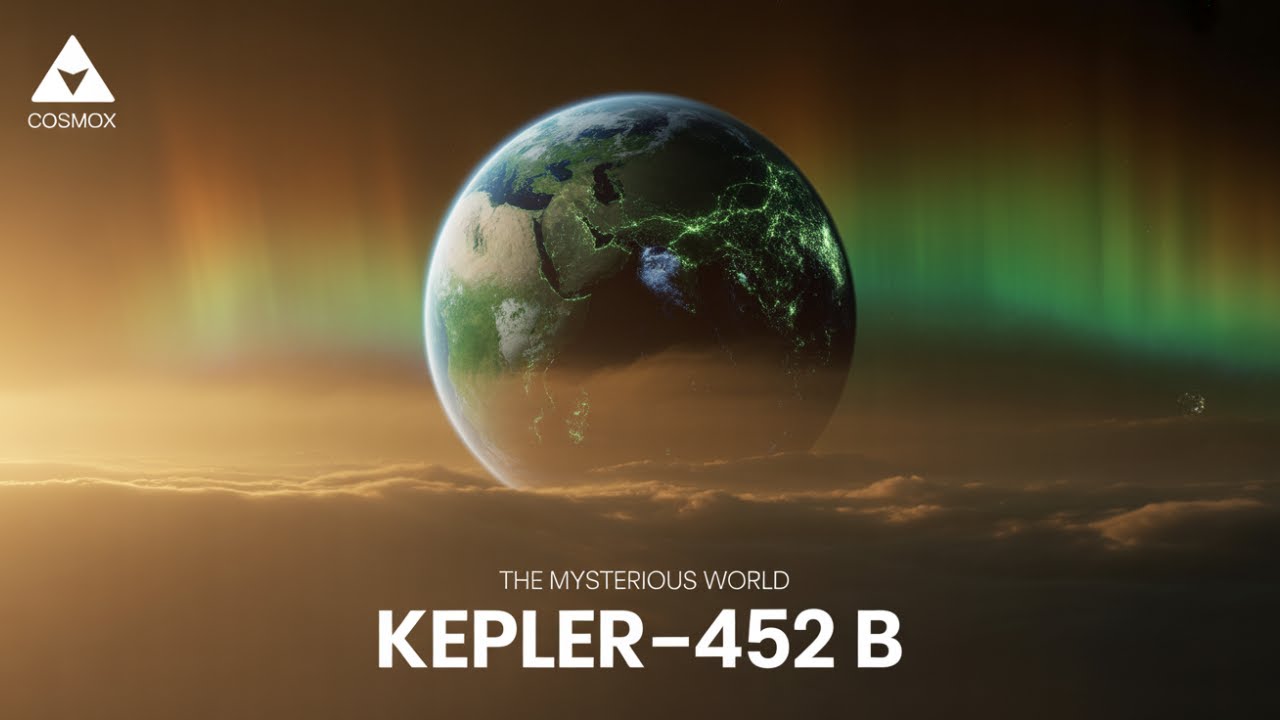
In this video, we take you on an immersive voyage across the galaxy, visualizing the surface of Kepler-452b as it might appear — vast oceans, thick clouds, and lush continents bathed in golden sunlight. Through breathtaking visuals and the latest scientific insights, we’ll explore how Kepler-452b formed, what its atmosphere might contain, and whether it could truly sustain life as we know it.
🔬 The Science Behind the Mystery
Scientists use a combination of transit photometry, spectroscopy, and computer modeling to study exoplanets like Kepler-452b. By observing tiny dips in a star’s brightness as a planet passes in front of it, researchers can infer the planet’s size, orbital period, and sometimes even hints about its composition.
Kepler-452b orbits its star every 385 days — almost the same as Earth’s year. Its slightly greater distance from its star means it receives about 10% more energy than Earth does from the Sun. This could make it a bit warmer, but not necessarily uninhabitable. If it has cloud cover or reflective oceans, the planet could remain within a comfortable temperature range for life to flourish.
🧬 Could Life Exist There?
The key to understanding whether Kepler-452b could support life lies in its atmosphere. Unfortunately, because it’s so far away, we can’t yet directly study its atmospheric composition. However, upcoming telescopes like the James Webb Space Telescope (JWST) and future missions such as the LUVOIR and HabEx concepts might one day allow us to detect carbon dioxide, oxygen, methane, and water vapor — the chemical fingerprints of potential life.
If Kepler-452b has an active climate, tectonic activity, and oceans, it might host microbial ecosystems similar to those found on early Earth. Or, if it evolved differently, it could harbor entirely alien forms of biology adapted to its unique environment.

Информация по комментариям в разработке