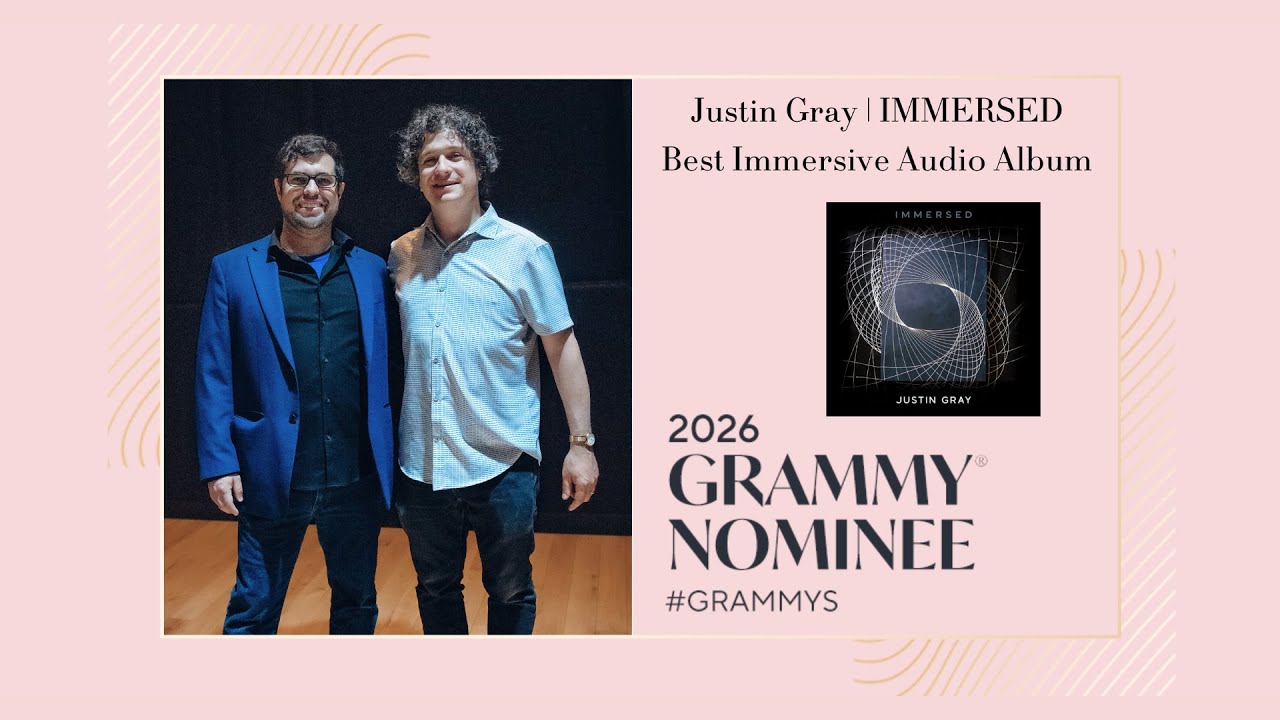
GRAMMY®-nominated: Justin Gray | IMMERSED | Best Immersive Audio Album (For Your Consideration – Final Voting)
🎧 Listen to IMMERSED: www.justingraysound.com/Immersed
When writing the music of IMMERSED, I explored how space shapes our perception of timbre. Treating the position of an instrument in 3D space as an orchestration tool at the compositional level opens new possibilities for blend, density, and musical narrative.
...
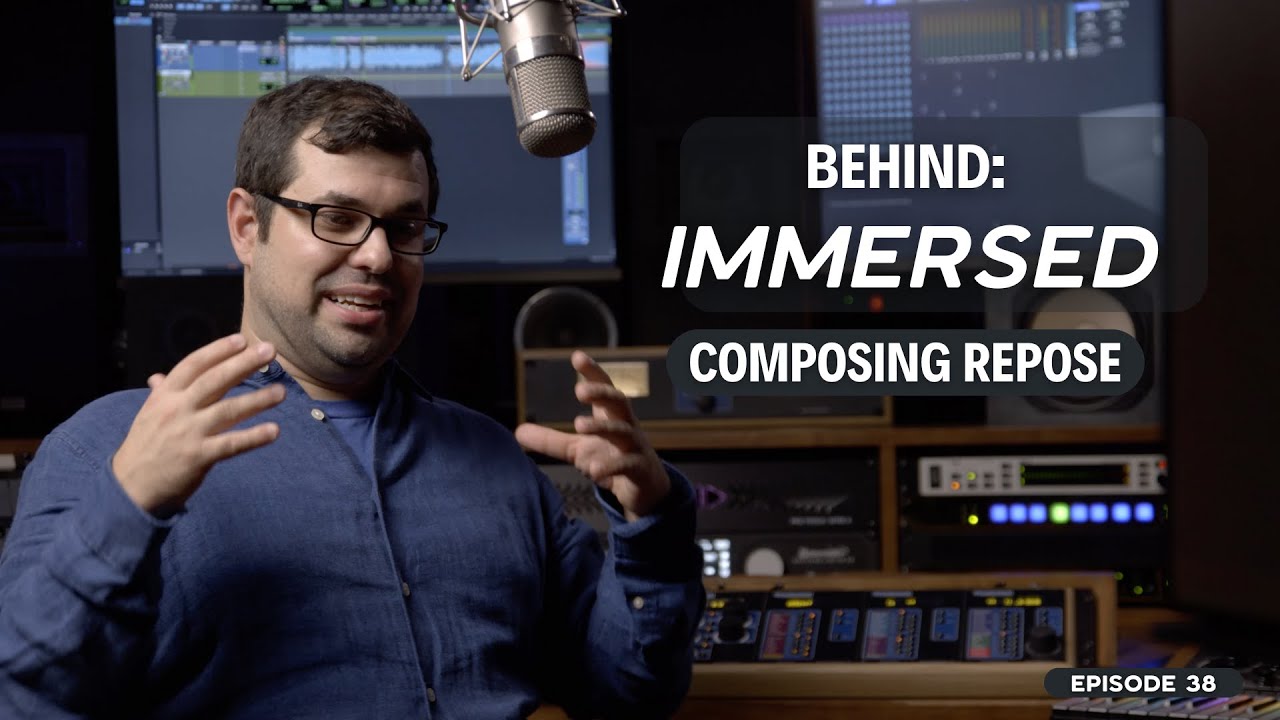
Repose is the third piece on IMMERSED. This longer, through-composed work synthesizes multiple musical influences that have shaped my musical life over several decades. The composition began with an exploration of a melodic theme inspired by the Hindustani classical raga Bilahishkani Todi, with roots tracing back to early dhrupad traditions.
I first studied this raga with my teacher, Pandit Shantanu Bhattacharyya, in Kolkata, India, nearly twenty years ago. Over time, I have explored this raga in a range of contemporary musical settings, drawn to its depth, gravity, and expressive potential.
The opening of Repose unfolds as an alap, performed by me on bass veena, alongside Andrew Kay on a pitched set of Himalayan singing bowls.
The bass veena is a hybrid fretless instrument that I designed and co-created with luthier Les Godfrey. This opening section establishes the piece's melodic and emotional world before rhythm is introduced.
A primary spatial orchestration decision for this work was to present the Himalayan singing bowls from a unique, surreal perspective—placing the listener at the center of the instrument while still perceiving its balance from outside.
Andrew improvised an alap inspired by the raga’s melodic framework, performing on bowls arranged in a semi-circle according to the raga's pitch set and the composition's spatial design. These performances were captured using an inward-facing microphone dome, allowing the bowls to fully envelop the listener and function as both texture and foundation.
During this introduction, the bass veena is orchestrated toward the front of the sound field, anchoring the listener within the immersive world created by the bowls.
As the piece develops, a written melody emerges for the esraj, performed by Jonathan Kay on a large Bora esraj. I wrote this melody specifically for Jonathan, as we have both studied this raga for nearly two decades, and I knew he would be able to express its subtle nuances with precision and musicality.
This melody is featured primarily in the center channel. At the same time, the surrounding rhythmic and harmonic material is spatially orchestrated throughout the immersive field to support and frame the front-facing line.
The rhythmic framework and harmonic movement draw inspiration from both chautal (a 12-beat cycle associated with dhrupad) and the slow 12-beat cycles found in flamenco Soleá por Bulerías. I have spent considerable time performing flamenco music as well, and these traditions share deep historical and melodic connections (a more extended discussion for another time).
Vocal solkattu, performed by Suba Sankaran and layered throughout the immersive field, becomes both rhythmic engine and spatial texture.
Following the bass veena solo, the piece moves into an extended soli section that builds intensity and energy toward the composition's climax. This section features a specific seven-part instrumental unison texture. My intent is that, when experienced in a properly calibrated 7.1.4 (or ideally 9.1.6) listening environment, the listener perceives these discrete parts as a single unified immersive gesture.
Spatiality profoundly shapes how we perceive timbre. When used as an orchestration tool at the compositional level, it opens new approaches to blend, density, and musical motion.
Instrumental orchestration:
• L — Alto Sax
• C — Clarinet
• R — Soprano Sax
• LS — Synth 1
• RS — Synth 2
• LRS — Guitar
• RRS — Violin
Above this texture sits a nine-part vocal orchestration performed by Suba Sankaran. Suba composed the syllables specifically for this section, drawing inspiration from Carnatic solkattu and an ancient South Indian dance language.
Vocal orchestration:
• L — Double
• C — Main performance
• R — Triple
• LW — 5th harmony
• RW — 5th harmony (double)
• LS — Low-octave harmony
• RS — Low-octave harmony (double)
• LRS — Whisper layer
• RRS — Whisper layer (double)
Rhythmically, the orchestration combines multiple tabla parts positioned beside and behind the listener, a drum kit anchored in front, and daf arranged quadraphonically (L, R, LRS, RRS).
Harmonically, the chord progression is supported by bass veena, piano, Rhodes, guitar, synth, and immersive string textures created by co-producer Drew Jurecka.
⸻
👍 Like & Subscribe to learn more about mixing, mastering, production, and recording.
💬 Have questions? Drop them below & let’s connect.
🔗 Learn more about my studio and work:
🌐 www.justingraysound.com
📷 Instagram: @justingraysound












Информация по комментариям в разработке