Neon (atomic number 10) is a noble gas, meaning it's chemically unreactive. It has three stable, naturally occurring isotopes.
Neon-20 ($\text{^{20}Ne}$):
Composition: 10 protons, 10 neutrons.
Abundance: ~90.48%
Properties: Stable and by far the most abundant isotope.
Applications: Primarily used in neon lights for its characteristic red-orange glow. Studies of its isotopic ratios in geological samples can reveal insights into Earth's mantle and crustal evolution, and potentially ancient solar material.
Neon-21 ($\text{^{21}Ne}$):
Composition: 10 protons, 11 neutrons.
Abundance: ~0.27%
Properties: Stable.
Applications: Used in some scientific research, including quantum physics (e.g., in Masers). Its presence can indicate cosmic ray exposure ages of rocks and meteorites, as it is produced by spallation reactions. It also forms through nucleogenic processes in the Earth's crust.
Neon-22 ($\text{^{22}Ne}$):
Composition: 10 protons, 12 neutrons.
Abundance: ~9.25%
Properties: Stable.
Applications: Used in the production of the medical radioisotope Sodium-22 ($\text{^{22}Na}$). Like $\text{^{21}Ne}$, its isotopic variations are used in noble gas geochemistry to trace fluid-rock interactions, mantle degassing, and crustal recycling.
Neon isotopes, due to their inertness and mass differences, are powerful tools in geochemistry and cosmochemistry for understanding Earth's history, mantle dynamics, and cosmic ray exposure dating.
Isotopes of Oxygen (O)
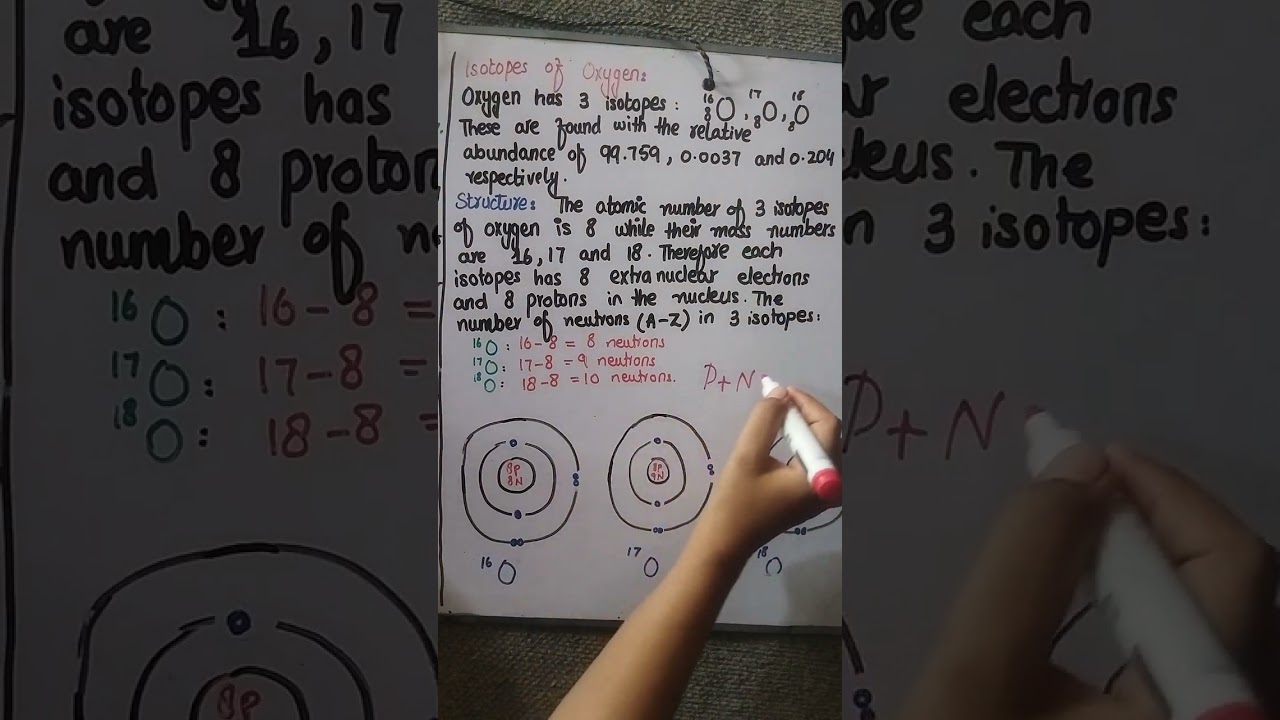
Oxygen (atomic number 8) is a highly reactive nonmetal essential for life. It has three stable, naturally occurring isotopes.
Oxygen-16 ($\text{^{16}O}$):
Composition: 8 protons, 8 neutrons.
Abundance: ~99.76%
Properties: Stable and overwhelmingly the most abundant oxygen isotope.
Applications: Its relative abundance makes it the primary form of oxygen in water, the atmosphere, and biological systems. Used in the production of radioactive Nitrogen-13 ($\text{^{13}N}$) for PET imaging.
Oxygen-17 ($\text{^{17}O}$):
Composition: 8 protons, 9 neutrons.
Abundance: ~0.038%
Properties: Stable. Unique among oxygen isotopes for having a nuclear spin that makes it detectable by Nuclear Magnetic Resonance (NMR) spectroscopy.
Applications: Used as a tracer in medical research to study cerebral oxygen utilization. Its NMR properties make it valuable for studying the structure and dynamics of oxygen-containing molecules.
Oxygen-18 ($\text{^{18}O}$):
Composition: 8 protons, 10 neutrons.
Abundance: ~0.20%
Properties: Stable. Significantly heavier than $\text{^{16}O}$.
Applications:
Paleoclimatology: The ratio of $\text{^{18}O}$ to $\text{^{16}O}$ ($\delta\text{^{18}O}$) in ice cores, marine sediments (shells), and other geological records is a crucial proxy for reconstructing past temperatures and ice volume. Lighter $\text{^{16}O}$ evaporates more easily, so colder periods lead to more $\text{^{18}O}$ in oceans and less in ice.
Hydrology: Used to trace water sources and movement in groundwater, rivers, and precipitation.
Medical Applications: Large quantities are used to produce Fluorine-18 ($\text{^{18}F}$), a positron-emitting radioisotope vital for Positron Emission Tomography (PET) scans in medicine, especially for cancer detection.
Geochemistry: Used to determine the temperature of mineral formation, source of fluids, and water/rock ratios in geological processes.NeonIsotopes
#OxygenIsotopes
#StableIsotopes
#Geochemistry
#Paleoclimatology
#NMRSpectroscopy
#PETScan
#MedicalIsotopes
#Cosmochemistry
#NobleGases
#EnvironmentalScience
#ClimateResearch
#Hydrology
#ScientificApplications

Информация по комментариям в разработке