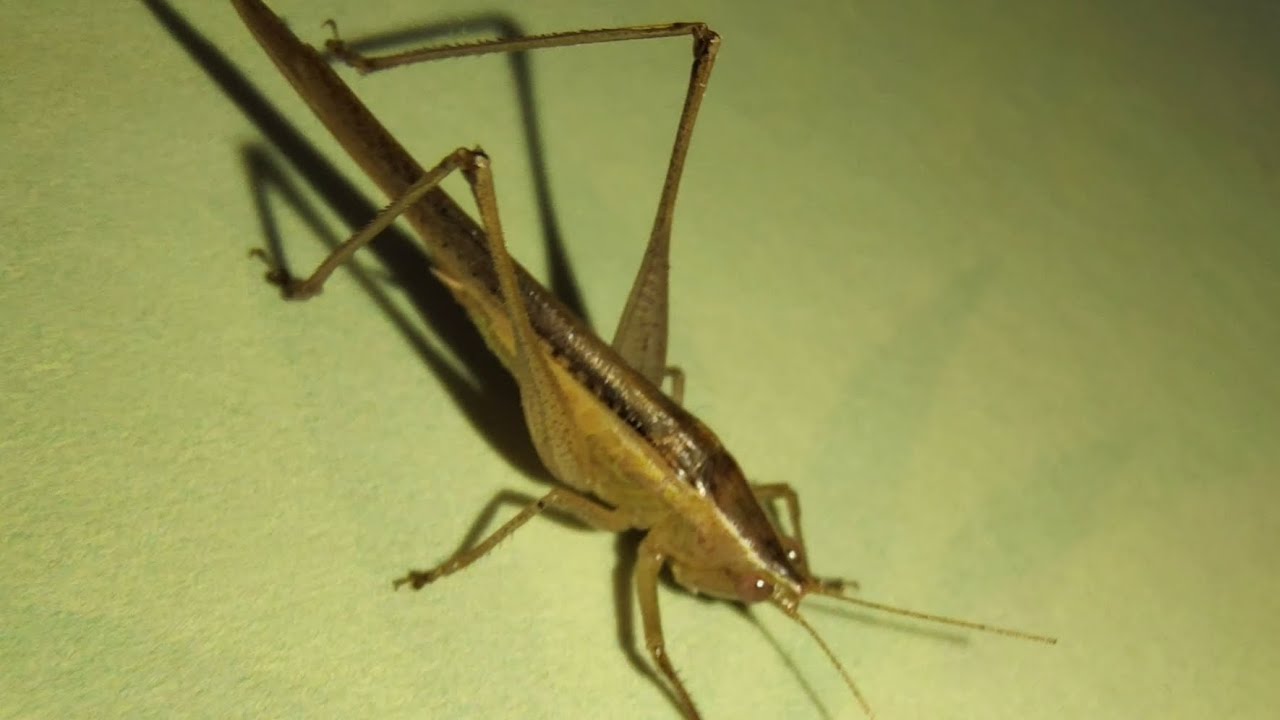
Conocephalus sp. (A meadow katydid)
Katydid (Tettigoniidae). Conocephalus sp. or similar
Maybe Conocephalus maculatus or Conocephalus fuscus
Conocephalus maculatus or close to it.
Lesser Meadow Katydids
Conocephalus is a genus of bush crickets, known as coneheads (a term also sometimes applied to members of the related genus Ruspolia). It was described by Carl Peter Thunberg in 1815
Spotted Meadow Katydid-Conocephalus maculatus
Kingdom: Animalia
Phylum: Arthropoda
Subphylum: Hexapoda
Class: Insecta
Subclass: Pterygota(Winged and Once-winged Insects)
Order: Orthoptera (Grasshoppers, Crickets, and Katydids)
Suborder: Ensifera (Katydids, Crickets, and Allies)
Infraorder: Tettigoniidea (Katydids, wētā, and allies)
Superfamily: Tettigonioidea
Family: Tettigoniidae (Katydids)
Subfamily: Conocephalinae (Coneheads and Meadow Katydids)
Tribe: Conocephalini (Common Meadow Katydids)
Genus: Conocephalus (Lesser Meadow Katydids)
Subgenus: Anisoptera (Anisoptera)
Tettigoniids of the subfamily Conocephalinae are characterized by their head forming a pointed or rounded cone
that projects beyond the basal segments of the antennae. Most species occur in brown and green forms, are well
camouflaged and widely distributed in the tropical and subtropical parts of the world.
Conocephalus(Tribe: Conocephalini) is usually less than 25mm in length (some up to 27mm), slender, with wings usually not extending beyond the tip of the abdomen and the ovipositor being from straight to slightly curved. Many members of this tribe
have strong mandibles for seed feeding and, in some cases, predation. According to Orthoptera Species File (Eades et al
., 2016) eight subgenera are recognized comprising 151 species world over. In the Indian subcontinent, the genus
Conocephalus Thunberg (1815) is well represented including seven species
C. honorei,C. longipennis,C.maculatus,C. melaenus,C. laetus,C. bambusanus
and C. bispinatus.
Katydids are insects in the Tettigoniidae family, closely related to grasshoppers and crickets.
Some of the most noticeable and prevalent insects in tropical insect populations are tettigoniids, also known as long-horned grasshoppers or katydids
Katydids are also called long-horned grasshoppers. They belong to the suborder Ensifera and the superfamily Tegonioidea. They are very easily idened by their very long antennae, (hence the common name) and sword- or sickle-shaped long ovipositor with four segmented tarsi. They are more similar to crickets than other grasshoppers.
The majority of them are found in the world's tropical and subtropical regions. As
they are consumed by birds, rodents, bats, monkeys, amphibians, and reptiles, they play a significant role in the food web in the tropics.
Orthoptera is one such group. Among them are the well-known locusts, crickets,
katydids, mantids, and grasshoppers. They constitute a dominating group of herbivorous insects worldwide.
To explain the difference to a kid:
A katydid, cricket, and grasshopper may look similar but have some differences. Think of katydids as "leafy crickets" – they look like leaves and usually sing at night, using their wings to make sounds. Crickets are like katydids but are often darker, live closer to the ground, and also chirp by rubbing their wings. Grasshoppers, on the other hand, are usually seen in the daytime and have shorter antennae. They make sounds by rubbing their legs on their wings and love hopping around.
So...
Katydids
Order: Orthoptera
Suborder: Ensifera
Family: Tettigoniidae
Crickets
Order: Orthoptera
Suborder: Ensifera
Family: Gryllidae
Grasshoppers
Order: Orthoptera
Suborder: Caelifera
Family: Acrididae
Differences: While all belong to the order Orthoptera, katydids and crickets fall under Ensifera and are closely related, often having longer antennae and night activity. Grasshoppers, in Caelifera, are more often seen during the day, have shorter antennae, and live in grassy or open areas.
Katydids are often camouflaged to blend with foliage, while crickets are more likely to be found in burrows or under logs.
Katydids are generally nocturnal insects, well adapted to blend in with their leafy surroundings during the day, thanks to their green, leaf-like bodies. They feed on plants, especially leaves, flowers, and fruits, though some species also consume other insects. Males produce sounds (stridulation) to attract mates, and their unique “chirps” vary by species. Female katydids lay eggs on plants or in soil, which hatch into nymphs. Katydids are solitary, relying on camouflage and stillness for protection against predators.
Shishodia et al. (2010) menoned some 160 species from 72 genera of tegoniids in his checklist of Orthoptera
The ovipositional preference of C. maculatus towards 11 different ovipositional sites viz., P. maximum, C. dactylon, O.
sativa, C. barbata, C. lachryma, C. rotundus, P. typhoideum
#katydids #Orthoptera #tettigoniids #Tettigoniidae #Conocephalus
#insects

Информация по комментариям в разработке