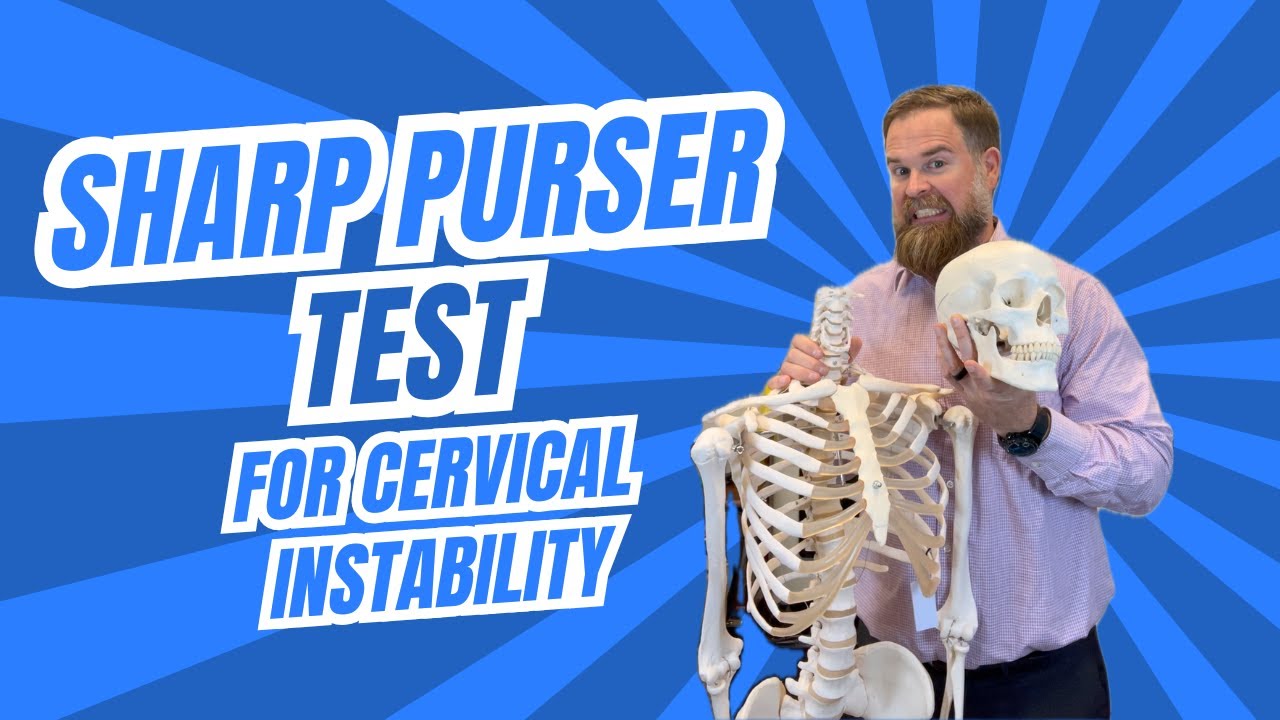
This test is to look at the integrity of the transverse ligament, which maintains the position of the odontoid process. This test was developed by Dr. J. Sharp and D.W. Purser in their 1961 article (Sharp, J., & Purser, D. W. (1961). Spontaneous atlanto-axial dislocation in ankylosing spondylitis and rheumatoid arthritis. Annals of the rheumatic diseases, 20(1), 47.) In this paper, they were looking at the displacement of the atlanto-axial area in people with rheumatoid arthritis and ankylosing spondylitis. They were looking at ways to diagnose this displacement and then confirmed it with imaging.
Their original testing is as follows:
-Palm of one hand is on the patient’s forehead and thumb of opposite hand is on the spinous process of the axis
-Have the patient relax their neck so it’s in a semi-flexed position
-Press the head backwards with the palm
They stated that only in severe cases of displacement would movement be noticed but patients would often have pain.
There is a variation that can be performed which is often utilized prior to any sort of manipulation/mobilization is performed, or if there is a suspected tear of the transverse ligament after something like a car accident.
-Palm of hand is on patient’s forehead and a pincher grip is used on the axis spinous process
-Patient has their neck flex slightly
-Press the head backwards with the palm
In this manner, the examiner is feeling for that excessive movement, or even a “clunk” or “click”. If this is felt, the patient needs to be seen for emergency medical intervention
There is some controversy about this test as well. Mansfield did a systematic review (Mansfield, C. J., Domnisch, C., Iglar, L., Boucher, L., Onate, J., & Briggs, M. (2020). Systematic review of the diagnostic accuracy, reliability, and safety of the sharp-purser test. Journal of Manual & Manipulative Therapy, 28(2), 72-81.) which he said the test has inconsistent validity, poor inter-rater reliability and the potential to cause harm by compressing the spinal cord.
However, in a letter to the editor (Landel, R. (2021). Letter to the editor Re: Mansfield et al. Systematic review of the diagnostic accuracy, reliability, and safety of the Sharp–Purser test. JMMT 2020, VOL. 28, NO. 2, 72–81. Journal of Manual & Manipulative Therapy, 29(6), 337-338.) Landel said that the test is good at ruling in upper cervical instability, so a positive is a positive. Additionally, the statement that it “may cause harm” was just the author’s conclusion not backed by any of the papers cited.
With this all being said, this test could be used if you suspect upper cervical instability in any case. Of course paying attention to the mechanism of injury (like an MVA) or the patient’s medical history (RA) along with some signs and symptoms. Sharp and Purser did say there were clinical features of displacement 1) Pain in the upper neck that radiates to the occipital and sometimes temporal and frontal areas which can be made worse with jarring movements 2) difficulty with getting the head back after looking down, can’t look up to shave (their words), or the sensation of “falling forwards” of the head and 3) flattening of the occipito-cervical curve with some torticollis. I would also throw in the 5 D’s and 3 N’s as well
So what do you think of this test? Do you use it? Is it valuable? Share it in the comments below.

Информация по комментариям в разработке