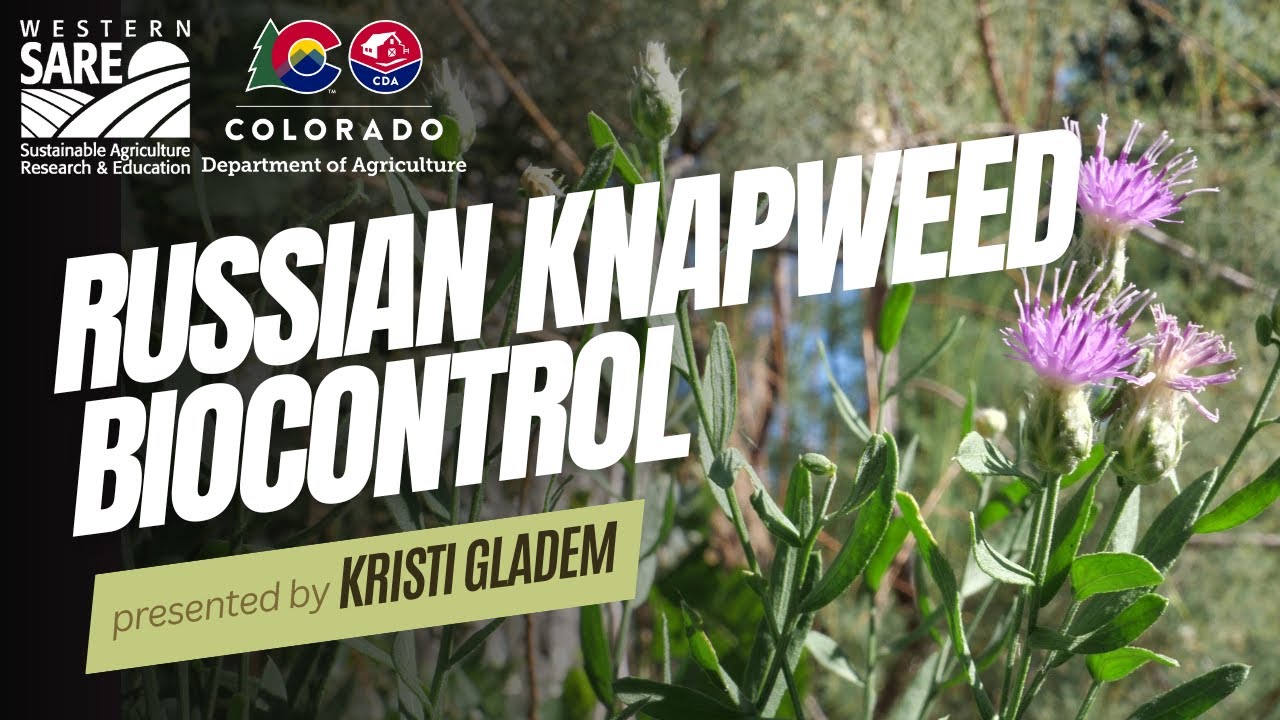
Introduced to North America in the late 1800s, Russian knapweed, Rhaponticum repens, is a noxious invasive perennial that forms large rhizomatous colonies. It is the most widely distributed invasive knapweed in the Western US. In this video we will discuss this pesky invasive weed, control methods, and the current best classical biological control agents for use against Russian knapweed, Jaapiella ivannikovi and Aulacidea acroptilonica, the Russian knapweed rosette galling midge and stem galling wasp. Topics will include identification, collection, sorting, release and what to expect from these biological control agents.
Timestamps
00:00 Introduction
00:40 Russian knapweed, Rhoponticum repens, Introduction and Identification
01:29 Russian knapweed, Rhoponticum repens, History & Lifecycle
03:30 Russian knapweed, Rhoponticum repens, Control Methods
03:30 Russian knapweed, Rhoponticum repens, Will bicontrol work?
05:44 Russian knapweed Rosette Galling Midge, Jaapiella ivannikovi, History & Life Cycle
07:02 Russian knapweed Rosette Galling Midge, Jaapiella ivannikovi, Collection & Release
08:16 Russian knapweed Stem Galling Wasp, Aulacidea acroptilonica, History & Life Cycle
09:42 Russian knapweed Stem Galling Wasp, Aulacidea acroptilonica, Collection
11:21 Russian knapweed Stem Galling Wasp, Aulacidea acroptilonica, Rearing Indoors
15:04 Russian knapweed Stem Galling Wasp, Aulacidea acroptilonica, Release
16:14 Russian knapweed Stem Galling Wasp, Aulacidea acroptilonica, What to Expect
17:30 Russian knapweed, Rhoponticum repens, Integrated Management
Acknowledgements:
Photography, videography, and video editing by Kristi Gladem and Torri Gladem
Field work by Kristi Gladem, Torri Gladem, and Kelly Hanrahan
Additional photos by Sonya Daly
Further information:
https://ag.colorado.gov/conservation/...
https://naisma.org/biocontrol/
https://naisma.org/programs/biocontro...
https://ibiocontrol.org/weed-biocontr...
https://biocontrol.entomology.cornell...
This material is based upon work that is supported by the National Institute of Food and Agriculture, U.S. Department of Agriculture, under MSU Subaward ID #G125-24-W9986 through the Western Sustainable Agriculture Research and Education program under project number WPDP23-006. USDA is an equal opportunity employer and service provider. Any opinions, findings, conclusions, or recommendations expressed in this publication are those of the author(s) and do not necessarily reflect the view of the U.S. Department of Agriculture.

Информация по комментариям в разработке