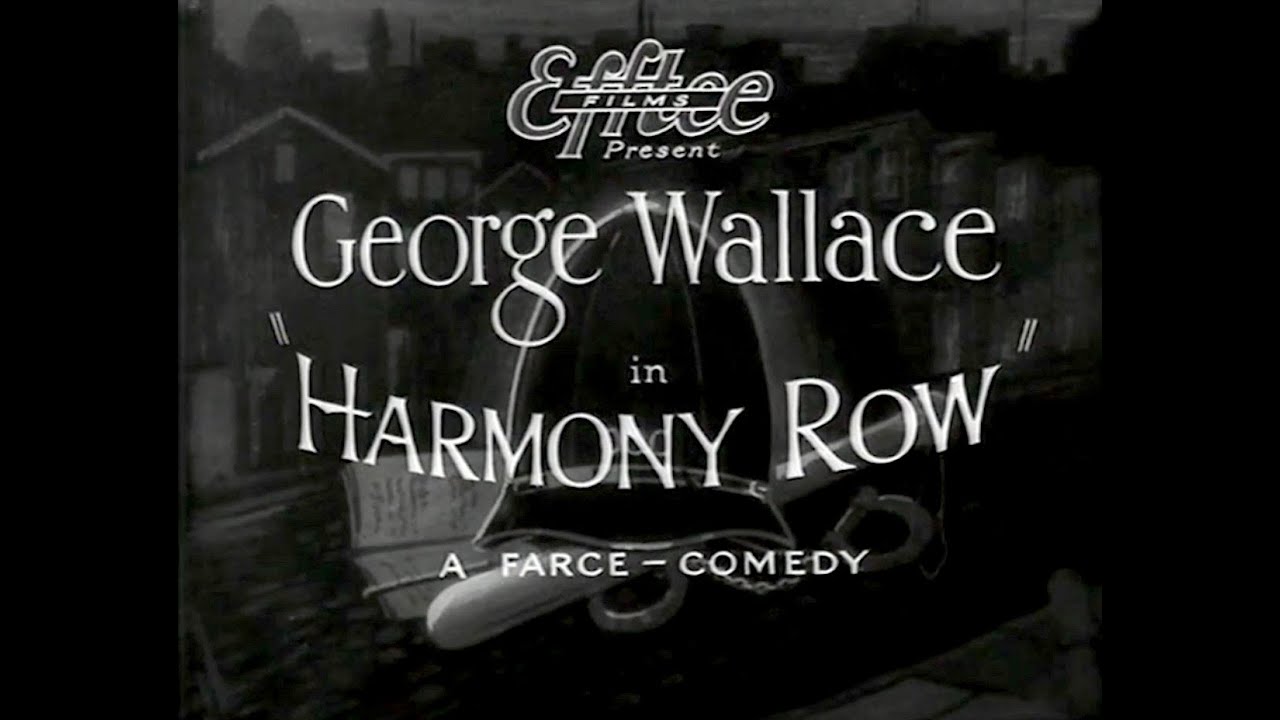
Harmony Row in full (previously only on this channel as five excerpts, starting here • Harmony Row (1933) (1) - old time comedy c... ).
Harmony Row was written by George Wallace, but owes much to vaudeville traditions and his routines. While the fight in the ring that forms the climax is done in Wallace's inimitable style, with nimble and dexterous slapstick, it owes more than a few of its moments to silent movie scenes, including Charlie Chaplin's performance as a boxer in City Lights (1927) and in The Champion (1915).
As first released, the film contained a long haunted house sequence, in which Constable Dreadnought tries to solve a mystery in an upper class suburban mansion. According to the Oxford Book of Australian Film, a shorter sequence was later shot to replace this episode and bridge a gap in the plot. The new sequence featured George Wallace mistaking a high society gentleman for a thief and trying to arrest him, with Thring favourite Campbell Copelin playing the gentleman (with no credit in the film's titles).
The shorter version would seem to be the one issued on VHS, as it features Wallace in a routine involving dodgy servants, and missing jewellery hidden behind a wooden panel in the mansion.
However a number of haunted house routines remain, with some by-play between George Wallace and a Notre Dame-style monster/servant who in a way haunts the house (John Dobbie as boxer Slogger Lee).
George Wallace would later make several films with director Ken Hall (Let George Do It and Gone to the Dogs), and both would show more discipline and adjustment to the needs of film. In his films for Thring, Wallace remained true to his theatrical and vaudeville origins. Despite his films, he continued to attract most attention as a stage performer.
Wallace rarely attempted serious roles in his career, and his attempt to leaven the dramatic mood in Chauvel's Rats of Tobruk, as the barber of Tobruk, is one of the reasons that film failed to cohere.
In his day, Wallace rivalled the legendary Roy "Mo" Rene in terms of public affection.
He has a wiki listing here
https://en.wikipedia.org/
wiki/George_Wallace_
(Australian_comedian)
There is a good short bio at ADB here.
https://adb.anu.edu.au/
biography/
wallace-george-leonard-11942
Character actor John Dobbie was a frequent partner in Wallace's stage and screen comedies routines, deploying a big physique and deep voice. In this film he's the giant boxing foil to Wallace's clowning. Dobbie took a regular gig with J. C. Williamson's Comic Opera Company, before turning to work in commercial radio in Brisbane, dying there in 1952.
See this excellent pdf profile
https://ozvta.com/
wp-content/uploads/
2011/02/
dobbie-john-hokanson.pdf
F. W. Thring had an ADB bio and a wiki listing
https://en.wikipedia.org
/wiki/F._W._Thring
https://adb.anu.edu.au/
biography/
thring-francis-william-frank-8803
"Contemporaries lamented the loss to theatre and the film industry through Thring's early death. Gladys Moncrieff recalled him as 'a gentle and exceptionally kind man' who 'knew the theatre and what he wanted he eventually got'. Ken Hall considered him the first Australian to 'make professional sound feature films'. If some doubted his artistic ability, all praised his skills as a producer. He was, said Monkman, a man 'whose big body was matched by his courage, vision and ambition'."
Details:
Production company: Efftee Film Productions
Budget: £11,000
Locations: largely a studio piece, shot in Efftee's His Majesty's Theatre studio in Melbourne.
Filmed: Harmony Row was completed in time to accompany producer F. W. Thring on his voyage on the Orama to England, August 23rd 1932, with the aim of selling the studio's entire output to that date into Britain.
Australian distributor: Universal
Australian release: joint premiere with Diggers in Blighty Hoyts Theatre De Luxe Melbourne, 11th February 1933, and thereafter around Australia, usually as a double bill with that film.
Rating: For general exhibition.
35mm black and white
Running time: 78 mins (Oxford*)
NFSA VHS time: 1'15"14
Box office: in Australia the film shared the same relative success as Diggers in Blighty, but as with that film, the amount of film rentals returned to producer F. W. Thring was limited, and led to a campaign by Thring to introduce a quota system for Australian feature films in film theatres.
Thring took the film to Britain as part of an Efftee studios package in August 1932 (he was away for six months, and feature film production ceased for that time, though short and newsreel production continued). Thring claimed a sale of £100,000 to Universal for British rights for the package, but it's been suggested that Thring lost as much as £57,000 on his studio and feature film ventures.
Pike, Andrew and Cooper, Ross, Oxford Australian Film 1900-1977, OUP, revised edition 1998

Информация по комментариям в разработке