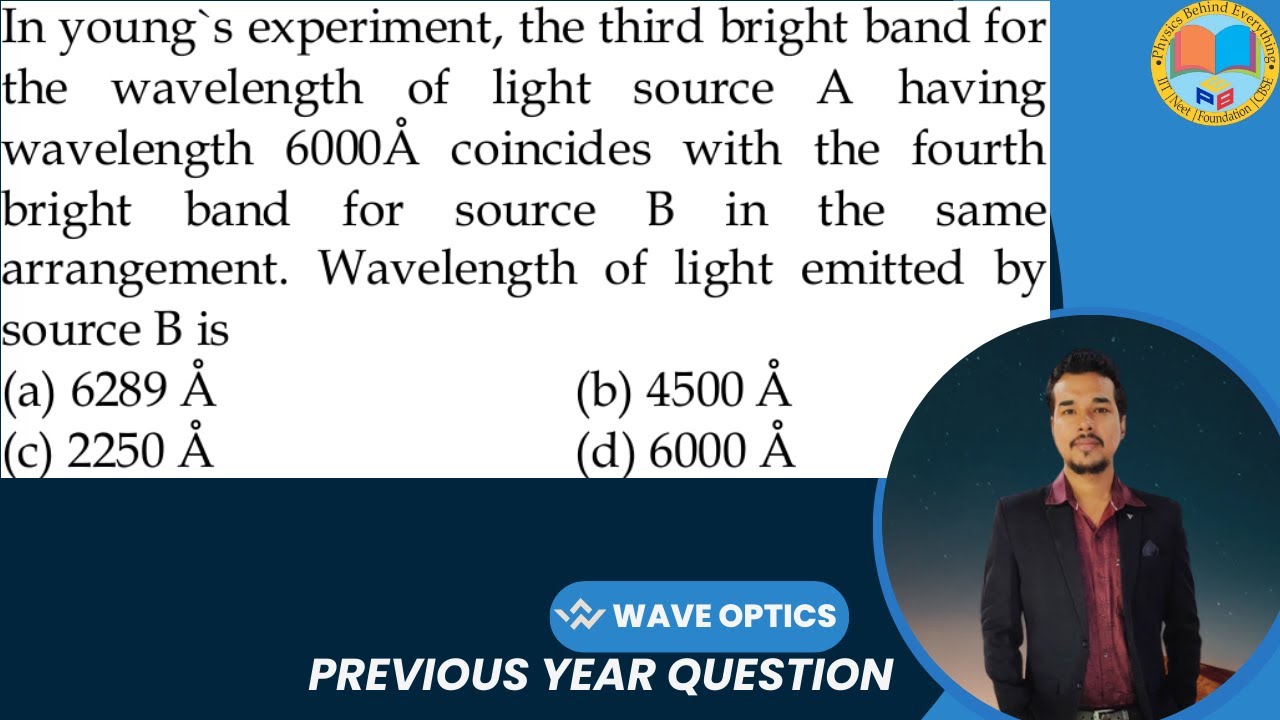
In young`s experiment, the third bright band for the wavelength of light source A having wavelength 6000Å coincides with the fourth bright band for source B in the same arrangement. Wavelength of light emitted by source B is
(a) 6289 Å (b) 4500 Å
(c) 2250 Å (d) 6000 Å
*Description:*
In Young's double-slit experiment, light from two different sources is used to create an interference pattern of bright and dark bands. The problem involves two sources, A and B, with different wavelengths. It states that the *third bright band* for *source A* with a wavelength of *6000 Å* coincides with the *fourth bright band* for **source B**.
*Key Concept:*
**Young's Experiment and Interference**: The interference pattern formed in Young's double-slit experiment depends on the wavelength of light. The bright bands (constructive interference) occur at positions where the path difference is an integer multiple of the wavelength.
**Formula for Bright Bands**:
The condition for constructive interference (bright bands) is:
\[
y_n = \frac{n \cdot \lambda \cdot D}{d}
\]
where:
\( y_n \) is the position of the \(n\)-th bright band,
\( \lambda \) is the wavelength of the light,
\( D \) is the distance between the screen and the slits,
\( d \) is the distance between the slits,
\( n \) is the order of the bright band (1st, 2nd, etc.).
Given that the third bright band for source A coincides with the fourth bright band for source B, the ratio of their wavelengths can be determined based on the position of the bright bands.
*Steps for Calculation:*
Let \( \lambda_A = 6000 \, \text{Å} \) (wavelength of source A).
The position of the third bright band for source A is proportional to \( 3 \cdot \lambda_A \).
The position of the fourth bright band for source B is proportional to \( 4 \cdot \lambda_B \), where \( \lambda_B \) is the unknown wavelength of source B.
Since both bands coincide at the same position, we have:
\[
3 \cdot \lambda_A = 4 \cdot \lambda_B
\]
Substitute \( \lambda_A = 6000 \, \text{Å} \):
\[
3 \cdot 6000 = 4 \cdot \lambda_B
\]
Solving for \( \lambda_B \):
\[
\lambda_B = \frac{3 \cdot 6000}{4} = 4500 \, \text{Å}
\]
**Answer**: The wavelength of light emitted by source B is **4500 Å**.
---
*SEO Tags with Hashtags:*
#Physics, #JEE2025, #NEET2025, #IITJEE, #JEEPreparation, #NEETPhysics, #YoungsExperiment, #InterferencePattern, #Wavelength, #PhysicsProblems, #JEEAdvanced, #NEETUG, #PhysicsConcepts, #WaveOptics, #LightWaves, #Interference, #ConstructiveInterference, #PhysicsTheory, #CompetitiveExams, #PhysicsEducation, #StudyPhysics, #PhysicsFun, #LearnPhysics, #ExamPreparation, #PhysicsLearning, #WavePhysics, #Optics
---
Let me know if you need any further adjustments!
do just one support to us that you don't forget to like and share our video..( if you like our content )... also don't forget to subscribe our channel...
it will give a huge support to us from your end...
It will be helpful for iit, neet and as well as for cbse, icse,and other state boards examination.
for any further query contact us at : 7843900879
#physics #onlinemyschool #physicsbehindeverything
facebook : / pbevns
twitter : https://twitter.com/behind_physics?s=09
Instagram : https://www.instagram.com/physics_beh...
@pbe @physicsbehind everything

Информация по комментариям в разработке