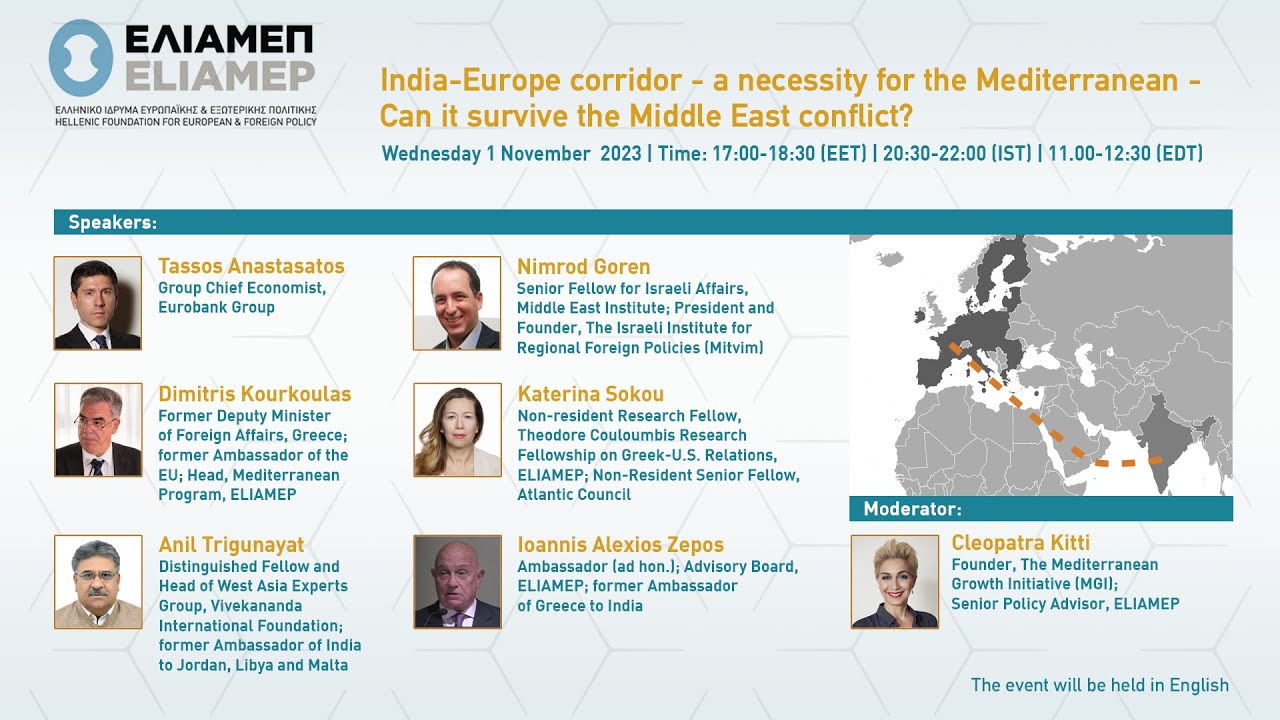
At the most recent G20 summit a new economic and infrastructure interconnectivity was announced to connect India to Europe through the Arabian Gulf, Israel, and Greece. This corridor is supported by the US, UAE, Saudi Arabia, France, Germany, Italy, and the EU.
· Will the project retain its momentum, given the re-emerging conflict in the Middle East? Could the whole project to be derailed by the long-term ramifications of the conflict as trust might erode among the indispensable partners?
· Can a positive agenda retain its importance at times of conflict and humanitarian crises?
· Can Greece be the convener that maintains momentum of possibilities for collaboration between India and Europe? What are the economic dynamics underpinning the geopolitical agenda? The Mediterranean remains the least connected region in the world. Creating interconnectivity, trade and economic opportunity across the Mediterranean is imperative if it is to find relevance in regional and multilateral partnerships – in technology, transport, energy efficient supply chains and infrastructure.
Speakers: Tassos Anastasatos: Group Chief Economist, Eurobank Group Nimrod Goren: Senior Fellow for Israeli Affairs, Middle East Institute; President and Founder, The Israeli Institute for Regional Foreign Policies (Mitvim) (TBC) Dimitris Kourkoulas: Former Deputy Minister of Foreign Affairs, Greece; former Ambassador of the EU; Head, Mediterranean Program, ELIAMEP Katerina Sokou: Non-resident Research Fellow, Theodore Couloumbis Research Fellowship on Greek-U.S. Relations, ELIAMEP; Non-Resident Senior Fellow, Atlantic Council Anil Trigunayat: Distinguished Fellow and Head of West Asia Experts Group, Vivekananda International Foundation; former Ambassador of India to Jordan, Libya and Malta Ioannis Alexios Zepos: Ambassador (ad hon.); Advisory Board, ELIAMEP; former Ambassador of Greece to India Moderator: Cleopatra Kitti, Founder, The Mediterranean Growth Initiative (MGI); Senior Policy Advisor, ELIAMEP
Key moments:
0:00-11:31 intro
11:31-15:08 “We can be more peaceful, if interconnected interests are more not less” Cleopatra Kitti
15:08-26:23 “The EU's engagement in the Southern neighbourhood is not longer a matter of choice, but a strategic imperative in order to protect itself from the chaos, that surrounds us everyday more and more” Dimitris Kourkoulas
26:23-38:18 “If you look at every country in the whole region you will realise that each one had its one geopolitical and geoeconomical reasons for being part of this corridor” Anil Trigunayat
38:18-45:15 “We have two centres Greece and India that I think are now looking positively towards one another, discovering still one another and all this lends a hand to the idea of this corridor, that can be a very interesting project for the future” Ioannis Alexios Zepos
45:15-55:56 “The US on its part hopes to cool off tensions in the region by working with its regional partners to build partnerships and by facilitating this normalisation process” Katerina Sokou
55:56-1:06:34 “The corridor idea is a meaningful one, it generated interest in Israel partly because it was was implementing the concept of regional integration” Nimrod Goren
1:06:34-1:19:24 “For India having access to western markets for capital is instrumental for growth and having access also to know how is instrumental for increasing the productivity of the economy which in term is instrumental for India to reach its goals” Tassos Anastasatos
1:19:24-1:34:25 Questions & Discussion

Информация по комментариям в разработке