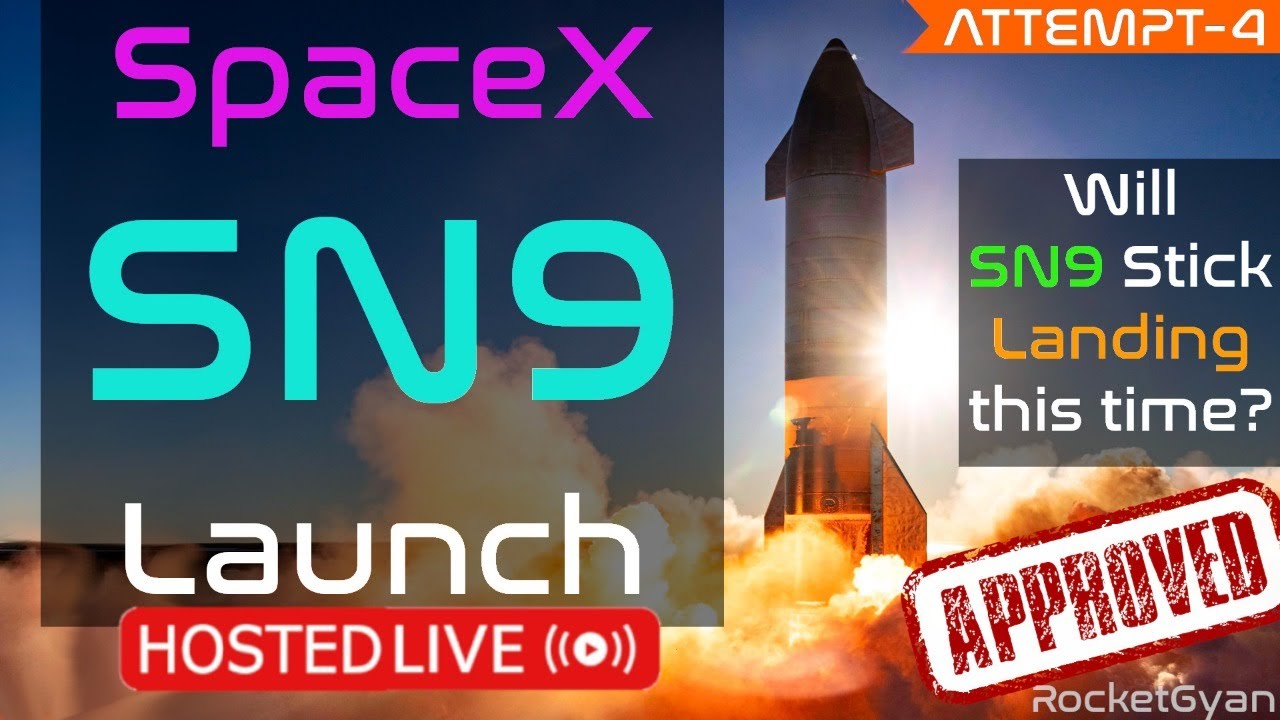
SpaceX will be attempting to launch the Starship SN9 prototype to a 10km high altitude after SN8 had a massive explosion just before the landing. Will SN9 Stick landing this time?
Support me on patreon and stop me from running away from youtube - / rocketgyan
#SpaceX #SN9 #Starship
SpaceX will be conducting a 10 km test flight of their SN9 prototype vehicle. This flight will be a repeat of the largely successful SN8 test flight, with some possible minor flight profile changes.
SN9 will lift off from Boca Chica, Texas under the power of its three Raptor engines. The Raptor engines will shut off one by one during ascent to decrease loads and acceleration on the vehicle. At apogee, the single Raptor engine still burning will initiate the vertical-to-horizontal flip before shutting off. SN9 will make use of its body flaps to keep it stable during descent. Prior to landing, SN9 will ignite two of its Raptor engines to reorientate itself back into a vertical position and perform a propulsive landing.
SN9 will perform a 10 km test flight – the second high altitude flight of a Starship prototype. The flight will be very similar to SN8’s. SpaceX will pressurize SN9’s header tanks with helium for this flight, which should prevent them from losing pressure like the methane header tank did during SN8’s flight.
As early as Tuesday, February 2nd, the SpaceX team will attempt a high-altitude flight test of Starship serial number 9 (SN9) – the second high-altitude suborbital flight test of a Starship prototype from our site in Cameron County, Texas. Similar to the high-altitude flight test of Starship serial number 8 (SN8), SN9 will be powered through ascent by three Raptor engines, each shutting down in sequence prior to the vehicle reaching apogee – approximately 10 km in altitude. SN9 will perform a propellant transition to the internal header tanks, which hold landing propellant, before reorienting itself for reentry and a controlled aerodynamic descent.
The Starship prototype will descend under active aerodynamic control, accomplished by independent movement of two forward and two aft flaps on the vehicle. All four flaps are actuated by an onboard flight computer to control Starship’s attitude during flight and enable precise landing at the intended location. SN9’s Raptor engines will then reignite as the vehicle attempts a landing flip maneuver immediately before touching down on the landing pad adjacent to the launch mount.
A controlled aerodynamic descent with body flaps and vertical landing capability, combined with in-space refilling, are critical to landing Starship at destinations across the solar system like mars.
SN9 tipped over in the high bay the day after SN8’s flight, causing a delay to its planned rollout while SpaceX inspected and replaced damaged parts – namely, one of the forward body flaps that was crushed between the vehicle and the wall of the high bay. Starship SN9 finally rolled out just before Christmas, with two of its three engines already installed – its third engine was installed at the launch site.
SN9 conducted two cryo tests, followed by a static fire. Several days later, SN9 conducted three static fire tests on the same day. Two of the engines were damaged following the trifecta of static fires. They were swapped out and SN9 successfully static fired for a fifth time.
Starship is SpaceX’s next-generation super-heavy launch vehicle. Starship can refer to just the second stage of the vehicle or the entirety of the launch vehicle. Its first stage, known as Super Heavy, will have 28 Raptor engines and will produce approximately 71.2 MN (16 million lbs) of thrust. That will make it more powerful than the Saturn V moon rocket. Starship and Super Heavy will lift off from a launchpad in either Boca Chica, Texas; Cape Canaveral, Florida; or from an offshore launch platform. After main engine cut-off (MECO), Super Heavy will separate from Starship and go back to land near the launch site. Starship will continue on to orbit. Depending on the mission, Starship will either deploy its payload or rendezvous with several “tanker” Starships and refuel before continuing to the Moon or Mars.
Prior to re-entry, Starship will perform a re-entry burn to bleed off enough of its velocity to leave orbit. It will then flip around and re-enter horizontally. Just before landing, Starship will flip around for a second time, performing a “belly-flop maneuver” to orient itself to a vertical position. It will fire its three sea-level Raptor engines and land in a similar way as the Falcon 9 and Super Heavy first stages.
Source - Spadre, Cbass productions, Everyday Astronaut

Информация по комментариям в разработке