Angel's trumpets - Brugmansia arborea Kongmansia - Devil's Trumpet - Gaddaepli - Þyrniepli - Trompetblóm - Englalúður - Toxic Herbs - Poisonous Plants - Sagt er að ilmur blómanna sé einn sá besti sem hugsast getur en ekki er hægt að segja það sama um lyktina af sjálfum fræunum sem er vægast sagt vond. Það er mikill munur á Datura og Brugmansia sem báðar bera alþýðunafnið Englatrompet - Angels Trumpets og voru áður flokkaðar saman sökum hversu líkar þær eru. Allar tegundir Datura eru einærar og bæði minni og þéttari en Brugmansia sem eru fjölær runnakenndar plöntur sem geta orðið 8. m. á hæð. Blóm Datura standa upprétt en blóm Brugmansia eru drjúpandi eins og pendúll. Ástæða þess að Brugmansia er vinsælli í ræktun en Datura er vegna þess að hún er fjölær því kosnaðarsamt er að kaupa Datura ár hvert sem er mjög dýr hjá plöntusölum.
Brugmansia Kongmansia - Evergreen shrub. The name Brugmansia, which should be applied to this plant previously called Datura, is from Sebald Justin Brugmans, 1763-1819, a Dutch professor of natural history - The easiest method is to propagate from semi-ripe and softwood cuttings about 10-15cm long. Insert cuttings into sandy, free-draining compost with bottom heat of 18-21°C in spring or late autumn.
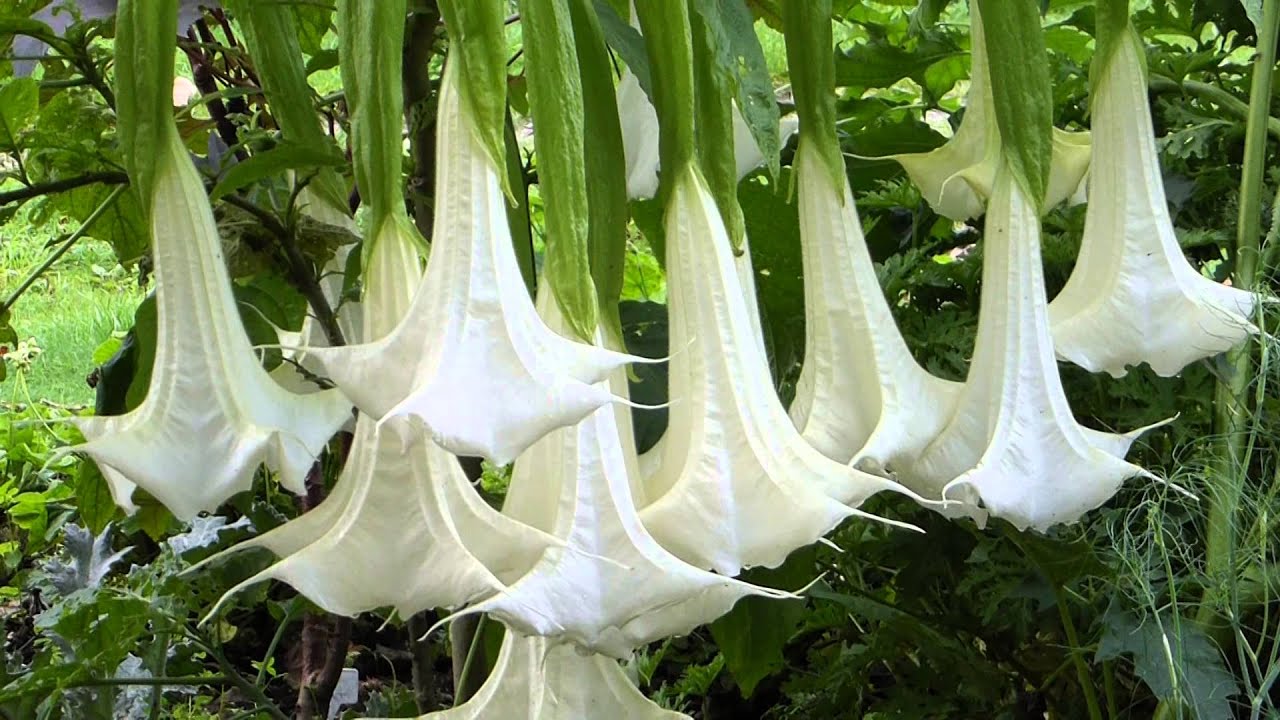
Brugmansia arborea is an evergreen shrub or small tree reaching up to 7 metres in height. The ovate leaves have coarsely toothed margins when in their best condition. The leaves, flower stalks, fruit, and especially the young shoots are covered with fine velvety white down. Flowers are strongly fragrant, trumpet-shaped, nodding to sub-horizontal, white to ivory-white or cream. At 12–17 centimetres. See more: https://en.wikipedia.org/wiki/Brugman...
It was believed to have been favoured by professional killers because the victims rapidly lose the wish, or ability, to move and quietly go off to sleep. Note that this runs contrary to most of the actual case reports which talk of agitation and excitement. In Mexico, a drink called Ololiuqui or Piule is made by chopping up Datura seeds and soaking them in pulque, the fermented juice of agaves. In the Mexican state of Oaxaca, there was once a group called the ‘Puliero Band’ who would travel to the more remote villages and offer their services, in return for payment, resolving disputes or solving crimes. They would use the Piule to produce intoxication in all the people involved in a case and claim that, under its influence, people were compelled to tell the truth. See more: http://www.thepoisongarden.co.uk/atoz...
Náttskuggaætt eða kartöfluætt - Solanaceae - er ætt dulfrævinga sem margir eru ætir en sumir eitraðir (og sumir bæði með eitraða og æta hluta eins og tómatar og kartöflur. http://is.wikipedia.org/wiki/N%C3%A1t...
Brugmansia is a plant with an unusual habit. It must create a Y shape in the trunk (a fork) before it will bloom. All of your flowers will come above this Y shape in the trunk. The plant will further branch out from there, and at each node, it will create a peduncle containing a covered flower bloom. At first, the bloom-pod (actually a calyx) will point upwards. As the flower begins to grow inside and fill out the calyx, it will begin to turn downwards. See more: http://www.trumpetflowers.com/info/ge...
Brugmansia are woody trees or shrubs, with pendulous, not erect, flowers, that have no spines on their fruit. Datura species are herbaceous bushes with erect (not pendulous) flowers, and most have spines on their fruit. Like many ornamental plants, all parts of Brugmansia can be toxic. See more: https://en.wikipedia.org/wiki/Brugmansia
This evergreen or semi-evergreen shrub makes a large, striking container plant for a conservatory or cool greenhouse. It is grown for its bold, trumpet-shaped flowers, which are often deliciously scented. Although these plants are not fully hardy, they can be positioned outdoors during the frost-free summer months. Brugmansia were once known as Datura, but that name is now used onle for certain annual or short-lived plants with similar but less pendulous flowers. See more: https://www.rhs.org.uk/advice/profile...
In northern climates this attractive plant is often grown indoors because people assume its common name refers to the look of the flowers rather than the indication that this is the sound to be heard after ingestion of a fatal amount. See more: http://www.thepoisongarden.co.uk/atoz...
Fragrant in the evenings to attract pollinating moths, they hang half-closed during the day, but return to their peak again in the evenings. See more: https://en.wikipedia.org/wiki/Brugman...

Информация по комментариям в разработке