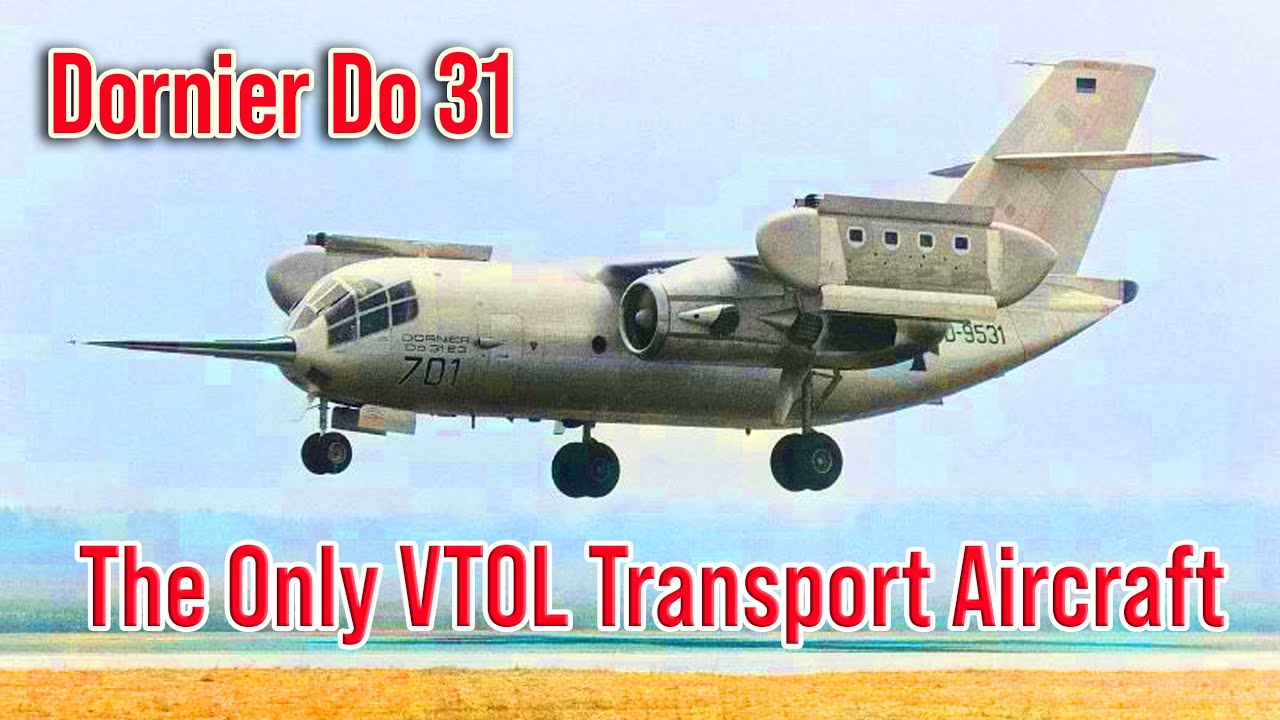
Copyright Disclaimer: - Under section 107 of the copyright Act 1976, allowance is mad for FAIR USE for purpose such a as criticism, comment, news reporting, teaching, scholarship and research. Fair use is a use permitted by copyright statues that might otherwise be infringing. Non- Profit, educational or personal use tips the balance in favor of FAIR USE. Following WWII, Western countries next to the Soviet Union were concerned about the security of their aviation bases. The Dornier Do 31 vertical takeoff and landing personnel transport was created by the new German air force, the Luftwaffe. Three prototypes were created by German engineers, resulting in a troop transport with ten engines. Today, the Dornier Do 31 is the only VTOL direct transport aircraft to have established five world records, making it the only aircraft to have done so.
The Germans developed vertical takeoff and horizontal flight VTOL aircraft to meet their aviation demands. Long runways and airfields would be unnecessary, allowing them to be hidden in the countryside or used as tiny operations bases. The German military might even launch these planes from the Autobahn network. West Germany began investigating a VTOL Air Force in the 1960s, while the Luftwaffe adapted its Lockheed F 104 starfighters to rocket launch them from stationary ramps. The objective was to develop a safe and effective platform capable of swiftly launching aircraft into the sky while maintaining a quick operating reaction force in the shortest period of time.
The project, which had some success, was superseded in 1962 with true VTOL aircraft. For tiny bases or autobahn launches, the Federal Ministry of Defence required a VTOL aircraft. Positive VTOL fighters had been tried by British, French, Soviet, American, and German aircraft, notably the Hawker Siddeley Deso Bozak and Lockheed Hummingbird.
Three German companies filed for the development of VTOLs with strike, fighter, and transport types. The first was the Messerschmitt, Heinkel, and Belken EWR V. J. 101 interceptor aircraft. It was capable of Mach two and the first VTOL to exceed Mach one during testing. The VJ 101, on the other hand, was cancelled in 1968 owing to a faulty roter gyro and an unmanageable roll induced by a faulty roter gyro.
VFW designed the German VTOL VAK 191 Strike Fighter to replace the Italian Fiat G 91 as a nuclear-equipped fighter. However, due to continual development revisions, it was cancelled in 1975. Dornier, a well-known maker of flying boats, set out to create the world's first VTOL transport, the Do 31E, which could carry up to 35 soldiers and vehicles. This enormous undertaking demonstrated the brilliance of German aircraft engineering.

Информация по комментариям в разработке