#Chhattar_Manzil #Lucknow #Gyanvik_vlogs #छतर_मंजिल_का_इतिहास #Farhat_Bakhsh_Kothi #lucknow_Heritage
You can join us other social media 👇👇👇
💎Instagram ID 👉 / vedanshroy3393
💎FB Page Link 👉 / gyanvikvlogs
Chhatar Manzil Palace of Lucknow
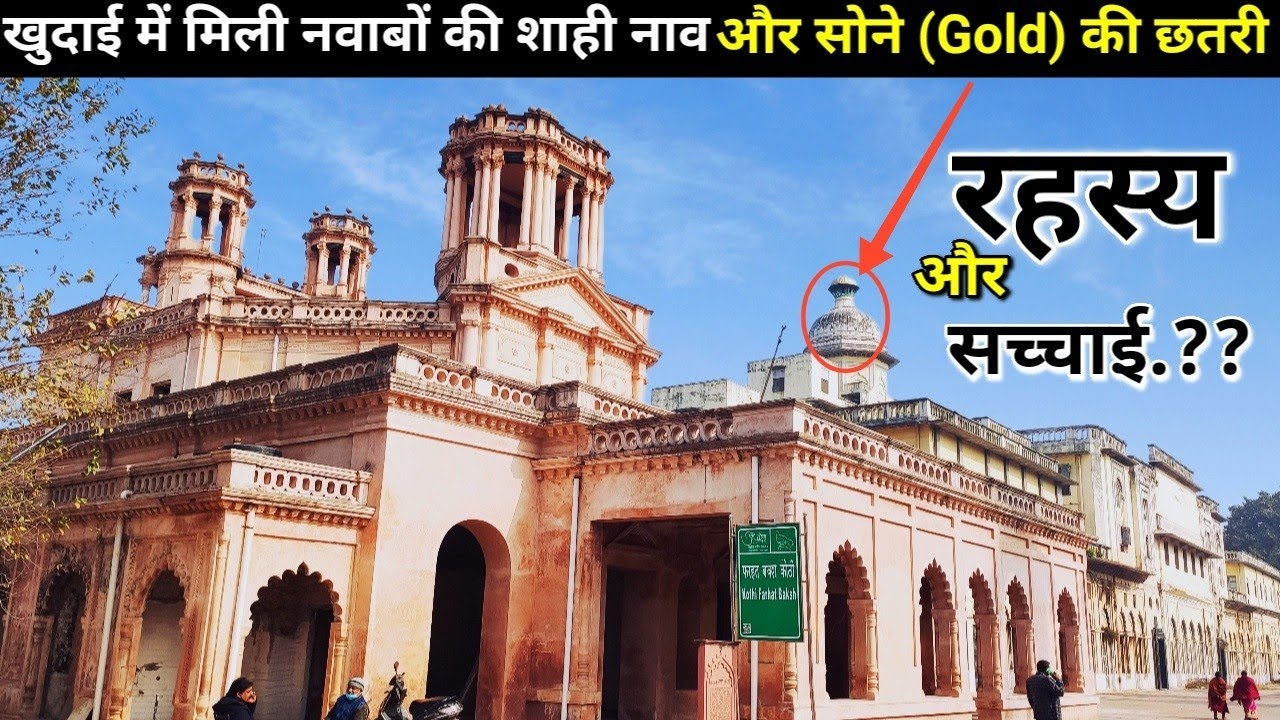
In May 2019, the Uttar Pradesh State Archaeological Department made such an interesting discovery that caused panic throughout the city of Lucknow. Excavation was going on in place of the 220-year-old Chhatar Manzil Palace on the banks of the Gomti River, when a 42-foot-long and 11-foot-wide gondela boat was found there, which belongs to the time of the Nawabs. The penta of this type of traditional boat is flat. This discovery has put a new light on the dilapidated palace. Until recently, the Palace used to house Central Drug Research Institute.
Chattar Manzil or Umbrella Palace is located on the Mahatma Gandhi Road in Lucknow in front of the old building of the High Court. It was once the residence of the Begums of Lucknow. It is also related to the kothi of the famous French traveler Claude Martin (1735–1800) in the Lucknow Durbar.
In 1775, Nawab Asaf-ud-Daula made Lucknow the capital of Awadh, excluding Faizabad. It was here that he built grand buildings like Rumi Darwaza and Bada Imambara and a magnificent court. Due to the wealth of the Lucknow Durbar, merchants and travelers from all over the country and abroad used to come to Lucknow to try their luck.
Farhat Baksh Kothi is one of the finest specimens of the city's architecture, today known as Chhatar Manzil. Due to the design of the building, it got its name Chhatar Manzil. Major General Claude Martin built the Farhat Baksh Kothi, which he called his town house, by clearing the forests on the banks of the Gomti River near his residence. Martin also had a large house outside the city called Constantia and where La Martinière College is now. The construction work of Farhat Baksh Kothi was completed in 1781 and Martin lived here till 1800. He died in a room here. According to his wish, he was buried in Constantia, which is now La Martiniere College for Boys. Martin had already built a corpse for his grave here.
Martin used to have a library and museum in the main hall of the building. He had close to four thousand books in French and English. In addition, there were five hundred books written in Persian language. An English tourist described Martin's museum as a blissful museum. It would have large glass, china and glass utensils, fireworks, Chinese toys, biological specimens (including a woman's skeleton), puppet theater items and clocks as well as modern items such as steam engines, printing presses, magical lanterns Were. Martin also had a large collection of paintings.
After Martin's death, his Spanish colleague Joseph Queiros auctioned the residence and bought it for forty thousand rupees. Nawab of Awadh Saadat Ali Khan had also bid in the auction, but Joseph had bought it by bidding more. However, in the meantime, the Nawab fell ill and took this kothi to change the ab-o-hawa. After recovering from the disease, the Nawab forced it to buy Quairos. This Kothi was the residence of the Nawabs and kings of Awadh for a long time. Wajid Ali Shah (1847–1856) later made Qaisar Bagh his place of residence. It was also called the Qasr-e-Sultan of the king.
Nawab Saadat Ali Khan built Lal Baradari and China Bazaar near Farhat Baksh Kothi. His son Ghaziuddin Hyder, who was the first king of Awadh, built a garden near Farhat Baksh Kothi where the idols were set. He named it Gulistan-e-Iram (garden of heaven). In front of the garden, he also made a kothi by the name of Darshan Vilas. Chhatri Manzil had emerged from the modernization and other construction of Ghazi Uddin Haider in Farhat Baksh Kothi, although by the time of his demise in 1827, these constructions were incomplete.
The construction of Chhatar Manzil Bhawan, part of the Chhatar Manzil complex, was started by Nawab Saadat Ali Khan in memory of his Hindu mother Chhatar Kanwar, but the construction work was completed by his third son Ghaziuddin Haider Shah in 1810. He had built another similar small building called Chhoti Chhatar Manzil. The first building was called Badi Chhatar Manzil. There were umbrellas on the dome above both buildings. Chattar Manzil was known for its gold umbrellas.
#Nawab_Saadat_Ali_Khan
#Chhoti_Chhattar_Manzil #Ghazi_Uddin_Haider

Информация по комментариям в разработке