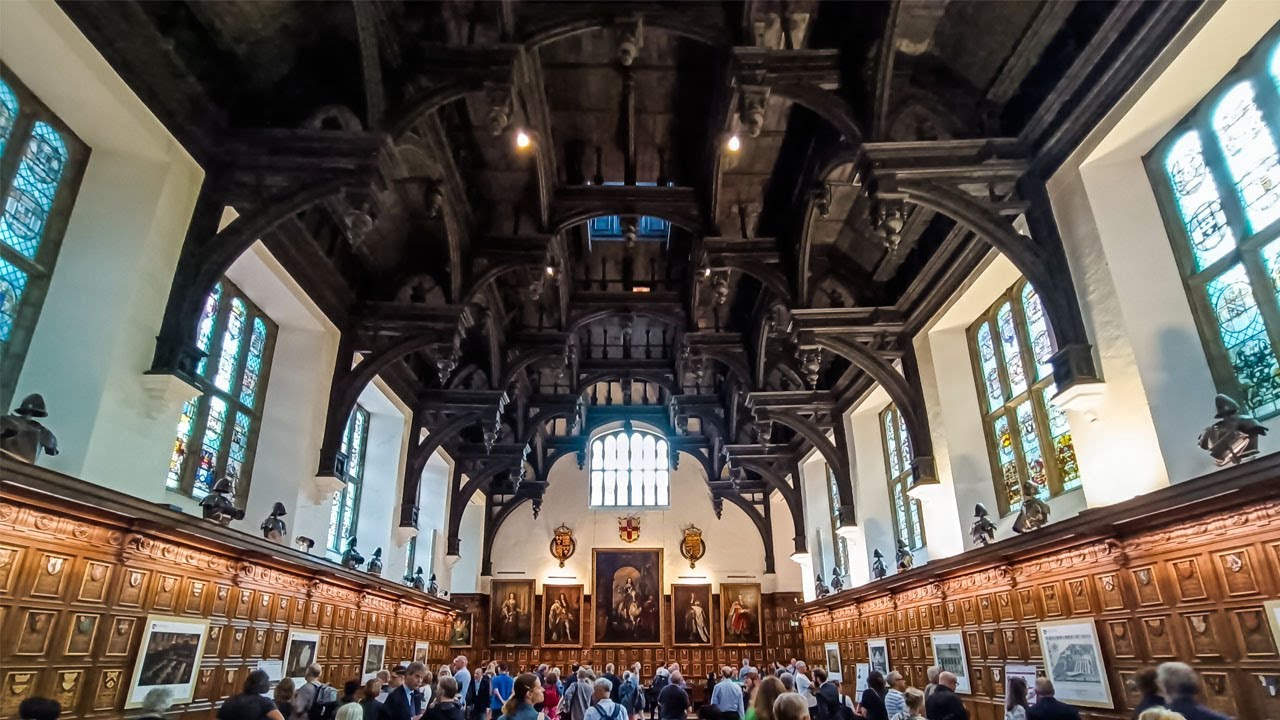
The Honourable Society of the Middle Temple, commonly known simply as Middle Temple, is one of the four Inns of Court exclusively entitled to call their members to the English Bar as barristers, the others being the Inner Temple, Gray's Inn and Lincoln's Inn. It is located in the wider Temple area of London, near the Royal Courts of Justice, and within the City of London. As a liberty, it functions largely as an independent local government authority.
👉If you like, follow me❤️:
🎥Youtube: / @visitplaces
📷Instagram: / erolugilde
🛠Gear used GoPro Hero 8: https://amzn.to/3w4YuSJ
💳The credit card I recomend for travel: https://americanexpress.com/en-gb/ref...
💵The debit card I use when abroad without fee for the currency exchange: https://join.monzo.com/c/zxw5r4x
During the 12th and early 13th centuries the law was taught, in the City of London, primarily by the clergy. But a papal bull in 1218 prohibited the clergy from practising in the secular courts (where the English common law system operated, as opposed to the Roman civil law favoured by the Church). As a result, law began to be practised and taught by laymen instead of by clerics. To protect their schools from competition, first Henry II and later Henry III issued proclamations prohibiting the teaching of the civil law within the City of London. The common law lawyers migrated to the hamlet of Holborn, as it was easy to get to the law courts at Westminster Hall and was just outside the City. They were based in guilds, which in time became the Inns of Court.
The Middle Temple is the western part of "The Temple", which was the headquarters of the Knights Templar until they were dissolved in 1312. There have been lawyers in the Temple since 1320, when they were the tenants of the Earl of Lancaster, who had held the Temple since 1315. The Temple later belonged to the Knights Hospitaller. In 1346 the knights again leased the premises to the lawyers – the eastern part (which became Inner Temple) to lawyers from Thavie's Inn, an Inn of Chancery in Holborn, and the western part to lawyers from St George's Inn. The Cross of St George is still part of the arms of Middle Temple today.
All of the Inn's records were burned during the Peasants' Revolt of 1381.
After Henry VIII seized the Temple from the Knights Hospitaller in 1540, each Inn continued to hold its share of the Temple as tenants of the Crown for £10 a year, until it was granted to them jointly in 1608 by James I, to be held in perpetuity so long as they continue to provide education and accommodation to lawyers and students and maintain the Temple Church and its Master. The Temple Church, consecrated in 1185, still stands as a "Royal Peculiar" (extra-diocesan) church of the Inner and Middle Temples.
Much of the Middle Temple was destroyed in a fire in January 1679, which caused more damage to the Inn than the Great Fire of 1666. The Thames being frozen over, beer from the Temple cellars was used to fight the fire, which was eventually only contained by blowing up some buildings with gunpowder. The Lord Mayor of London tried to exploit the occasion to assert his own jurisdiction over the Temple – which was independent of the City – and on being thwarted in this endeavour, he turned back a fire engine which was on its way to the fire from the City.
The first woman to be admitted to any Inn was Helena Florence Normanton, who joined Middle Temple as a student member on 24 December 1919.
The Temple was damaged extensively during the Blitz (1940–1944). The Library was destroyed, much of the Church was destroyed, the Master's House burned down, and the Hall was badly damaged. 112 chambers were destroyed, out of a pre-war total of 285 (39%).
The Inns served as colleges for the education of lawyers until they stopped being responsible for legal education in 1852, although they continue to provide training in areas such as advocacy and ethics for students, pupil barristers and newly qualified barristers. Most of the Inn is occupied by barristers' offices, known as barristers' chambers. One of the Middle Temple's main functions now is to provide education and support to new members of the profession. This is done through advocacy training, the provision of scholarships (over £1 million in 2011), subsidised accommodation both in the Temple and in Clapham, and by providing events where junior members may meet senior colleagues for help and advice.
In 2008 the 400th anniversary of the charter of James I was celebrated by Elizabeth II issuing new letters patent confirming the original grant.
#MiddleTemple #HonourableSocietyoftheMiddleTemple #barriesterslondon

Информация по комментариям в разработке