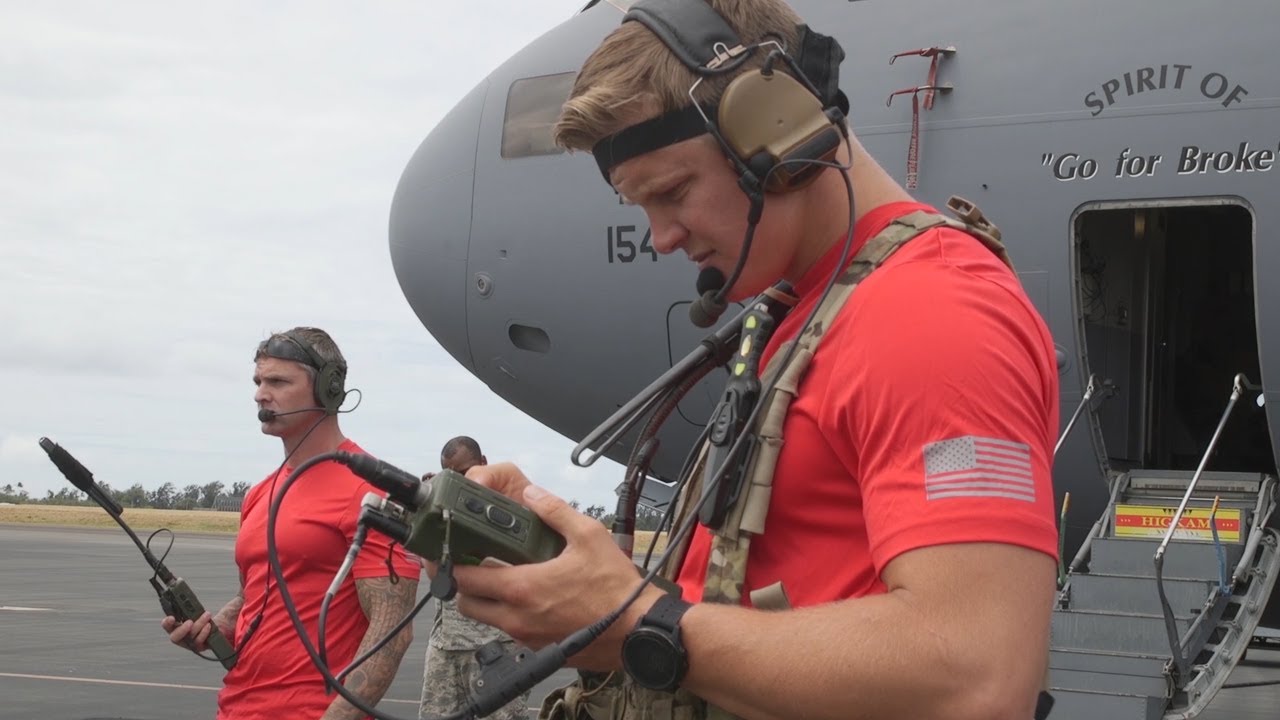
The Hawaii Air National Guards 204th Airlift squadron has been preparing for e Contingency Astronaut Rescue for 4 years. In preparation for the SpaceX launch a C-17 is loaded with 3 rafts, 2 jet skis, a bunch of other rescue gear, and a team of PJ's and pilots standby. The Guardian Angels PJ's from Nellis Air Force base prepare for the Contingency Astronaut Rescue Mission in the event that there is a problem with the SpaceX launch.
On May 30, the world watched anxiously as history was made when the Falcon 9 prepared to launch as part of NASA’s SpaceX Demonstration Mission 2 at the Kennedy Space Center, Cape Canaveral, Fla.
For the first time since the conclusion of the space shuttle program in 2011, NASA astronauts would be launching from American soil in a commercially built and operated spacecraft on its way to the International Space Station (ISS).
Crowds waited in anticipation as they heard the familiar countdown.
“Three, two, one...liftoff!”
The rocket ignited in a burst of grandeur and lifted off towards its destination. For those watching, it was a truly memorable moment to observe; however, for a select group watching, it was much more than just witnessing it—they were a part of it.
Three teams of Rescue Specialists stood on-call, with radios in hand and phones fully charged, ready to jump into an aircraft and carry out a search and rescue mission anywhere worldwide in the event of a mission abort.
The 58th Rescue Squadron’s Guardian Angels assigned to Nellis Air Force Base made up the three-team Space Flight Support Force distributed amongst Patrick AFB, Fla., Joint Base Charleston, S.C., and JB Pearl Harbor-Hickam, Hawaii, in support of the historic launch.
“It was great to be a part of history,” said Maj. Lucas Gagliardi, 58th RQS, director of operations. “Pararescue has been a part of manned space flight since it began in the 1960s, so to be included in the first team to bring back some of our heritage was a super humbling and awesome experience.”
The rescue teams were positioned at key alert locations based on the probability of an in-flight emergency during the launch until the SpaceX craft linked up with the ISS. In the event of an abort or emergency, the nearest team would race to the site and begin the rescue. Each team was prepared to fly with a Guardian Angel crew made up of pararescuemen and combat rescue officers.
According to Capt. Joshua McGee, 58th RQS combat rescue officer and Hickam team troop commander, they watched the launch live knowing the first minutes determined if a team would have to respond and which crew would be sent.
The Patrick AFB team stood by in the immediate area with HH-60 Pavehawk helicopters and an HC-130 Combat King II, ready to respond in case something went wrong during the early stages of the launch.
Once the ship began to ascend, a C-17 Globemaster III waiting at JB Charleston took over the watch, ready to travel up and down the east coast if it started to descend back down to earth.
Lastly, a C-17 from Hickam stood ready to traverse the Pacific Ocean in a recovery effort in case there was an emergency in orbit before the capsule finally reached the ISS.
To prepare for this intricate game plan, the teams traveled to Cocoa Beach, Florida, one month prior to the launch to work with members of Detachment 3 under the 45th Space Wing, from Patrick AFB for Just-in-Time-Training (JITT).
Their JITT included hands on work with a mock capsule in the bay and open ocean. The teams worked on tactics on how to operate the recovery with contingencies for different emergencies.
With a capsule possibly crashing back down to the ground, the alert teams had to account for hazardous gas, unpredictable weather and sea conditions, and prepare themselves for a rescue anywhere across the globe.
“We spent, between 12 to 14 hours daily, working in the basin and getting hands-on training with the capsule,” said Gagliardi. “We had a wide variety of instructors from retired pararescuemen, to pilots, firefighters, doctors, basically the whole gamut of rescue personnel who each brought their unique, capabilities and expertise to train us up for this mission.”
The teams trained extensively at JITT to familiarize themselves with their locations, mission plan, and most importantly to reinforce their safety protocols.
''If something were to go wrong, we trained to be able to support multiple contingencies and hazards during day or night ops,” said Gagliardi. “For example, in all these scenarios we had to be prepared to execute a recovery in the open ocean for up to 72 hours, treating patients until a helicopter arrived or a recovery by a ship of opportunity.”
More Info:
https://www.airforce.com/careers/deta...
Footage Credit: Tech. Sgt. Tabitha Hurst
#NASA #SpaceX #TacticalMode

Информация по комментариям в разработке