Logo video2dn
  • Сохранить видео с ютуба
  • Категории
    • Музыка
    • Кино и Анимация
    • Автомобили
    • Животные
    • Спорт
    • Путешествия
    • Игры
    • Люди и Блоги
    • Юмор
    • Развлечения
    • Новости и Политика
    • Howto и Стиль
    • Diy своими руками
    • Образование
    • Наука и Технологии
    • Некоммерческие Организации
  • О сайте

Скачать или смотреть CFD simulation of oil injection into conical rotary compressor

  • CFX Berlin
  • 2023-01-03
  • 2245
CFD simulation of oil injection into conical rotary compressor
CFX BerlinANSYS-SoftwareANSYS CFDStrömungssimulationCFXFluentTwinMeshconical rotary compressorcompressor
  • ok logo

Скачать CFD simulation of oil injection into conical rotary compressor бесплатно в качестве 4к (2к / 1080p)

У нас вы можете скачать бесплатно CFD simulation of oil injection into conical rotary compressor или посмотреть видео с ютуба в максимальном доступном качестве.

Для скачивания выберите вариант из формы ниже:

  • Информация по загрузке:

Cкачать музыку CFD simulation of oil injection into conical rotary compressor бесплатно в формате MP3:

Если иконки загрузки не отобразились, ПОЖАЛУЙСТА, НАЖМИТЕ ЗДЕСЬ или обновите страницу
Если у вас возникли трудности с загрузкой, пожалуйста, свяжитесь с нами по контактам, указанным в нижней части страницы.
Спасибо за использование сервиса video2dn.com

Описание к видео CFD simulation of oil injection into conical rotary compressor

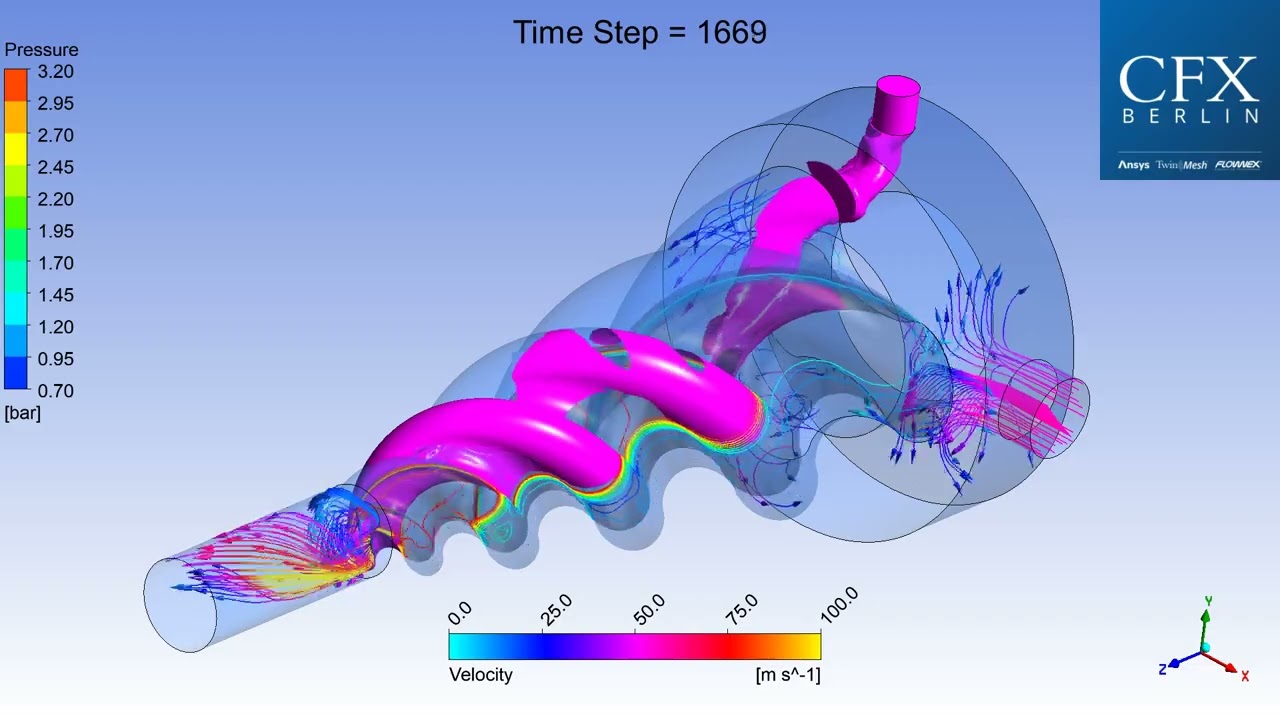
This animation shows a conical rotary compressor with non-parallel variable pitch rotor that compresses air from 1 bar to 3 bar. Starting from a single-phase solution without oil, 5 l/min oil are injected. The oil seals the radial gap between rotor and stator, and cools down the gas during compression so that air flow increases compared to dry-running compressor.

The shape of the conical rotary compressor is similar to an eccentric screw pump but with decreasing radial extent and, in this case, decreasing chamber length in transport direction to compress the gas during transportation. The lobe combination of inner and outer rotor is 3 by 2. Outer stator diameter is 80 mm at suction side, 18.56 mm at pressure side, the rotor length is 160 mm with a variable pitch, eccentricity at suction side 10 mm. The size of the radial gap between rotor and stator is 100 µm at suction side, decreasing proportional to stator diameter towards pressure side.

The meshes for the fluid region between rotor and stator were pre-generated for each 2° rotation angle of the rotor with TwinMesh. We used the outerfix approach, i.e. the mesh nodes are fixed on the stator surface and move on the rotor surface. We discretized with 180 elements in circumferential direction, 25 elements in radial direction, and 180 elements in axial direction, i.e. with 810,000 hexahedrons for the rotating and deforming part. These meshes were transformed by Perl scripts to account for variable diameter and variable pitch angle along the z axis. Meshes for the static parts, i.e. suction and pressure side with air and oil injection pipes, were generated with Ansys Icem CFD and Ansys Meshing and consist of approx. 550,000 elements (mainly hexahedrons) together.

For the setup, we use air described as calorically perfect ideal gas, and incompressible oil with density 800 kg/m³. Boundary conditions are 1 bar and 20°C at air inlet and 3 bar at outlet with standard reflecting boundary conditions; at oil inlet 5 l/min oil enter at 20°C. The rotor rotates at 3000 rpm, rotor and stator walls are at 20°C. The multi-phase simulation starts from the almost periodic single-phase solution where oil inlet was defined as wall; this single-phase solution has an air mass flow rate of 6.17 g/s (312 l/min) with a power consumption of 1560 W.

Time step size is 111 µs (2° rotation angle at 3000 rpm), 5 coefficient loops are used at each time step with high resolution scheme for advection and second order backward Euler scheme in time. Simulation was running for 3600 time steps, i.e. 20 revolutions of the rotor, on 6 cores local parallel with Ansys CFX and needed approx. 80 hours of simulation time, i.e. 4 hours for one rotor revolution. Finally, the air mass flow increases to 13.5 g/s (684 l/min), power consumption rises to 2210 W.

The animation shows pressure distribution as contour lines on the rotor surface; the pressure rise in the compressor from suction towards pressure side can be seen. Additionally, velocity at inlet, at suction and at discharge port is shown by coloured streamlines with a length of 1 ms, and isosurface for an oil volume fraction of 10% is added in purple, showing the transport of oil through the compressor.

Комментарии

Информация по комментариям в разработке

Похожие видео

  • О нас
  • Контакты
  • Отказ от ответственности - Disclaimer
  • Условия использования сайта - TOS
  • Политика конфиденциальности

video2dn Copyright © 2023 - 2025

Контакты для правообладателей [email protected]