Southeast Asia is one of the most strategically important maritime regions in the world, and Offshore Patrol Vessels (OPVs) play a critical role in protecting national interests, enforcing maritime law, and safeguarding vital sea lanes. In this full in-depth review, we analyze Southeast Asia’s most powerful OPVs, comparing their capabilities, technology, armament, and operational roles across different regional navies.
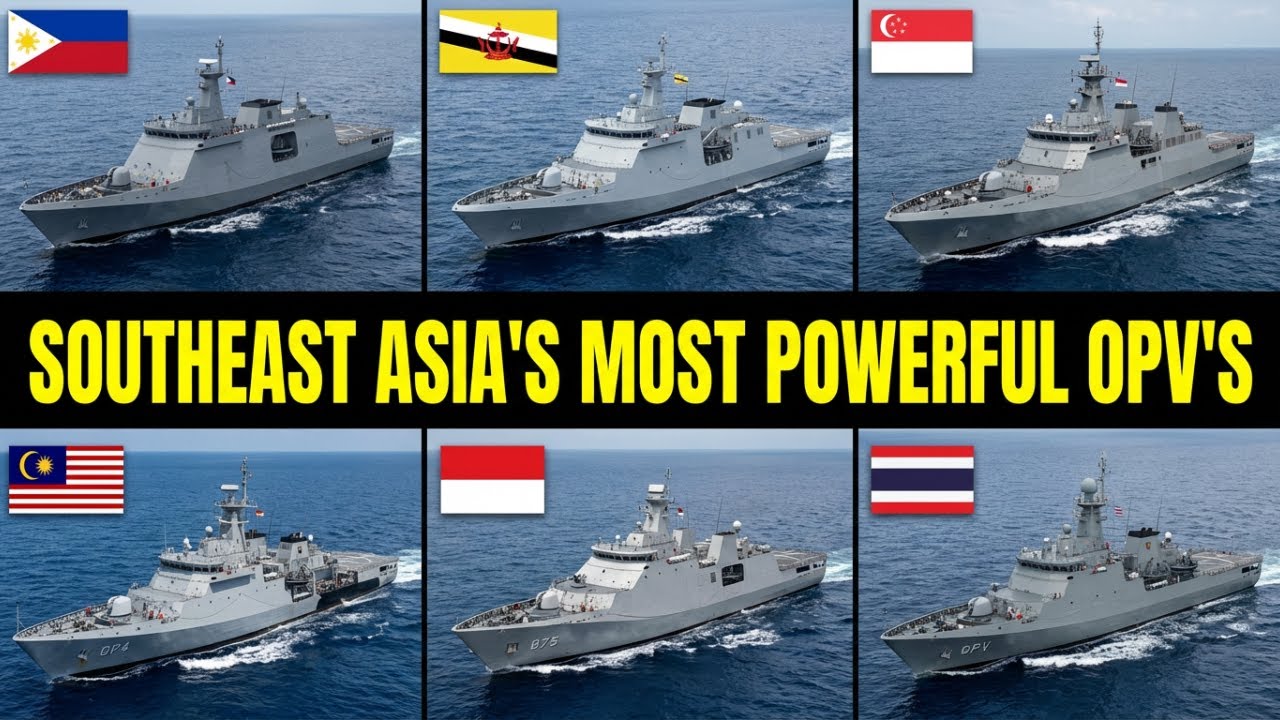
This video provides a comprehensive breakdown of modern OPVs operated by Southeast Asian countries, including the Philippines, Singapore, Malaysia, Indonesia, Thailand, and Brunei. These ships are designed to operate in complex maritime environments such as the South China Sea, Malacca Strait, and exclusive economic zones (EEZs) where security, sovereignty, and deterrence are essential.
⚓ What Is an Offshore Patrol Vessel (OPV)?
An Offshore Patrol Vessel (OPV) is a highly versatile naval ship designed primarily for maritime patrol, surveillance, and security operations. Unlike frigates or destroyers, OPVs focus on endurance, flexibility, and cost-effective power projection. Modern OPVs are increasingly armed with advanced sensors, combat management systems, and modular weaponry, making them capable of limited combat roles when required.
Key missions of OPVs include:
Maritime patrol and surveillance
Exclusive Economic Zone (EEZ) enforcement
Anti-smuggling and anti-piracy operations
Search and rescue (SAR) missions
Disaster relief and humanitarian assistance
Border protection and sovereignty enforcement
In Southeast Asia, OPVs are especially important due to territorial disputes, illegal fishing, piracy, and growing regional naval competition.
🌏 Why Southeast Asia’s OPVs Matter
Southeast Asia sits at the crossroads of global trade, with over one-third of world maritime commerce passing through its waters. As regional tensions rise and naval modernization accelerates, OPVs have become a first line of defense for many countries.
Rather than relying solely on expensive warships, Southeast Asian navies are investing in modern, heavily equipped OPVs that offer:
Long-range patrol capability
Reduced operational costs
Advanced radar and surveillance systems
Scalable firepower
These vessels are perfectly suited for gray-zone operations, where presence and deterrence matter more than high-intensity naval warfare.
🚢 Countries Featured in This Full Review
🇵🇭 Philippines
The Philippine Navy has rapidly modernized its OPV fleet to enhance maritime security in the West Philippine Sea. New OPVs feature modern sensors, improved endurance, and upgraded command-and-control systems, enabling effective patrol operations across vast maritime zones.
🇸🇬 Singapore
Singapore operates some of the most advanced OPVs in the world, integrating cutting-edge electronics, automation, and stealth design. These vessels are optimized for rapid response, network-centric warfare, and multi-role operations.
🇲🇾 Malaysia
Malaysia’s OPVs are designed for long-endurance patrols across the South China Sea and Malacca Strait. Emphasis is placed on mission flexibility, helicopter operations, and law enforcement capability.
🇮🇩 Indonesia
Indonesia’s vast archipelagic geography demands powerful OPVs with long range and robust sea-keeping capabilities. Indonesian OPVs are built to operate in challenging environments while supporting maritime security and sovereignty enforcement.
🇹🇭 Thailand
Thailand’s OPVs combine affordability with modern naval technology. These ships are optimized for patrol missions, humanitarian assistance, and regional maritime cooperation.
🇧🇳 Brunei
Despite its small size, Brunei fields highly capable OPVs equipped with modern combat systems, reflecting a focus on quality over quantity in maritime defense

Информация по комментариям в разработке