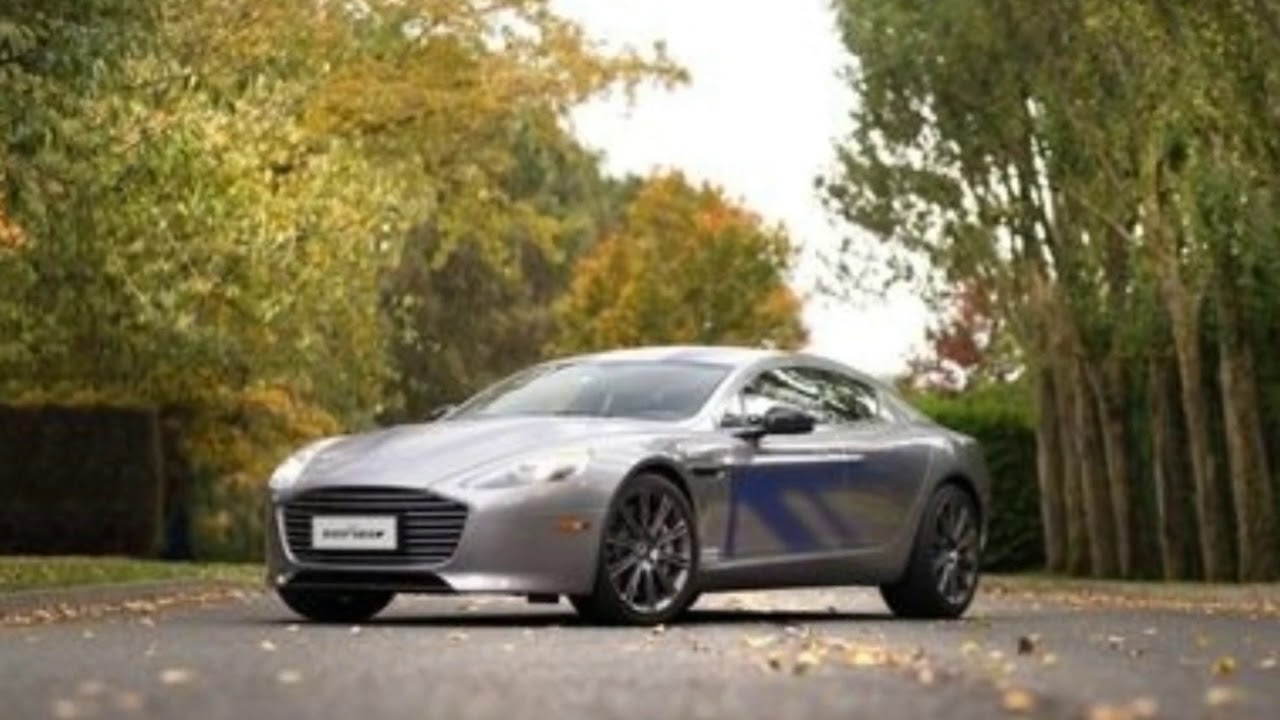
Although the electric version of the Aston Martin Rapide isn’t meant to go racing, it is very much a product of Britain’s Motorsport Valley. English topography isn’t accommodating enough to make this an actual valley, the reference instead being to the compact region in which you’ll find the headquarters of six Formula 1 constructors, plus numerous specialist suppliers and consultancies. The race teams could be surrounded by a 60-mile ring cast with sufficient accuracy.The region is packed with very hot hothouses—and also some unlikely technical collaborations. Aston Martin has a partnership with the Red Bull Racing Formula 1 team, including creation of the forthcoming Valkyrie megacar and—coming soon—a joint development center. Yet it’s a different Formula 1 constructor, Williams Advanced Engineering, that is Aston’s partner for its first electric car, the RapidE—a clever bit of naming, just capitalizing the letter e in the brand’s Rapide sedan, although not much use as an internet search term.Regardless, it’s what brought us to Williams HQ at Grove, in Oxfordshire, to experience an electrically powered Aston for the first time. Or more accurately, to have a brief drive in what is being pitched as a proof of concept, a very early prototype. The finished reality will be delivered to select customers in 2019.Although recognizable as a Rapide—the long and coupelike, hatched sedan that Aston spun from the DB9—the test mule we’re driving is far from street legal. The donor car first served as an early engineering mule during initial development of the conventionally powered Rapide, so it’s at least eight years old and has undergone substantial cobbling to accommodate a new electric powertrain. Popping the hood reveals the obvious difference: A bright-orange battery pack squats in the space formerly occupied by the V-12 engine. This pack is so large that some firewall surgery was required to make it fit, effectively precluding the car from anything other than low-speed use. Other factors preventing street legality include nonfunctional windshield wipers and turn signals, both lost with the partial switch to a new electrical architecture. The digital instrument panel does still work, communicating gear and speed information but accompanied by a scrolling panel of warnings and status messages on the right-hand side. In the manner of the finest prototype vehicles, there’s also a big, red stop-everything emergency button in the middle of the passenger compartment.Even restricted to the road around the Williams parking lot, it is clear that the prototype isn’t going to be humbling a Tesla Model S in a drag race. Indeed, a Nissan Leaf would almost certainly smoke it off the line. There’s a slight delay between pressing the RapidE’s long-travel accelerator pedal and power arriving—we’re told that this is intentional due to the lack of traction control. Once the electrons are flowing, it feels strong, but according to the speedometer our top speed of the day is just 40 mph—impressive only in the context of the 15-mph speed limit in the Williams lot.We’re told that the battery pack intended for the production RapidE will be more compact and will still be mounted under the hood. A different rear-axle configuration is also deemed likely, possibly incorporating two motors. The goal is to deliver similar performance to the existing V-12 Rapide. A governed 155-mph top speed is cited, almost absurdly, as justification for limiting the electric car’s production run to 155 units.While this prototype RapidE is some way off the finished article, it does succeed in its primary mission of proving the viability of an electron-propelled Aston. It certainly lacks the aural charisma of the velvety 12-cylinder engine,

Информация по комментариям в разработке