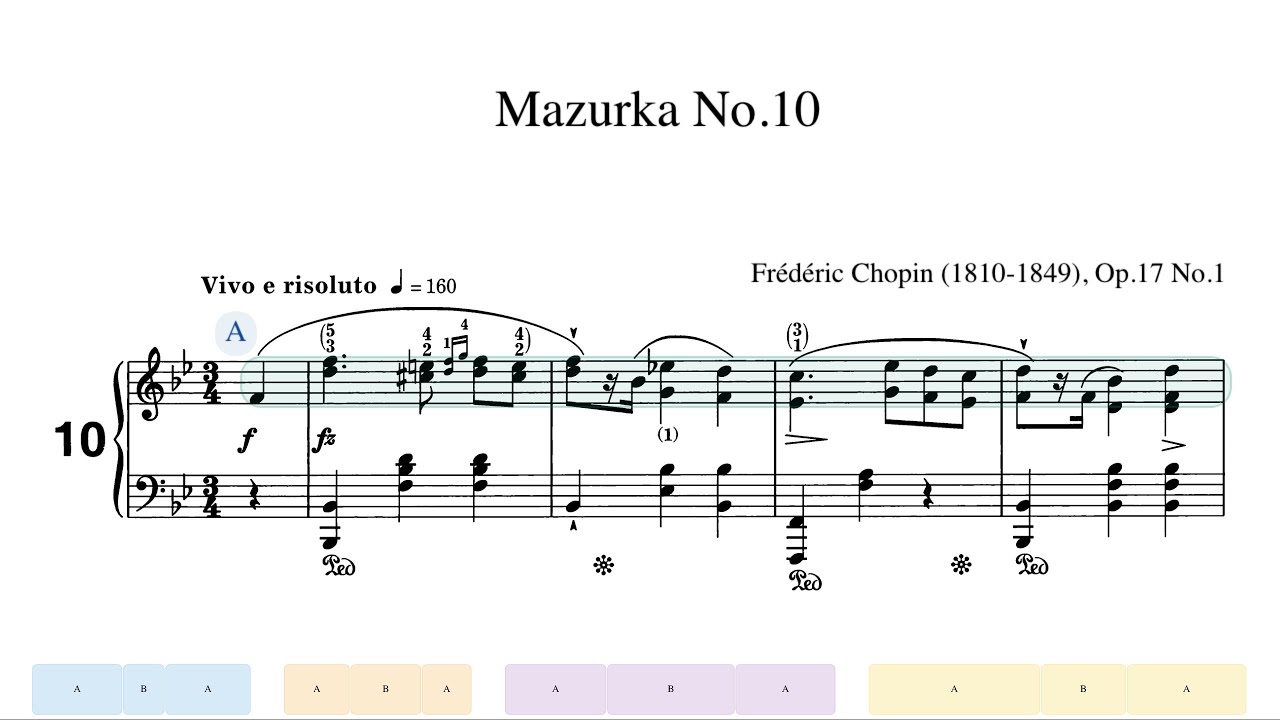
Frédéric Chopin's 4 Mazurkas (No.10~13), Op.17 No.1~4, with synchronized sheet music (score) and a theme-and-structure analysis.
Performance:
Nikita Magaloff (piano), 1977/08 Stereo, Netherlands (Op.17-1,17-2,17-3)
Vladimir Horowitz (piano), 1985/04 Stereo (DDD), New York (Op.17-4)
Analysis, Score Editing, Synch: ScoreMan
-----
00:00 Mazurkas No.10 in B flat major, Op.17-1 (Magaloff)
02:16 Mazurkas No.11 in E minor, Op.17-2 (Magaloff)
04:14 Mazurkas No.12 in A flat major, Op.17-3 (Magaloff)
07:40 Mazurkas No.13 in A minor, Op.17-4 (Horowitz)
HISTORICAL CONTEXT
Composed shortly after Chopin permanently left Poland — a time of nostalgia and homesickness. These emotions are reflected in the melancholic and inward tone of much of the set.
The November Uprising in Poland (1830–31) had failed, and Chopin, in exile, processed his loss and longing through music.
Parisian salons admired these mazurkas not just as dances, but as serious art music — intimate, character-rich miniatures.
MUSICAL CHARACTER
No. 1 in B-flat major
Opens warmly with a singing theme. Gentle, elegant, and tinged with sweetness.
Its lyricism is pure and heartfelt, often compared to a vocal folk melody.
No. 2 in E minor
The most famous of the set. Deeply melancholic and mysterious.
The middle section glows with a kind of aching warmth before returning to the haunting main theme.
This mazurka is often interpreted as an emotional cry of exile — a spiritual lament for Chopin’s lost homeland.
No. 3 in A-flat major
Light, graceful, and filled with inner dialogue between left and right hand.
There’s a gentle playfulness here, with subtle rhythmic shifts and ornamental turns.
No. 4 in A minor
A remarkable work — dark, serious, almost tragic.
It ends unusually: fading into silence, unresolved, evoking deep introspection.
Some have called this a masterpiece in miniature — it anticipates the poetic ambiguity of later Romantic composers.
WHY THEY MATTER
Op. 17 shows Chopin's transformation of the mazurka into a deeply personal and expressive form.
The emotional range across this set is vast: joy, nostalgia, sorrow, and introspection all find voice here.
This set is often seen as one of the first truly mature mazurka collections, showcasing Chopin's stylistic independence and emotional subtlety.
They laid the foundation for his later mazurkas, which became even more daring harmonically and rhythmically.
✨ Beethoven's Masterpieces (sorted by Opus) • L. v. Beethoven's Masterpieces
🎶 Beethoven Symphonies • L. v. Beethoven - 9 Symphonies
✨ Chopin's Masterpieces (sorted by Opus) • F. Chopin's Masterpieces
🎶 Chopin Mazurkas • F. Chopin - 21 Mazurkas
🎶 Chopin Polonaises • F. Chopin - 19 Polonaises
🎶 Chopin Nocturnes • F. Chopin - 22 Nocturnes
🎶 Chopin Waltzes • F. Chopin - 19 Waltzes
🎹 Piano Sonata Collections • Piano Sonata Collection
🎹 Piano Concerto (Piano & Orchestra) Collections • Piano Concerto Collection
🎻 Violin Concerto (Violin & Orchestra) Collections • Violin Concerto Collection

Информация по комментариям в разработке