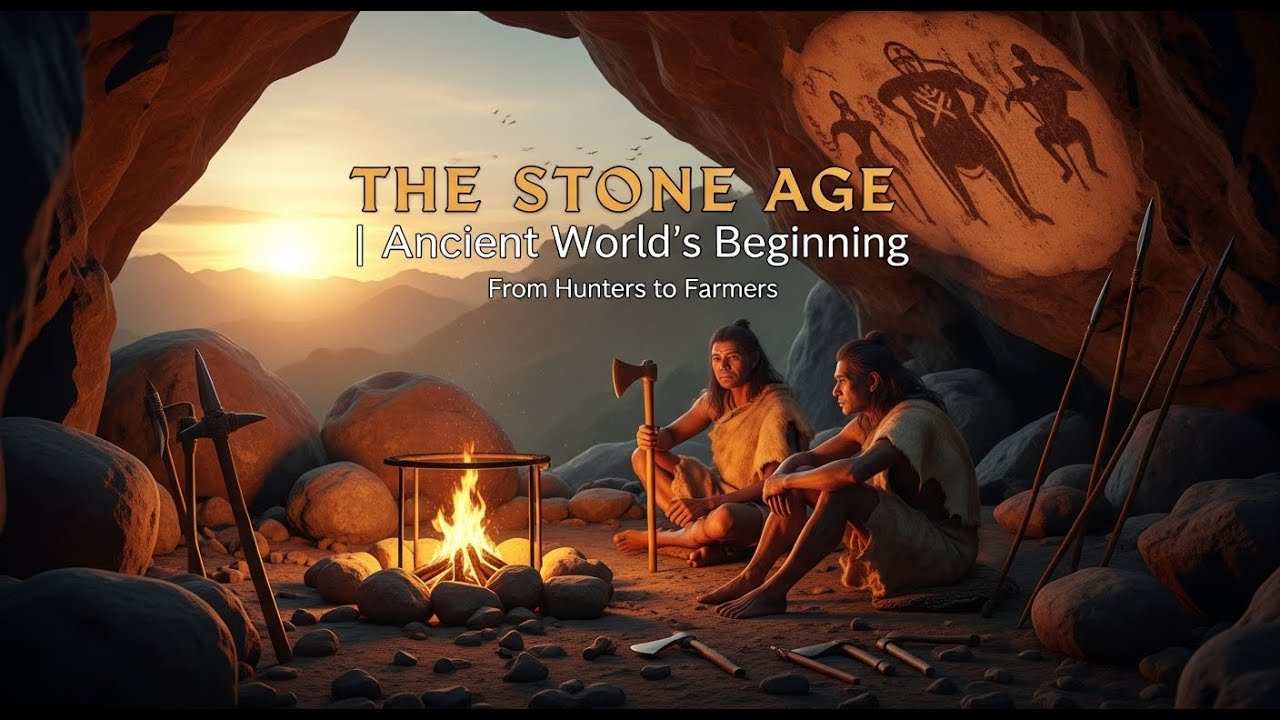
Before writing, before kingdoms, before cities — there was the Stone Age.
This documentary-style lecture takes you on a cinematic journey through India’s earliest human history — from the dawn of humankind to the rise of agriculture and metal use.
In this video, we explore how early humans evolved, survived, and shaped civilization through thousands of years — guided entirely by archaeology, not written words.
--------------------------------------------
🧩 Topics Covered:
🔹 1. Understanding History, Archaeology & Timeline
– What is the difference between Prehistory, Protohistory, and History?
– How archaeologists reconstruct the past through excavations, tools, and fossils.
– The concept of BCE–CE (Before Common Era / Common Era) simplified.
🔹 2. The Major Ages of Early Human Development
– Division of the Stone Age: Paleolithic, Mesolithic, and Neolithic.
– Transition from Stone Age to Chalcolithic (Copper–Stone Age).
🔹 3. The Paleolithic Age (Old Stone Age)
– Lower, Middle, and Upper Paleolithic phases.
– Development of tools: hand axes, cleavers, flakes, and blades.
– Evolution of humans: from primitive man to Homo sapiens.
– Key Indian sites: Soan Valley, Belan Valley, Didwana, Hunsgi, Nevasa, Patne, and Bhimbetka.
– Bhimbetka cave paintings — the birth of human art and creativity.
🔹 4. The Mesolithic Age (Middle Stone Age)
– Period: 9000–4000 BCE — post-Ice Age transformation.
– Discovery of microliths (small geometric stone tools).
– First signs of animal domestication — dogs, cattle, goats.
– Early settlements and rock art.
– Major sites: Bagor, Langhnaj, Adamgarh, Chopani Mando, Sarai Nahar Rai, and Birbhanpur.
🔹 5. The Neolithic Age (New Stone Age)
– The Neolithic Revolution — the invention of agriculture.
– Shift from food gathering to food production.
– First permanent villages and community life.
– Development of pottery, polished stone tools, and weaving.
– Evidence of early farming and animal herding.
– Key sites:
• Mehrgarh (Baluchistan) – earliest farming, cotton cultivation, mud-brick houses.
• Burzahom & Gufkral (Kashmir) – pit dwellings, dog burials.
• Chirand (Bihar) – bone tools.
• Koldihwa (U.P.) – earliest rice cultivation.
• Sanganakallu, Brahmagiri, Maski, Hallur (Karnataka) – millet farming, ash mounds.
🔹 6. The Chalcolithic Age (Copper–Stone Age)
– Discovery and use of copper alongside stone.
– Rise of rural communities and advanced crafts.
– Important cultures:
• Ahar–Banas (Rajasthan) – near copper mines of Khetri.
• Malwa (Madhya Pradesh).
• Jorwe (Maharashtra) – major sites: Nevasa, Inamgaon, Daimabad.
– Daimabad finds: bronze sculptures of man with chariot, elephant, rhino, and buffalo.
--------------------------------------------
🧠 Key Learnings:
✔️ How human life evolved through innovation and adaptation
✔️ Role of archaeology in discovering India’s prehistoric past
✔️ The journey from hunter-gatherers to settled farmers
✔️ How simple stone tools laid the foundation of civilization
--------------------------------------------
🎓 Perfect For:
– History students and educators
– UPSC / SSC / State PSC aspirants
– Archaeology and anthropology enthusiasts
– Documentary and storytelling lovers
--------------------------------------------
🕰️ Watch Till the End To Discover:
💡 How small inventions shaped the future of humanity
💡 What makes Indian prehistoric sites like Bhimbetka and Mehrgarh world-famous
💡 How the Stone Age gradually transitioned to the Bronze Age and Harappan Civilization
--------------------------------------------
🔔 Don’t Forget To:
✅ Subscribe for more cinematic history lectures
✅ Like & Share to support educational content
✅ Comment: Which prehistoric site amazed you the most?
#StoneAge #AncientHistory #HistoryOfIndia #PrehistoricIndia #Archaeology #Neolithic #Paleolithic #Mesolithic #Chalcolithic #Bhimbetka #Mehrgarh #Burzahom #IndianHistory #HistoryLecture #EducationalDocumentary #UPSC #HistoryStudents #HumanEvolution

Информация по комментариям в разработке