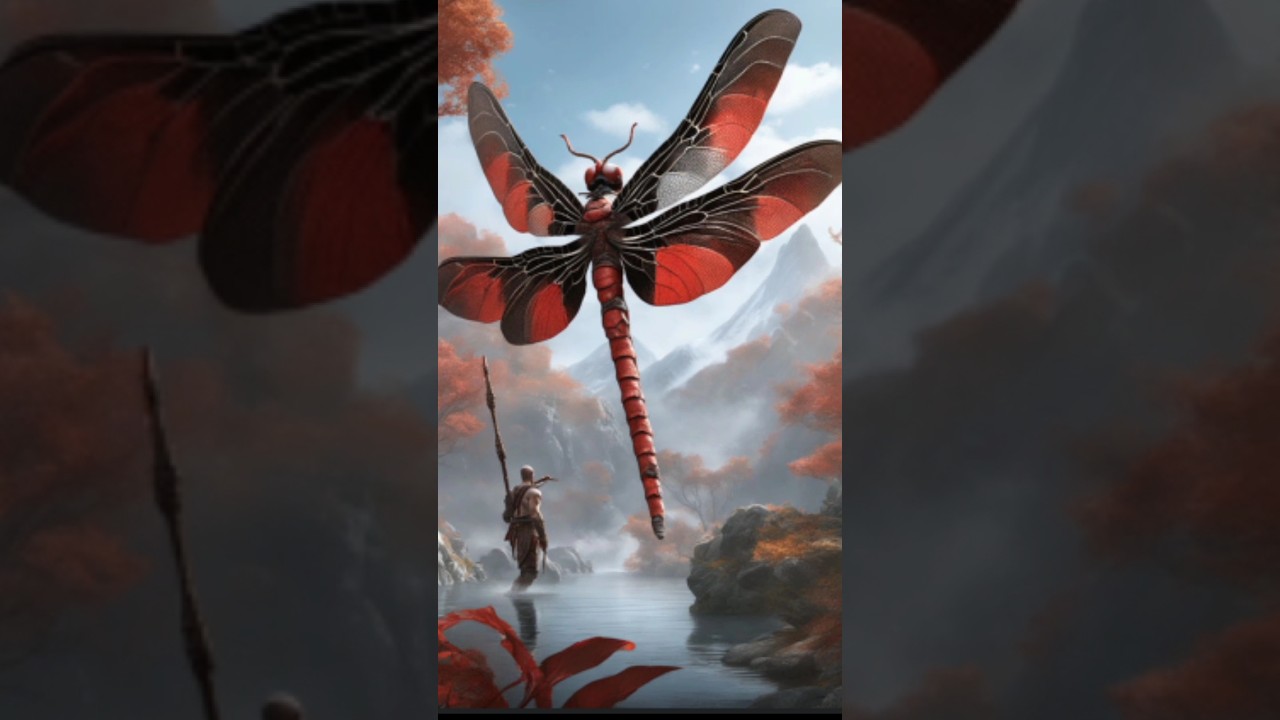
A dragonfly is a flying insect belonging to the infraorder Anisoptera below the order Odonata. About 3,000 extant species of dragonflies are known. Most are tropical, with fewer species in temperate regions. Loss of wetland habitat threatens dragonfly populations around the world. Adult dragonflies are characterized by a pair of large, multifaceted, compound eyes, two pairs of strong, transparent wings, sometimes with coloured patches, and an elongated body. Many dragonflies have brilliant iridescent or metallic colours produced by structural coloration, making them conspicuous in flight. An adult dragonfly's compound eyes have nearly 24,000 ommatidia each.
Dragonflies can be mistaken for the closely related damselflies, which make up the other odonatan infraorder (Zygoptera) and are similar in body plan, though usually lighter in build; however, the wings of most dragonflies are held flat and away from the body, while damselflies hold their wings folded at rest, along or above the abdomen. Dragonflies are agile fliers, while damselflies have a weaker, fluttery flight.
Dragonflies are predatory insects, both in their aquatic nymphal stage (also known as "naiads") and as adults. In some species, the nymphal stage lasts up to five years, and the adult stage may be as long as 10 weeks, but most species have an adult lifespan in the order of five weeks or less, and some survive for only a few days.[2] They are fast, agile fliers capable of highly accurate aerial ambush, sometimes migrating across oceans, and often live near water. They have a uniquely complex mode of reproduction involving indirect insemination, delayed fertilization, and sperm competition. During mating, the male grasps the female at the back of the head, and the female curls her abdomen under her body to pick up sperm from the male's secondary genitalia at the front of his abdomen, forming the "heart" or "wheel" posture. Dragonflies make use of motion camouflage when attacking prey or rivals.
Fossils of very large dragonfly-like insects, sometimes called griffinflies, are found from 325 million years ago (Mya) in Upper Carboniferous rocks; these had wingspans up to about 750 mm (30 in), though they were only distant relatives, not true dragonflies.
Dragonflies are represented in human culture on artefacts such as pottery, rock paintings, statues, and Art Nouveau jewellery. They are used in traditional medicine in Japan and China, and caught for food in Indonesia. They are symbols of courage, strength, and happiness in Japan, but seen as sinister in European folklore. Their bright colours and agile flight are admired in the poetry of Lord Tennyson and the prose of H. E. Bates.
Dragonflies and their relatives are similar in structure to an ancient group, the Meganisoptera or griffinflies, from the 325 Mya Upper Carboniferous of Europe, a group that included the largest insect that ever lived, Meganeuropsis permiana from the Early Permian, with a wingspan around 750 mm (30 in).[7] The Protanisoptera, another ancestral group that lacks certain wing-vein characters found in modern Odonata, lived in the Permian.[8]
Modern dragonflies do retain some traits of their distant predecessors, and are in a group known as the Palaeoptera, ancient-winged. They, like the gigantic griffinflies, lack the ability to fold their wings up against their bodies in the way modern insects do, although some evolved their own different way to do so. The forerunners of modern Odonata are included in a clade called the Panodonata, which include the basal Zygoptera (damselflies) and the Anisoptera (true dragonflies).[9] Today, some 3,000 species are extant around the world.
The relationships of anisopteran families are not fully resolved as of 2021, but all the families are monophyletic except the Corduliidae, and the Austropetaliidae are sister to the Aeshnoidea:


Информация по комментариям в разработке