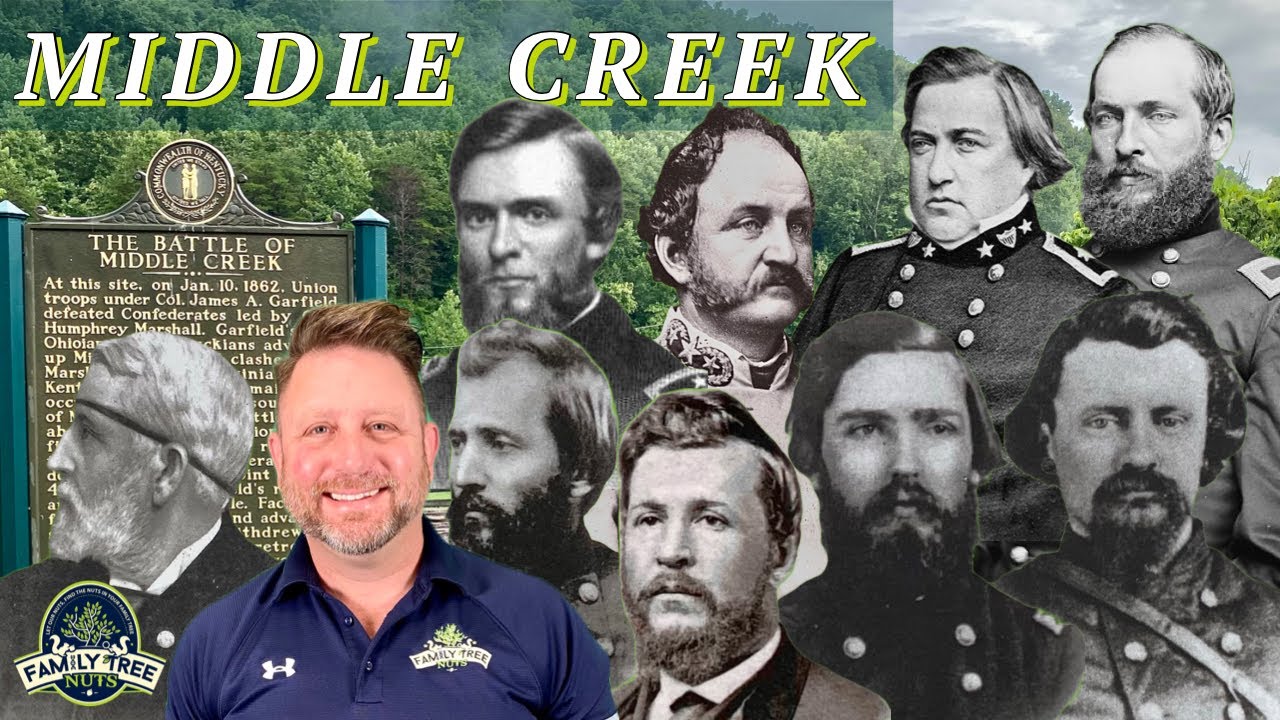
We visited the location of the Civil War Battle of Middle Creek, in Prestonsburg, Kentucky. This battle was early in the war an interestingly spring boarded the careers of many men.
Prominent secessionist men in Eastern Kentucky such as Jack May, Hiram Hawkins, Ezekiel Clay, James M. Thomas, Benjamin Desha, and others began to recruit men to form militia companies to fight for Southern Independence. In September 1861, these men marched their units to link up in Prestonsburg, at the Samuel May Farm, which was built by Revolutionary War veteran John May.
Former United States Vice-President John C. Breckinridge fled arrest in Lexington, and stopped by the Samuel May Farm and gave a moral boosting speech to the new recruits. Colonel John Stuart Williams took command of the Confederate forces being formed. Williams was also known as “Cerro Gordo” Williams for his heroic actions in the Mexican-American War.
The Union decided to act with a strong force. The Big Sandy Expedition began in mid-September 1861 when Union Brigadier General William “Bull” Nelson received orders to organize a new brigade in Maysville, Kentucky to conduct an expedition into the Big Sandy Valley region to cease the Confederate recruiting. Over the next few months, Nelson’s 5,500 troops split into two groups, one which pushed the Confederates out of Hazel Green, Kentucky, and the other out of West Liberty, Kentucky. The two-groups linked up in Salyersville, also known as Licking Station, and on November 7, 1861, the Battle of Ivy Mountain took place.
General Humphrey Marshall marched out of Wytheville, Virginia, through Pound Gap, and occupied Pikeville, Prestonsburg, and Paintsville. Union Major General Don Carlos Buell got word of the Confederate activity and sent Colonel James A. Garfield to take command of the 18th Brigade of the Army of Ohio to permanently drive the Confederates out.
General Marshall was pushed back from Paintsville to Prestonsburg, where he thought he could ambush Colonel Cranor’s men coming from Salyersville, but Cranor went to Paintsville, and fell in behind Garfield, to reinforced the battle later. Marshall set up his men on the ridges and hidden positions looking over the valley of Middle Creek.
Garfield expected an ambush and sent scouts slowly into the valley to identify where the Confederates troops were. Once Garfield knew the approximate positions of the enemy, he ordered his men to split into three groups and attack the ridge lines where the Confederates were set up to ambush the valley. Major Don A. Pardee’s men were pinned down by rebel sharpshooters. About this same time, Colonel Cranor arrived to link back up with the main force and Garfield ordered him to reinforce Pardee. Garfield then ordered Lieutenant Colonel George W. Monroe to select 120 Kentuckians to charge up the hill and assault the rebel sharpshooters. This detachment was quickly pinned down by the sharpshooters when Monroe ordered the men to fix bayonets and with loud yells they charged up the steep ridge to fierce combat of Kentuckian versus Kentuckian. Monroe’s men caused the rebels to fall back which opened the line for Pardee and Cranor to continue to advance. It is said Monroe’s charge likely determined the battles outcome.
The Confederates had artillery and the Union did not. This was thought to be an advantage for the rebels but ended up almost worthless. The artillery unit was formerly a militia unit from Nottoway County, Virginia and their ammunition had likely been in storage for more than twenty years which caused it to be faulty. Marshall was forced to retreat and fall all the way back into Virginia and give the Union the victory in the battle. The Confederates never again had as much of a hold on Kentucky as they did before this battle.
Check out our website at: www.familytreenuts.org
Contact us at [email protected]
#CivilWar #historychannel #history

Информация по комментариям в разработке