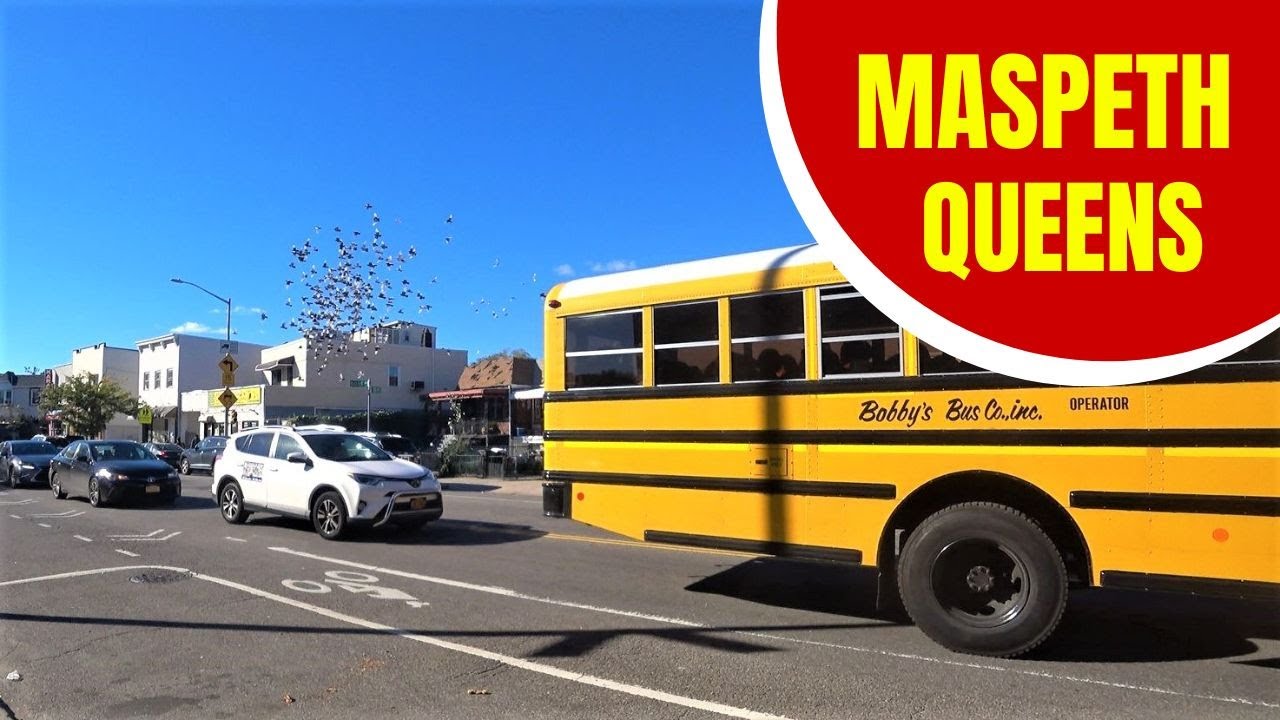
Just a short walk down Grand Ave in Maspeth, Queens today. Some low flying birds take over the last minute of the video. As I am posting some shorts this week, this isn't much more than a throwaway video. A good time to test out a new thumbnail design. The local school just finished when I filmed this, and I only speak for the last minute or so.
*The name "Maspeth" is derived from the name of Mespeatches Indians, one of the 13 main Indian tribes that inhabited Long Island. It is translated to mean "at the bad waterplace" relating to the many stagnant swamps that existed in the area.
The area known today as Maspeth was chartered by New Netherlanders and British settlers in the early 17th century. The Dutch had purchased land in the area known today as Queens in 1635, and within a few years began chartering towns. In 1642, they settled Maspat, under a charter granted to Rev. Francis Doughty, making Maspeth the first English settlement in Queens; the deed that was signed between the Native Americans and the settlers was the first one signed on Long Island. As part of the deed's signature, the "Newtown Patent" granted 13,000 acres (5,300 ha) to settlers. Conflicts with the Maspat tribe forced many settlers to move to what is now Elmhurst in 1643. The settlement was leveled the following year in an attack by Native Indians, and the surviving settlers returned to Manhattan.
In 1652, settlers ventured back to the area, settling an area slightly inland from the previous Maspat location. This new area was called Middleburg, and eventually developed into what is now Elmhurst, bordering Maspeth. Originally, 28 English Quakers had founded the village of Maspeth, which had sizable water and milling industries along Newtown Creek and Maspeth Creek. Two storekeepers, Nathanial Hazard and Francis T. White, sold food and clothes at the Maspeth Town Docks, at what is now 56th Terrace and Rust Street, by the late 18th century. After the American Revolutionary War, villagers repaved roads with crushed oyster shells or wooden planks.
Columbusville was the name formerly applied to a section of Maspeth. It was a development of Edward Dunn that took place on 69th Place (originally known as Firth Avenue) between Grand Avenue and Caldwell Avenue during 1854–55, and was subsequently absorbed into Maspeth. The name fell into disuse in the 1890s.
Following waves of immigration during the 19th century, Maspeth was home to a shanty town of Boyash (Ludar) Gypsies between 1925 and 1939, though this was eventually bulldozed. By the 1970s, the neighborhood had become home primarily to German, Irish, Lithuanian, and Polish residents. Maspeth was considered relatively safe compared to other New York City neighborhoods experiencing crime increases, and multiple generations of the same family often lived in Maspeth.
A sign at the intersection of Flushing, Grand, and Maspeth Avenues marks the place where streetcar lines (now the B57, Q58, Q59 bus routes) used to split.
On the front yard of the Church of the Transfiguration on Perry Avenue, a replica of a Lithuanian roadside shrine has stood since 1981.
St. Saviour's Church, built in 1847 at Rust Street and 57th Drive, was located on land formerly owned by lawyer and politician James Maurice. After a 1970 arson, it was cleaned up. However, by 2005, developers bought the church in order to demolish it, since the New York City Landmarks Preservation Commission had refused to landmark the church. This was largely opposed; however, its facade was torn apart, disassembled, and stored at All Faiths Cemetery by 2008. Despite community effort, led by the Juniper Park Civic Association, to make a park on the site, by 2011, the church's former site had become warehouses, while provisions for a new site for the church in All Faiths Cemetery had been approved.
The Ridgewood Gardens apartment/co-op complex, on a hill known as the Ridgewood Plateau, was built on 72 acres woods owned by James Maurice and donated to the Episcopal Church in 1850. Maurice Woods was bounded by Maurice Avenue, Jay Avenue, 66th Street, and Borden Avenue. 53rd Avenue went down a slope to 64th Street. The apartment complex was built later. It is notable for a step street that descends the hill, as well as for a very old, graffiti-covered lamppost on that street.
The Maspeth Theater, the neighborhood's largest theater in the 1920s, was built in 1924 at Grand Avenue and 69th Street by Straus and Strausberg, with 1,161 seats. It was owned by three companies before closing in 1965. Notable performers included Judy Garland. There were also many other theaters in Maspeth in the 1920s.
The Clinton Diner, at Maspeth and Maurice Avenues, was built in 1935 and is a truck stop that appeared in the movie Goodfellas, as well as in other movies. The Queens Head Tavern, nearby, was an American Revolutionary War-era tavern and was used as a stagecoach stop later on.
*https://en.wikipedia.org/wiki/Maspeth...

Информация по комментариям в разработке