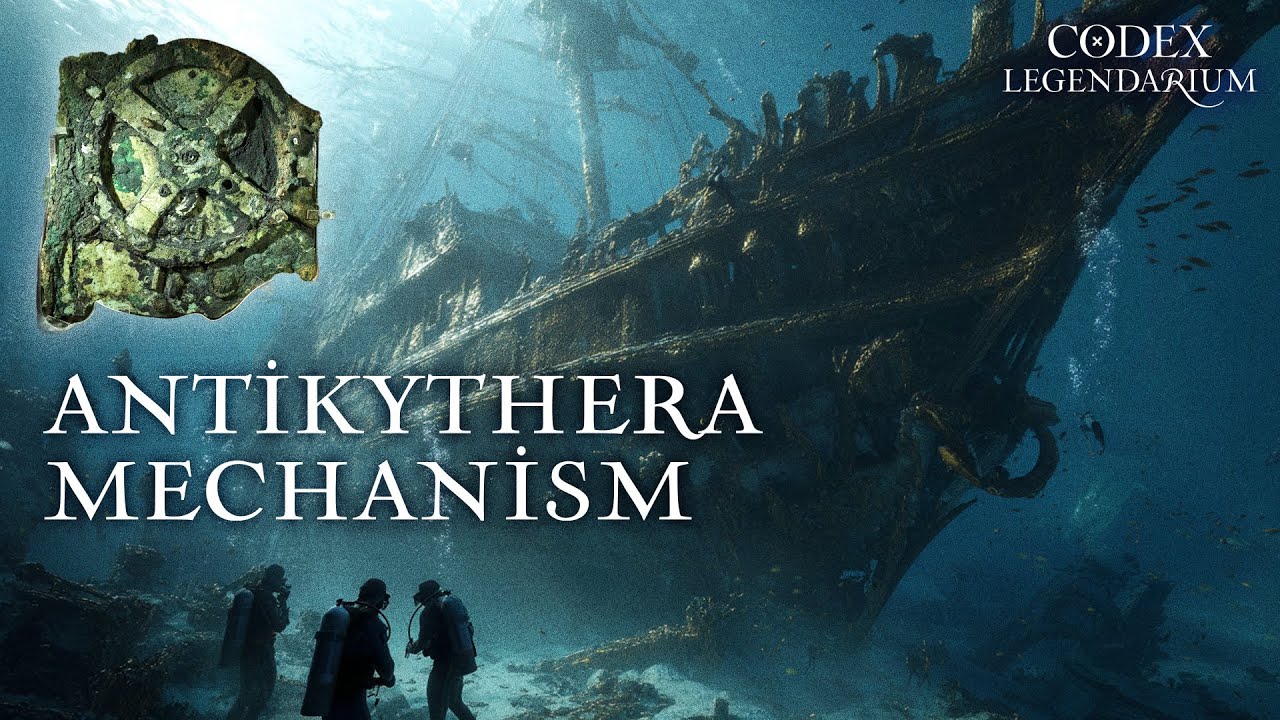
The world’s first computer is 2,000 years old, and survived two millennia at the bottom of the ocean.
Back in the year 1901, an unsuspecting group of divers made the discovery of a lifetime: a treasure-trove shipwreck off the coast of a small Greek Island. It was soon discovered that the coins, art, and marble statues recovered had been condemned to rest on the sea floor for over 2,000 years.
But alongside all that treasure was a strange lump of bronze, later called the Antikythera Mechanism. Little did we realize that it would defy everything we know about about ancient technology.
Advanced CT scans and X-ray machines revealed its secret. Concealed inside eons of corrosion was a machine, an advanced celestial map that charted the courses of the sun, moon, and planets—not only in the present, but in the future. And beyond that, it perfectly calculated major astronomical events like solar and lunar eclipses, and important dates like the start of the Olympic Games.
What really happened to this device, that kept it hidden from the world for 2 millenia? How did we discover there was a primordial computer hidden in a lump of corroded rock and metal? Why did the same event that spelled doom for the device become what saved it?
In this episode, enter the Codex Legendarium for a closer look at: the Antikythera Mechanism, the world’s first computer, one of the most mysterious shipwrecks in Greek history, ancient Greek astronomy, Babylonian astronomy, Derek J. de Solla Price, Tony Freeth, the movement of the planets, moon phases, the moon’s orbit, eclipses, heliocentric theory, elliptical orbit, the Metonic Cycle, the Saros cycle, the precision of ancient technology, and much more.
#antikytheramechanism #ancientgreek #computer
Информация по комментариям в разработке