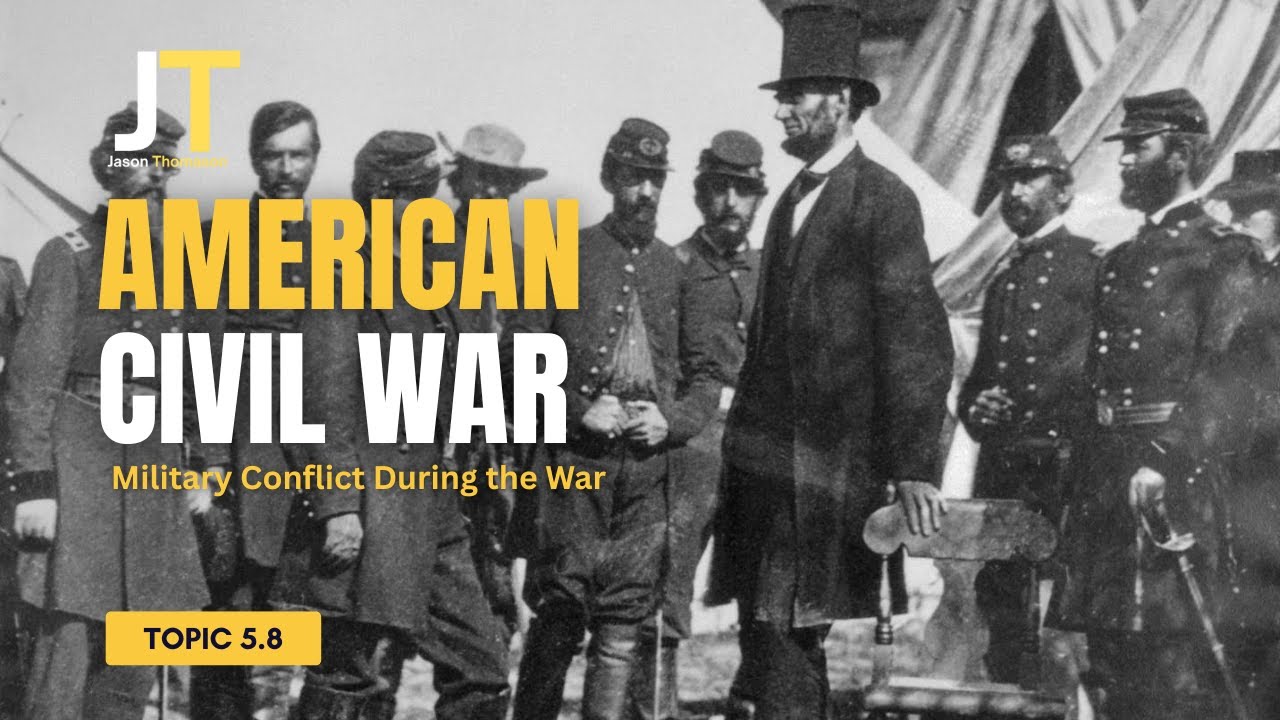
The American Civil War was more than a battle between North and South — it was a test of the nation’s identity, leadership, and will to survive. In this video lesson (5.8), “The Civil War: Conflict,” we trace the war’s most critical moments, from the shock of Bull Run to the decisive victories at Vicksburg and Gettysburg, revealing how strategy, industry, and determination shaped the Union’s path to victory.
Discover how the Union’s advantages in population, railroads, and manufacturing clashed with the Confederacy’s strong leadership and home-field resolve. Explore the Union’s four-phased plan for victory — including the Anaconda Plan, control of the Mississippi, and Sherman’s March to the Sea — that eventually crushed the Confederacy.
You’ll also learn about the 54th Massachusetts Regiment, the role of Black soldiers, and the human cost of the war that claimed more than 600,000 lives.
You may also like:
• 1864: From the Battlefields to the Ballot Box
What You’ll Learn:
The industrial and military advantages of the Union and Confederacy
The major strategies behind the Union’s four-phased plan for victory
The significance of the First Battle of Bull Run, Vicksburg, and Gettysburg
The role of Black soldiers and the creation of the Bureau of Colored Troops
How total war and leadership shaped the outcome of the Civil War
Why July 1863 marked the turning point of the war
Perfect for:
Students, teachers, history buffs, and anyone exploring the Civil War, U.S. history, or American military strategy.
Keywords: Civil War, Bull Run, Gettysburg, Vicksburg, Ulysses S. Grant, Robert E. Lee, Abraham Lincoln, Union vs Confederacy, Emancipation Proclamation, 54th Massachusetts, Reconstruction, American history, Civil War strategy, total war, Union victory, Black soldiers in the Civil War
#history #americanhistory #apush #africanamerican #education #money #power #war #teacher #teacherresources #usa #government #military #civilwar #america
Информация по комментариям в разработке