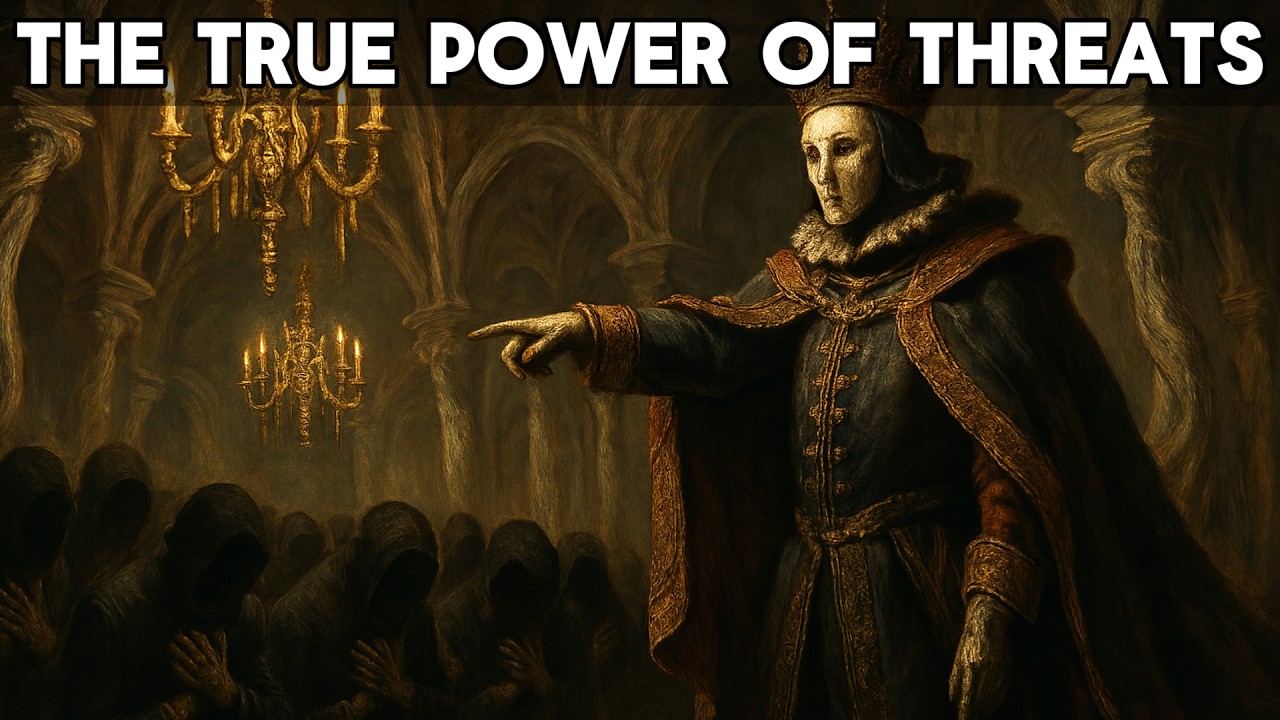
In today’s session, we will explore why threats often work better than punishments and what this reveals about dark psychology and human behavior. This video takes you deep into the hidden mechanisms of fear, showing how it shapes choices long before any punishment is ever delivered.
We will look at why threats influence behavior so powerfully, why punishments fail to create lasting change, and how fear conditioning, loss aversion, and subtle psychological control guide our actions in ways we rarely notice. You will also see how this plays out across history, in modern workplaces, on social media, and even within personal relationships.
This session is designed as an educative lecture, helping you recognize how much of your daily life is shaped by implied consequences rather than explicit rules. By understanding these forces, you can begin to see the quiet role fear plays in morality, power, and the choices people make every day.
👥 This Video Is Perfect For
Viewers curious about why threats control behavior more effectively than punishments.
People interested in how dark psychology explains fear-driven decisions in daily life.
Individuals noticing subtle power dynamics in workplaces, relationships, or social media.
Anyone questioning why implied consequences feel more powerful than explicit rules.
Thinkers exploring how fear conditioning and loss aversion influence human morality and compliance.
Audiences who enjoy deep, educative lectures on psychology, human behavior, and control systems.
⏱️ Timestamps
00:00:00 – The Silent Weight of Fear
00:04:58 – The Myth of Punishment as the Ultimate Control
00:13:32 – Understanding Threat Psychology
00:21:03 – Punishment and Its Psychological Limitations
00:28:29 – The Mechanisms That Make Threats Effective
00:36:11 – Authority and Power in Dark Psychology
00:43:09 – The Hidden Cost of Threat Environments
00:50:22 – Philosophical Dimensions of Fear and Threat
00:57:05 – Revealing the Dark Truth Behind Threats
01:03:58 – Modern Subtle Threats in Everyday Life
01:11:01 – The Lasting Grip of Fear and Power
📢 If this exploration gave you new insight into fear and power, share it with someone who might benefit from it. Comment with your thoughts on where you notice subtle threats in daily life, and subscribe for future deep dives into dark psychology and human behavior.
📚 Source References
Milgram, S. (1963). Behavioral study of obedience. Journal of Abnormal and Social Psychology, 67(4), 371–378.
Skinner, B. F. (1953). Science and human behavior. Macmillan.
Hobbes, T. (1651/1996). Leviathan. (R. Tuck, Ed.). Cambridge University Press. (Original work published 1651)
Foucault, M. (1975). Discipline and punish: The birth of the prison. Pantheon Books.
Baumeister, R. F., & Leary, M. R. (1995). The need to belong: Desire for interpersonal attachments as a fundamental human motivation. Psychological Bulletin, 117(3), 497–529.
Kahneman, D., & Tversky, A. (1979). Prospect theory: An analysis of decision under risk. Econometrica, 47(2), 263–291.
American Psychological Association. (2019). Physical punishment and mental health outcomes: Evidence, implications, and policy recommendations. APA Publications.
Bandura, A. (1977). Social learning theory. Prentice Hall.
⚠️ Disclaimer
This video is created for educational and informational purposes only. It is not intended to diagnose, treat, or encourage any form of harmful behavior. The content explores psychological and philosophical concepts to promote awareness and self-reflection. Viewer discretion is advised.
#DarkPsychology #Threats #HumanBehavior #FearResponse #PsychologyExplained #SocialControl #PowerDynamics #PsychologicalManipulation #MindControl #LossAversion #PsychologicalControl #Conditioning #ModernSociety #SurvivalInstincts #Authority #BehavioralPsychology #HiddenThreats #fear #MoralPhilosophy #Compliance #DarkTruth

Информация по комментариям в разработке