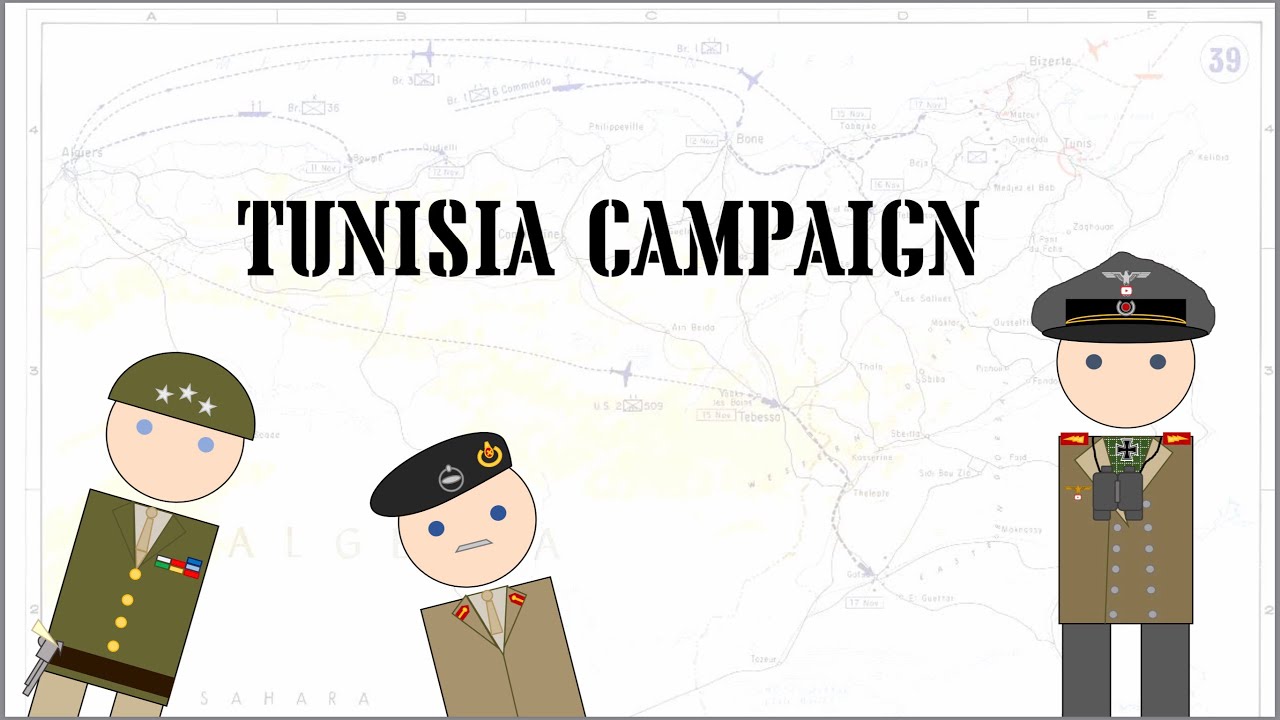
The Tunisia Campaign was a series of battles in North Africa from November 1942 to May 1943. It was one of the first big Allied pushes and started the collapse of the Axis, acting as a staging ground for further invasions and a major point in the careers of the triumvirate of great generals (Patton, Rommel, Montgomery).
If you enjoyed this video, please like and subscribe!
Instagram: / latemodernh. .
Twitter: / lmh_yt
Script:
By 1942, the Axis powers were at their height. The Allies needed to find a weakness in the seemingly unbeatable enemy, and found exactly what they were looking for in Africa.
After American and British forces landed in Operation Torch, pushing the Vichy French out, the Allies had a foothold in Africa. The defeat of the Vichy allowed an easy path through Libya right up to Tunisia. The French governor of Tunisia was reluctant to support either side, and so French airfields were totally open to both Axis and Allies. On November 17th, British and German forces made contact, with American, French, and Italian troops soon to enter the battle. The Allies met great resistance from Nazi forces, forcing both sides to ultimately retreat by December. December 10th saw the Allied forces up against not only about 200,000 Italian troops, but also terrible rain. Although they were severely lacking air support, the Allies took Longstop Hill, thus controlling the river corridor to get to Tunis by late December.
In January, the Allies launched a successful attack and cut off the German line of communication. British First Army commander, Kenneth Anderson, was appointed to coordinate the Allied attack by Eisenhower. Axis forces regrouped and began planning their defense of Tunis. Erwin Rommel and Giovanni Messe made plans to prevent an Allied attack from splitting their forces after losing Tripoli on January 23rd. In the Battle of Sidi Bou Zid, the Axis recaptured parts of Tunisia. On February 19th, Rommel led two Panzer divisions, the Afrika Korps, and Italian First Army, hoping to crush the Americans at the Kasserine Pass. It was a massacre, with the Allies losing ⅓ of their forces (about 10,000) to the Axis’s 2,000. His success led Rommel to believe only the British posed a threat and that he could easily defeat the Americans. Rommel was appointed head of Army Group Afrika, at behest of Albert Kesselring. After their defeat, the command of the II US Corps was passed to George S. Patton, with Omar Bradley his second-in-command.
The Axis launched a further attack at the Battle of Medenine. After being defeated by British, New Zealand, and French forces, Rommel decided it would be best to abandon Africa. After proposing this to Hitler, he was secretly put on “sick leave” and command shifted to Hans-Jürgen von Arnim. Bernard Montgomery, leader of the British forces, launched new offensives, winning at the Mareth Line and Wadi Akarit. The Battle of El Guettar saw Patton prove himself as Rommel’s equal and the Americans as a formidable opponent. Arnim foolishly believed the earlier victory at Kasserine Pass weakened the Allies. He regained some French held land, but was pushed back by the British. Arnim desperately tried another attack with Operation Ochsenkopf, but was met with yet another defeat.
By April of 1943, Allied forces had gained a foothold. Planes were moved forward and Admiral Cunningham of the Royal Navy arrived for naval support. The Americans led by Patton and the British led by Montgomery pushed toward the remaining Axis forces with help from the Free French, Polish, Greeks, and New Zealand (part of the British Commonwealth). On May 7th, Montgomery’s forces took Tunis and Patton’s took Bizerte. On May 12th, Mussolini order Messe to surrender. Arnim surrendered the next day.
The capture of Tunisia acted as one of many turning points in the war. The Italians began to crumble and the Germans learned they were not as invincible as they first thought. As Tunisia was the first major battle between American and German forces, it set the standard for German perception of the Americans. Not only was it the first time the three major generals of the war were in the same place, but it also set the stage for the remainder of their careers. Montgomery and Patton went on to lead more and more successful battles after their victories, and it was the first step to putting Rommel on Hitler’s bad side. Tunisia was later used as the staging ground for the Allied invasion of Sicily, thus was the first step in liberating Europe from the grip of the Axis powers.

Информация по комментариям в разработке