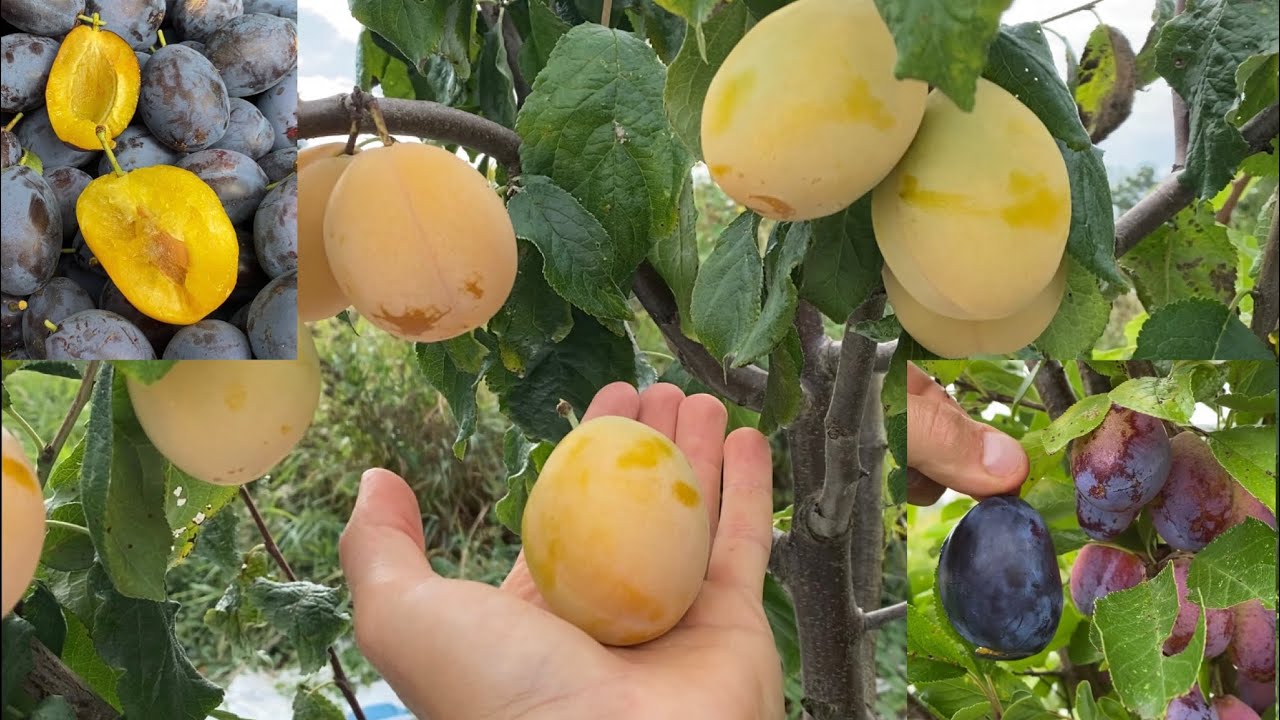
We believe this plum to be variety Warwickshire Drooper, but are uncertain. We found it growing in the garden of the first house we bought in Southampton in 1981, and took some suckers from it which grew true to variety (so it must have been growing on its own roots). We then grafted a few. As far as we can tell from books, it is either Warwickshire Drooper, Yellow Egg plum or Goldfinch, but it might be a new variety grown from a stone. We do not know, but it tastes great when fully ripe. Excellent also for cooking or preserves.
The lesson of this video is that many plums reach a better size when thinned, and ripen successionally, so you need to go over the tree and pick them as they become ripe, as revealed by subtle changes in colur. Don't pick them all at once.
This variety can be picked when it is green going on to yellow, and will then ripen in store. If you allow it to reach golden sugary perfection on the tree, with the red dots which denote utterly delectable ripeness, most likely rot and wasps will take over. Pick before perfectly ripe and allow to ripen in store.
PS you are very likely to be stung by a wasp while picking plums, look out for the wasp that has eaten into a hole in the plum, if you close your hand over it to pick it, you will be stung. If wasps are a big problem you can catch them in traps
PPS plum trees like this can yield an incredible amount of fruit sugar which cannot be all used as raw fruit for eating since plums do not store. There are various ways of preserviong plums-jam, chutney, freezing, drying (as prunes) and distilling to make eau de vie otherwise known as plum brandy or slivovicz. This is illegal in most countries, and if I had ever done it I wouldn't tell you, but I'm not a liar and actually I haven't. But I might if it was legal, and plum brandy is a truly lovely drink which could prevent the waste of plums which occurs in a good year when every grower has a huge crop which can't therefore be sold in time. Unless one is a determined tetotaller, there is a strong case for a more relaxed and reasonable approach to plum brandy. If growers knew there was a profitable outlet for gluts of fruit, plums woudl probably be more widely grown. They are a great fruit, but some years you get no crop due to frosted blossom, and other years there is a huge glut which wonlt travel or store, so uses like plum brabdy could grow the market, which incidentally would mean fresh plums should be more widely available, the lack of which has been bemoaned on British radio over the last week. Growers do not invest in plums as they are not always profitable: relaxed laws on plum brandy would make them more profitable, therefore more available.











Информация по комментариям в разработке