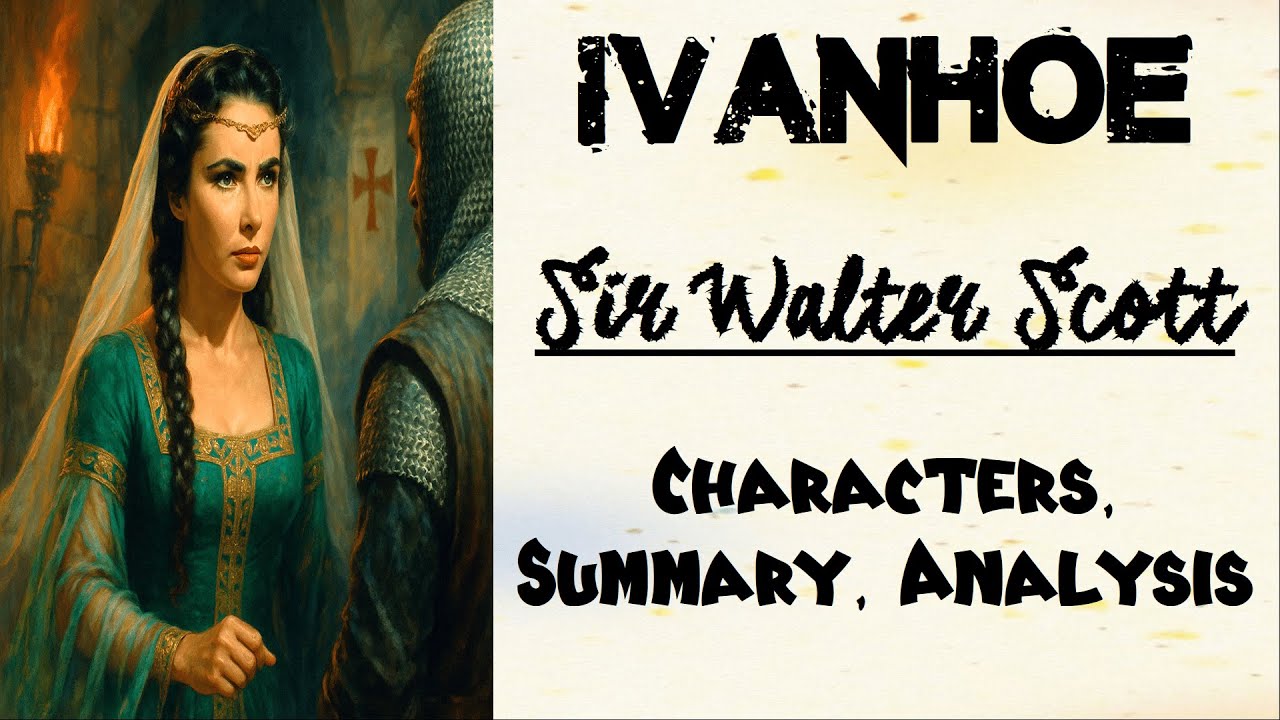
Ivanhoe (1819) is one of Sir Walter Scott’s most famous novels and a standout in his Waverley series, which largely focuses on Scottish history. Unlike the other novels in the series, Ivanhoe shifts to medieval England, exploring the tensions between Saxons and Normans after the Norman Conquest of 1066. This setting enables Scott to examine themes of chivalry, national identity, and cultural conflict within a distinct historical context.
The novel follows Wilfred of Ivanhoe, a disinherited Saxon knight, as he navigates a society dominated by Norman rulers. Key historical elements include the Crusades, the oppression of Saxons, and the legendary figure of Robin Hood. Scott blends romance, adventure, and historical detail, creating a vivid portrayal of 12th-century England.
Themes include the reconciliation of opposing cultures, the critique of feudal oppression, and the role of honor and loyalty. Unlike Scott’s Scottish novels, which often focus on Jacobite uprisings or clan conflicts, Ivanhoe emphasizes medieval pageantry and the mythic origins of English identity. Its success helped popularize historical fiction and cemented the romantic image of the Middle Ages in literature.
Ivanhoe was originally published in three volumes in 1819, following the standard publishing practice of the time for longer novels. The novel is divided into 44 chapters, with a roughly even distribution across the volumes. Volume 1 (Chapters 1-15) introduces the conflict between Saxons and Normans, Ivanhoe's return in disguise, and the tournament at Ashby-de-la-Zouche. Volume 2 (Chapters 16-31) deepens the political intrigue, including Prince John’s scheming, the kidnapping of Rowena and Rebecca, and the siege of Torquilstone Castle. Volume 3 (Chapters 32-44) resolves the main plotlines, featuring Rebecca’s trial, Richard’s return, and the restoration of order.
While the Waverley novels typically explore Scottish patriotism, Ivanhoe broadens Scott’s scope, making it a unique and influential work in his oeuvre.
.
.
.
So this is it for today. We will continue to discuss the History of English Literature as we strive to offer a complete course for the preparation of UGC NET English literature, NTA NET English literature, PGTRB English,, SET English literature, TGT PGT English, GATE English Literature, and other exams, please stay connected with the Discourse, Thanks, and Regards!

Информация по комментариям в разработке