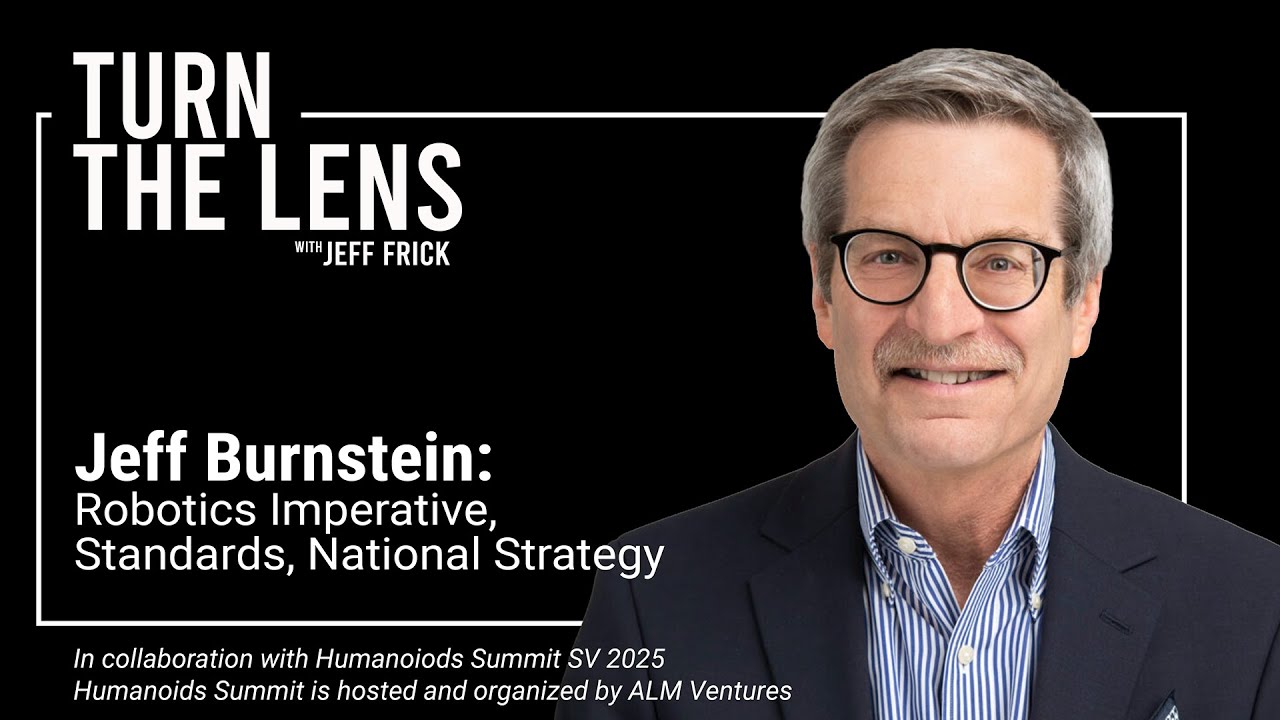
Jeff Burnstein, President of the Association for Advancing Automation (A3), reveals why eight countries have national robotics strategies while America doesn't—and what four decades of industrial robot history teaches us about humanoid adoption.
In this interview from Humanoids Summit SV 2025, Jeff explains the critical role of safety standards in commercialization, why Japan's 1960s strategy created sustained leadership while China dominates today, and how A3 is reframing "robotics" as "embodied AI" to gain traction in Washington D.C.
Key Topics:
• Why national robotics strategies drive competitive advantage
• Safety standards: from 1986 industrial robots to 2025 humanoids
• Cultural barriers: Hollywood's Terminator vs. Japan's friendly robots
• Hospital robotics: the under-recognized opportunity beyond manufacturing
• Historical lessons: hype cycles, dark periods, and realistic timelines
• Data privacy and AI training data issues for home robots
About Jeff Burnstein:
Jeff is President of the Association for Advancing Automation (A3), leading the organization's standards development, industry advocacy, and policy work including the push for a National Robotics Strategy. A3 developed the first American national robot safety standard in 1986, which became the basis for international ISO standards. With four decades in the robotics industry, Jeff witnessed the first industrial robot revolution and brings essential perspective on adoption cycles and commercialization barriers.
This interview is co-released by Turn the Lens and Humanoids Summit. Humanoids Summit is organized and hosted by ALM Ventures.
Recorded at the Humanoids Summit SV 2025, Computer History Museum, Mountain View, California.
For more on Humanoids Summit, including May 2026 in Tokyo visit
https://humanoidssummit.com/
For more from Humanoids Summit SV
• 🎙️ Lessons from the Industrial Robot Revol...
Resources:
Association for Advancing Automation (A3):
https://www.automate.org
World Robot Conference (Beijing):
https://www.worldrobotconference.com
More Humanoids Summit Interviews:
• Carolina Parada: Embodied AI, Gemini Robotics, Delightful Surprise | Turn the Lens Ep44
• Pete Florence: Generalist, Scaling Laws, Train One Improve All | Turn the Lens Ep46
• Nic Radford: Declining Labor, Generalizable Skills, Ready Market | Turn the Lens Ep47
• Ed Colgate: Soft Hands, Artificial Muscles, Large Contact Areas | Turn the Lens Ep48
• Chris Kudla, Mind Children
• Evan Wineland, Weave Robotics
• Jeremy Fishel, Sanctuary AI
• Joe Michaels, 1HMX
• Werner Kraus, Fraunhofer IPA
Timestamps:
00:00 - Waymo intro & collaboration announcement
02:18 - Welcome to Humanoids Summit 2025
02:55 - Jeff Burnstein introduction & 40 years of experience
03:10 - First industrial robot: 1961 GM factory
03:44 - Japan's early adoption & national strategy
04:09 - China's current leadership position
04:45 - Robots-as-a-Service business models
05:15 - Safety standards: the critical foundation
05:52 - Data privacy concerns for home robots
06:21 - A3's 1986 robot safety standard & ISO basis
06:51 - Developing humanoid safety standards today
07:32 - AI standards & training data provenance issues
08:02 - Cultural differences: Terminator vs. friendly robots
09:19 - Japan's cultural acceptance advantage
09:45 - World Robot Conference Beijing: 50 humanoid companies
10:40 - China's public acceptance strategy
11:07 - Hospital robotics: the underappreciated opportunity
12:01 - Home robots: specific purpose vs. humanoid form factor
12:34 - A3's 2026 priorities: National Robotics Strategy
13:07 - US vs. global competition: 8-10 countries have strategies
13:14 - Reframing robotics as "embodied AI" for Washington
13:41 - Most exciting time in four decade career
14:00 - Closing & wrap-up
#NationalStrategy #RoboticsPolicy #SafetyStandards #EmbodiedAI #IndustrialRobots #Humanoids #JeffBurnstein #A3 #HumanoidsSummit #RoboticsHistory #ChinaRobotics #JapanRobotics #Automation #ManufacturingRobotics #PolicyAdvocacy
Disclaimer and Disclosure
All products, product names, companies, logos, names, brands, service names, technologies, trademarks, registered trademarks, and registered trademarks (collectively, *identifiers) are the property of their respective owners. All *identifiers used are for identification and illustrative purposes only.
Use of these *identifiers does not imply endorsement.
Other trademarks are trade names that may be used in this document to refer to either the entities claiming the marks and/or names of their products and are the property of their respective owners.
We disclaim proprietary interest in the marks and names of others.
No representation is made or warranty given as to their content.
The user assumes all risks of use.
© Copyright 2026 Menlo Creek Media, LLC, All Rights Reserved

Информация по комментариям в разработке