Logo video2dn
  • Сохранить видео с ютуба
  • Категории
    • Музыка
    • Кино и Анимация
    • Автомобили
    • Животные
    • Спорт
    • Путешествия
    • Игры
    • Люди и Блоги
    • Юмор
    • Развлечения
    • Новости и Политика
    • Howto и Стиль
    • Diy своими руками
    • Образование
    • Наука и Технологии
    • Некоммерческие Организации
  • О сайте

Скачать или смотреть PitzDaily - OpenFOAM - LES vs k-Epsilon vs k-OmegaSST

  • louis vathan
  • 2024-04-24
  • 261
PitzDaily - OpenFOAM - LES vs k-Epsilon vs k-OmegaSST
Openfoamparaviewcfdsimulation
  • ok logo

Скачать PitzDaily - OpenFOAM - LES vs k-Epsilon vs k-OmegaSST бесплатно в качестве 4к (2к / 1080p)

У нас вы можете скачать бесплатно PitzDaily - OpenFOAM - LES vs k-Epsilon vs k-OmegaSST или посмотреть видео с ютуба в максимальном доступном качестве.

Для скачивания выберите вариант из формы ниже:

  • Информация по загрузке:

Cкачать музыку PitzDaily - OpenFOAM - LES vs k-Epsilon vs k-OmegaSST бесплатно в формате MP3:

Если иконки загрузки не отобразились, ПОЖАЛУЙСТА, НАЖМИТЕ ЗДЕСЬ или обновите страницу
Если у вас возникли трудности с загрузкой, пожалуйста, свяжитесь с нами по контактам, указанным в нижней части страницы.
Спасибо за использование сервиса video2dn.com

Описание к видео PitzDaily - OpenFOAM - LES vs k-Epsilon vs k-OmegaSST

Github: https://github.com/louisvathan/pitzDaily-O...

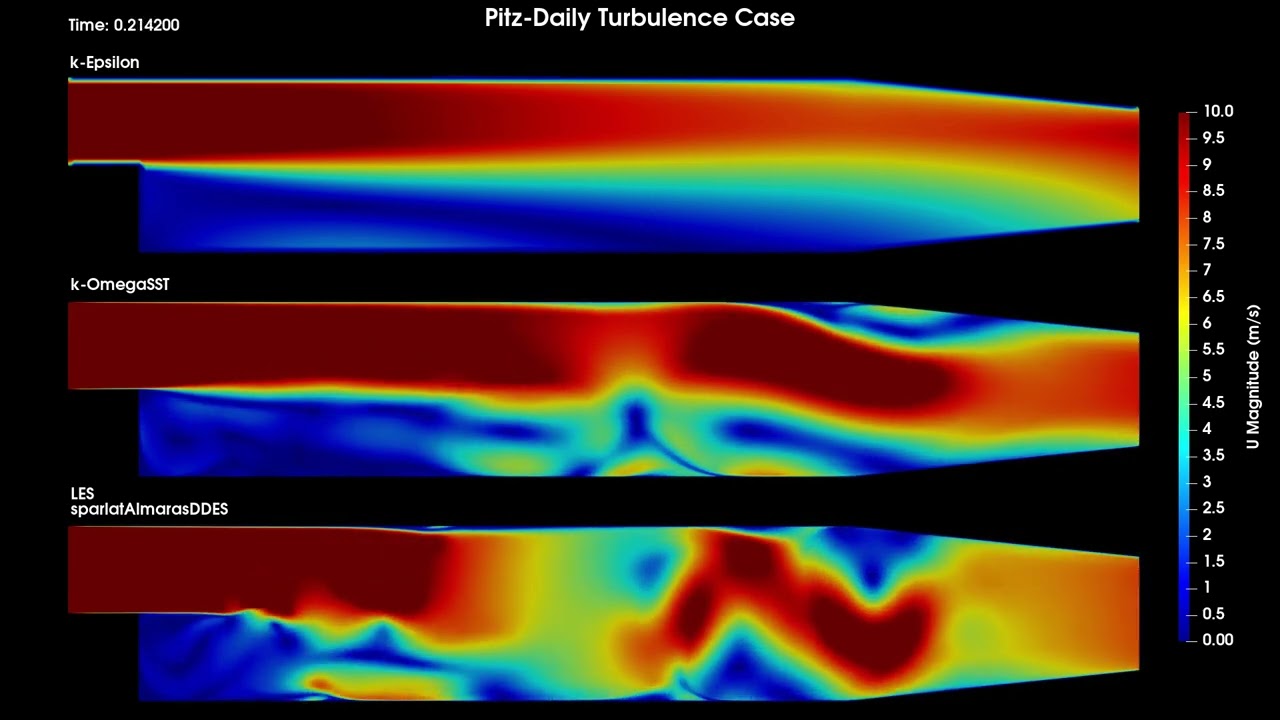
This simulation tries to replicate the turbulence case study performed by Robert W Pitz and John W Daily named “Experimental study of combustion in a turbulent free shear layer formed at a rearward facing step” in 1981
using OpenFOAM.

The flow is considered as incompressible, and the simulation is executed using the following turbulence
modelling techniques available in OpenFOAM.
➢ k-Epsilon
➢ k-Omega SST
➢ LES (Sparlat-Allmaras DDES)

The mesh sizes, solve times and results are compared between these turbulence models.

All these simulations are done using a transient solver called PimpleFOAM.

Since this is a 2d Case, the number of cells on the Z-direction is set to 1 cell with a depth of 1 mm for all the turbulence models.

Out of these turbulence models, k-Epsilon can handle large cell sizes which results in lower number of cells.

The mesh should be finer for K-OmegaSST model and much finer for the LES model.

The entire mesh is done using the blockMesh method in OpenFOAM. With the use of Simple Grading and Edge Grading options in the blockMesh, the small cell sizes near the walls are achieved.

A transient simulation is executed up to 0.5 seconds with a write interval of 0.0002 seconds.

Here the velocity is solved in first order using upwind differentiation.

To get better results, a specific range of y-plus values need to be maintained on the walls of the fluid domain.

The cell count and computation time are exponentially increasing from the k-Epsilon to k-Omega to LES modelling.

The vortices are well captured in k-Omega and LES models when compared to k-Epsilon model.

When selecting the turbulence model for any simulation a trade-off must be made between computational time and flow definition.

LES and k-Omega models are good if the flow definition is more important, but the computation time can be managed. k-Eplison model is good if the computational time needs to be reduced. But this comes at the cost of poor flow definitions in the fluid.

Комментарии

Информация по комментариям в разработке

Похожие видео

  • О нас
  • Контакты
  • Отказ от ответственности - Disclaimer
  • Условия использования сайта - TOS
  • Политика конфиденциальности

video2dn Copyright © 2023 - 2025

Контакты для правообладателей [email protected]