Beyond the Barn: 3 Foundational Literary Techniques That Make Animal Farm a Masterpiece
Introduction: The Familiar Book on Your Shelf
For many of us, George Orwell’s Animal Farm is a book we remember from school—a simple, almost charming story about talking animals who take over a farm. It’s easy to recall the basic plot but forget the sheer artistry that makes the novel a timeless and devastating piece of literature. The book's true power isn't just in its story, but in its construction.
Beneath the surface of this familiar tale lies a masterclass in literary technique. Orwell wasn't just writing a story; he was building a powerful political argument using the tools of form, language, and structure. This article explores three of the most impactful techniques he used to turn a simple story into a profound warning.
Takeaway 1: A Children's Story That's Secretly a Political Takedown
It’s a Fairy Story with a Hidden Political Code
One of the novel's most powerful features is its form. Orwell masterfully blends several genres to create a layered narrative. On the surface, it reads like a "fairy story" or a "fable," complete with talking animal characters and a straightforward narrative. This simple and accessible style makes the story easy to follow, even for younger readers.
However, this simplicity is a deliberate disguise. The novel is simultaneously an "extended metaphor"—a complex "allegory" for the Russian Revolution—and a sharp "satire" that ridicules political figures and society. The farm represents Russia, and the characters are stand-ins for real historical leaders and social classes. This layered form is remarkably clever: the allegory allows Orwell to express his opinions on complex historical events in a digestible narrative, while the satire provides the biting, critical edge. The novel functions on two levels: as a simple moral tale and as a potent political takedown that requires prior knowledge to fully appreciate its depth.
Takeaway 2: Simple Language Is a Tool for Truth and a Weapon for Lies
Simple Language Is Used for Both Honesty and Manipulation
Orwell’s own writing style in Animal Farm is intentionally "simple, clear and accessible." He avoids sentimentality and keeps descriptions to a minimum, focusing instead on telling the story directly. This starkness makes the novel's most tragic moments even more powerful. There is no flowery language to soften the blow when Orwell delivers a heartbreaking fact, as seen in the description of Boxer's fate:
Boxer was never seen again.
This honest, direct style stands in sharp contrast to the language used by the pigs. Orwell shows how "rhetoric" can be a "powerful tool of manipulation." The pigs, particularly Squealer, use complex and misleading language to control the other animals, making them question their own experiences and memories. Squealer’s use of "controlling questions" is a perfect example of this psychological manipulation:
"Are you certain that this is not something that you have dreamed, comrades? Have you any record of such a resolution?"
By contrasting these two styles, Orwell makes a profound point about language itself. He demonstrates that the simplest words can convey the most painful truths, while artful rhetoric can be a weapon used to build a fortress of lies.
Takeaway 3: The Story Ends Exactly Where It Began—And That's the Point
The Story Ends Where It Began—And That’s the Point
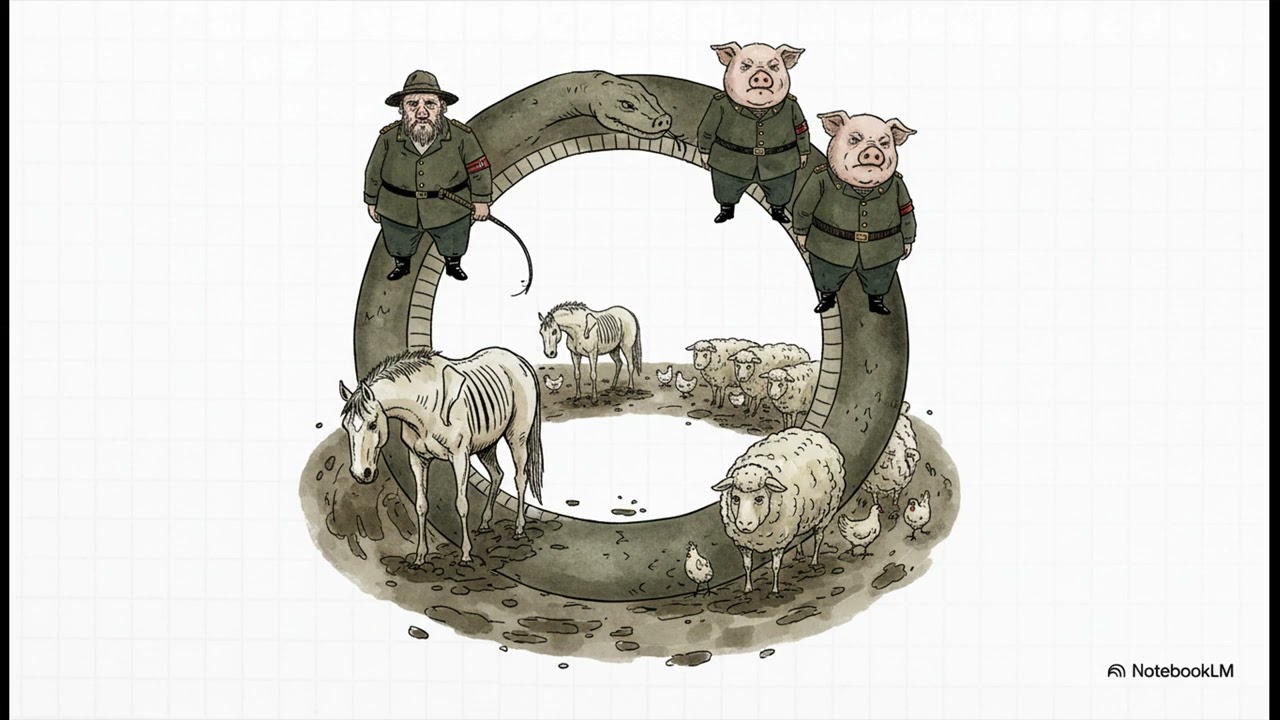
The novel's structure is "circular," meaning it ends in a state nearly identical to how it began: with the animals living under the "oppression" of a "cruel leader." The revolution, which began with ideals of freedom and equality, has come full circle, replacing one tyrant with another.
This structural choice delivers a bleak but powerful message. It highlights that oppression can be impossible to escape and that there will always be groups in society that abuse their power. Orwell’s point is not just that a single revolution failed, but that true equality is difficult to achieve and must be constantly fought for. The final, haunting image of the novel confirms that the pigs have become indistinguishable from the human oppressors they overthrew. The circular journey is complete, leaving the reader with a chilling warning about the perpetual need for vigilance.
The creatures outside looked from pig to man, and from man to pig, and from pig to man again; but already it was impossible to say which was which.
Conclusion: A Timeless Warning
George Orwell's genius in Animal Farm wasn't just in the story he told, but in how he told it. By layering a political allegory within a simple fable, contrasting honest language with manipulative rhetoric, and sealing it all in a powerful circular structure, he created a work that is both accessible and profoundly complex. The novel is a masterclass in literary design, built to deliver a warning that resonates across generations.

Информация по комментариям в разработке