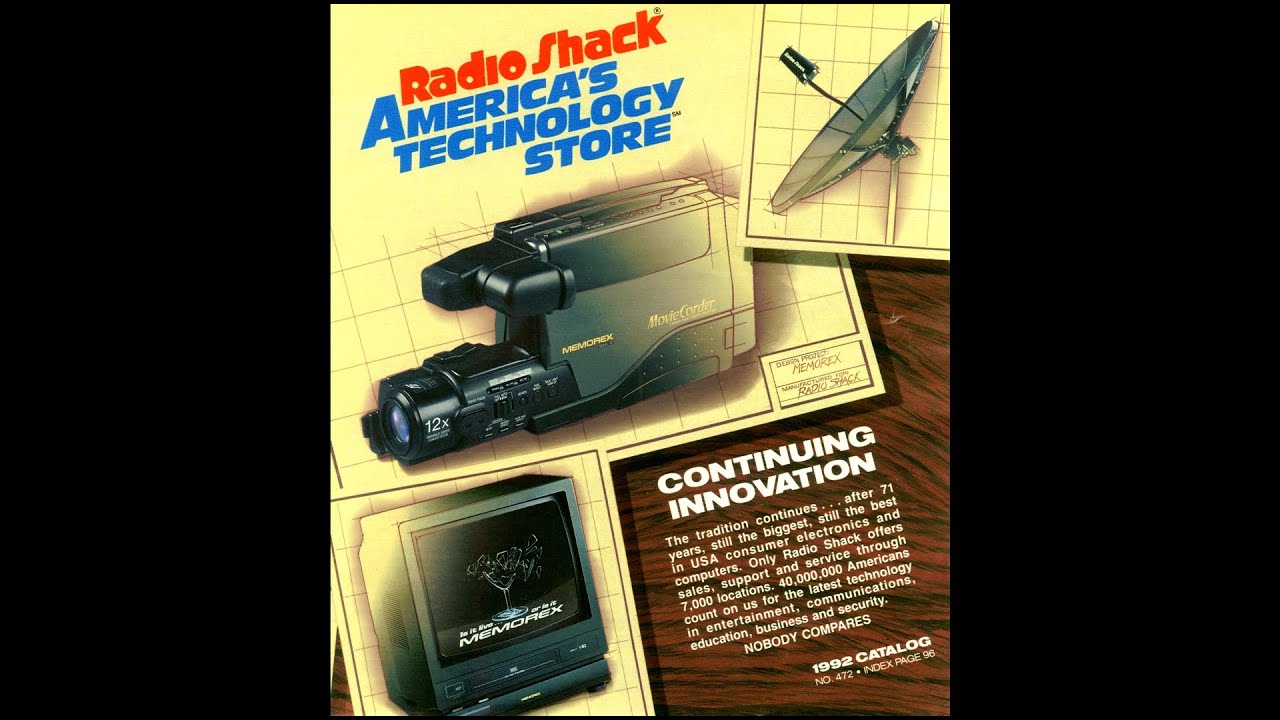
An archive of vintage Radio Shack Catalogs! All catalog pages are displayed in 1080p HD (high definition). To view text clearly, set your YouTube setting to display 1080p HD.
Visit www.RadioShackCatalogs.com to view the complete RADIO SHACK CATALOG ARCHIVE, and see...
■ 1939-2002 RadioShack Full-Line Products Catalogs
■ 2003-2011 RadioShack Electronic Parts & Accessories Reference Guides
■ 1977-1992 Tandy Computer & Computer Related Catalogs (including the TRS-80 computer line)
■ 1950-2012 RadioShack Sale Catalogs/flyers (domestic & foreign)
■ 1970-2011 RadioShack TV commercials (videos)
■ 1925-2006 RadioShack Electronic Parts & Accessories Advertisements
■ Vintage Photos of Radio Shack Stores & Hi-Fidelity Show Rooms
■ Tandy Computer "Whiz Kids" Comic Books
■ RadioShack Historical Data
■ RadioShack Memorabilia
Authorization to the use of RadioShack related content has been expressly granted to RadioShackCatalogs.com to maintain historical records of RadioShack Corporation.
-----------------------------------------------------------------------------------------------------------------------------------------------
** A BRIEF HISTORY OF RADIO SHACK CORPORATION **
In 1919, in Fort Worth, Texas, with a chance meeting of two friends, Norton Hinckley and Dave L. Tandy (1889-1966). During their visit, these ambitious young fellows decided to pool their resources and go into business together.
Two years later (1921) and half a continent away, two London-born Bostonian brothers, Theodore and Milton Deutschmann, opened a one-store retail and mail-order operation in the heart of downtown Boston. These young immigrant brothers wanted to provide amateur and ham radio equipment to the public; much of it was leftover Army gear. To pursue their interests, the brothers opened a retail store (a block from the site of the Boston Massacre). William Halligan, one of Deutschmann's first employees and later the founder of Hallicrafters, suggested the name, “Radio Shack”. They chose the name, "Radio Shack," which was a term for the room that housed a ship's radio equipment.
Beginning in 1921, Radio Shack would grow to a handful of stores clustered in the Northeast, and become a leading electronics mail-order distributor to hobbyists. This is how it would remain until the company and a young Texan named Charles Tandy crossed paths four decades later.
Meanwhile, the Hinckley-Tandy Leather Company grew modestly through the years. Although the company survived the Great Depression, it was nearly crippled when World War II began in 1941.
Mr. Tandy's oldest son, Charles D. Tandy (1918-1978), while serving in the Navy during the war, observed how leathercraft was used as a therapeutic tool for patients in military hospitals and by servicemen in recreation and rehabilitation centers. He told his father that leathercraft was the way to steer the company during the war years – and to prepare for what he believed would be a healthy, new, post-war hobby market.
In 1938, Radio Shack issued its first catalog when it entered the high-fidelity music equipment market.
In 1947, it opened the nation's first audio showroom; providing amplifiers, speakers, turntables, phonograph cartridges, and the like.
In 1954, Radio Shack began to sell their private-label products under the brand name Realistic®.
By the 1960s, Radio Shack had expanded to become a leading distributor of electronic parts and products around the world.
In 1963, Charles Tandy, bought the company for the equivalent of $300,000 cash.
The '70s proved to be a decade of incredible growth for Radio Shack. The incredibly popular citizen-band (CB) radios, were one of its top selling items.
Following the highly successful citizen-band (CB) radios in 1977, Radio Shack introduced the first mass-produced personal computer: the TRS-80® microcomputer - Only $599.95. This computer was the creation of a 24-year-old engineer named Steve Leininger.
In contrast to build-it-yourself units available at the time, the TRS-80 was fully wired and tested. Although a primitive machine by today's standards, it was a technological and price breakthrough, and overwhelming customer demand caused a production backlog that lasted for months. Over 200,000 TRS-80 Model I computers were sold from 1977 to 1981.
The '80s continued to make Radio Shack the "biggest name in little computers". Radio Shack offered the first affordably priced stereo receiver with digital technology, the first mobile/portable cellular telephone and the first high-performance satellite TV system that could be installed by the do-it-yourselfer.
The '90s brought an explosion in personal communications. The company invented the Family Radio Service (FRS), which uses license-free 2-way personal radios. RadioShack sold more wireless phones than any other retailer.
...to read more about the history of RadioShack Corporation, visit www.RadioShackCatalogs.com

Информация по комментариям в разработке