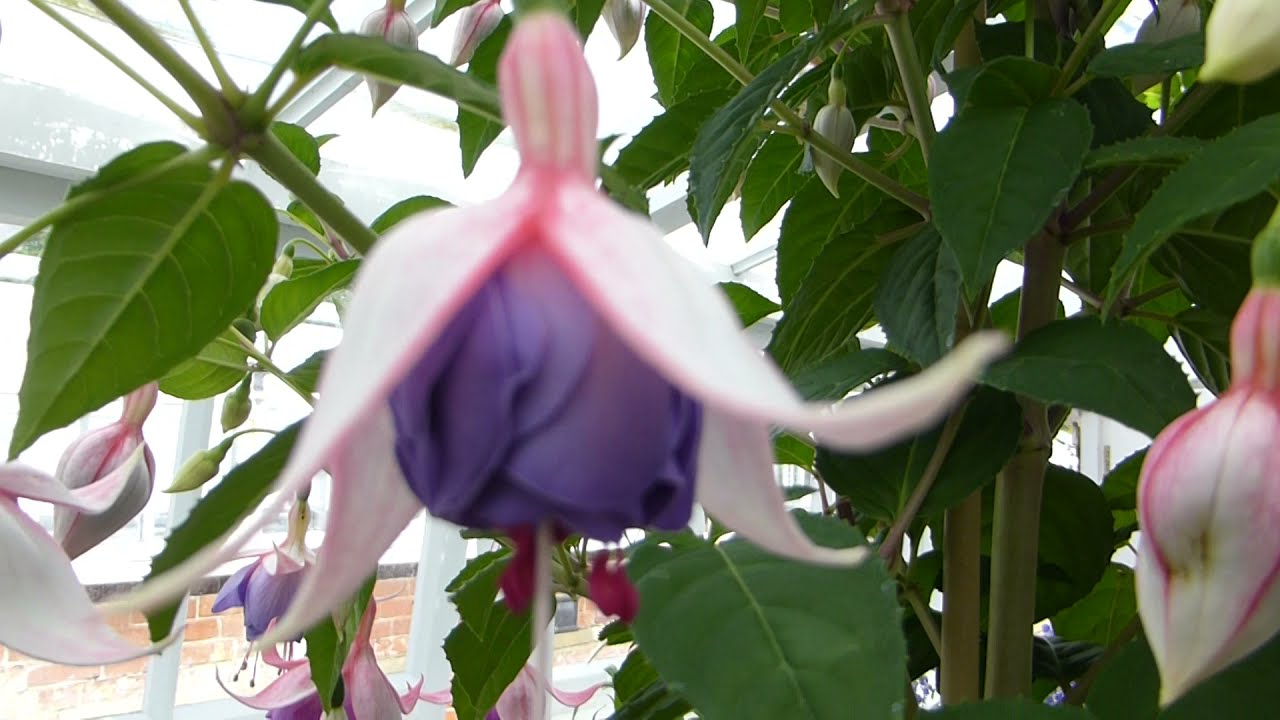
West Dean Gardens - Fuschia - Fuchsia eleanor Sinton - Blóðdropi Krists - Tárablóm - Fuksía - Bush Fuchsia - Fúksía - Garðafúksía - Fúsía - Fúxía - Fúshia - Fuschia Plants - Onagraceae - Eyrarósarætt - Pottaplöntur - Stofublóm - Garðyrkja. Bush Fuchsia with large double pink and lavender flowers. Almost 110 species of Fuchsia are recognized.
Blómstrandi runnar - Eitt blóm, fúxía, eða blóðdropi Krists eins og þessi planta er kölluð á íslandi. Þetta er í rauninni inniplanta sem þolir mjög vel að vera úti í eins konar sumarfríi. Hún fer vel í kerum á verönd þar sem er gott skjól. Hún fer líka vel í hengipottum. Svo þegar kólnar er tilvalið að taka plöntuna aftur í hús," sagði Lára Jónsdóttir garðyrkjufræðingur. : http://timarit.is/view_page_init.jsp?...
The first fuchsia species were introduced into English gardens and glasshouses at the end of the 18th century. Fuchsia coccinea Aiton arrived at Kew Gardens in 1788 to be formally described in 1789. It was apparently shortly followed by Fuchsia magellanica Lam. There is much early confusion between these two similar-looking species in the Quelusia Section and they seem to have hybridized readily as well. Fuchsia magellanica, however, proved very hardy outdoors and its cultivars soon naturalized in favorable areas of the British Isles. Other species were quickly introduced to greenhouses. Of special interest is the introduction of Fuchsia fulgens Moç. & Sessé ex DC in the 1830s as it resulted in an outpouring of new cultivars when crossed with the existing species. See more: https://en.wikipedia.org/wiki/Fuchsia
The first, Fuchsia triphylla, was discovered on the Caribbean island of Hispaniola (present day Dominican Republic and Haiti) in about 1696-1697 by the French Minim monk and botanist, Charles Plumier during his third expedition to the Greater Antilles. He named the new genus after the renowned German botanist Leonhart Fuchs (1501--1566). Fuchsia leaves are opposite or in whorls of 3--5, simple lanceolate and usually have serrated margins (entire in some species), 1--25 cm long, and can be either deciduous or evergreen, depending on the species. The flowers are very decorative; they have a pendulous "teardrop" shape and are displayed in profusion throughout the summer and autumn, and all year in tropical species. The ovary is inferior and the fruit is a small (5--25 mm) dark reddish green, deep red, or deep purple berry, containing numerous very small seeds. : http://en.wikipedia.org/wiki/Fuchsia
Fuschias are commonly used to attract hummingbirds.
Should always be brought under cover for winter as the main stem is prone to frost damage even if the variety is considered hardy. A balanced, liquid fertiliser used in summer encourages better blooms over a long flowering period. The fruit of all species and cultivars of fuchsia are edible but the quality is variable: some are tasteless, others have an unpleasant aftertaste. The fairly large fruit of Fuchsia splendens are reputedly the most worthwhile, having a citrusy, peppery tang. They are best used for jam. See more: https://www.rhs.org.uk/advice/profile...
West Dean Gardens has an impressive collection of thirteen working Victorian glasshouses built by Foster and Pearson. There is always colour on display from the large collection of plants including exotic plants, orchids, strawberry plants, figs, nectarines, peaches, gourds, grapes and melons. The splendid glasshouses were all built between 1890 and 1900 and were completely derelict before their restoration in the early 1990s. They are magnificent examples of Victorian craft and ingenuity. They are repainted on a four year cycle; the exteriors over summer, when the weather is kinder, and the interiors over winter, when the glasshouses can be emptied. In addition, they are hand scrubbed from top to bottom, inside and out, each winter, a process that takes two gardeners two months to complete. The glasshouses are heated by a woodchip burning boiler which also heats the College and associated buildings using woodchips produced from West Dean Estate's commercial forestry. See more: https://www.westdean.org.uk/gardens/e...
Nestled at the foot of the South Downs, West Dean Gardens in West Sussex is one of the greatest restored gardens open to the public today. Visitors can explore a wide range of historic features on a gentle walk around the grounds. From surreal trees to the restored walled garden, West Dean Gardens proudly presents its rich creative and social heritage. Creatively inspired by its rich heritage and setting. For a day out near Chichester West Dean Gardens is brimming with features to enjoy. An impressive collection of working Victorian Glasshouses, a 300 foot pergola, a spring garden with flint bridges and the occasional surreal fibreglass tree offer year-round interest to garden visitors. See more: https://www.westdean.org.uk/gardens

Информация по комментариям в разработке