October 14, 2025
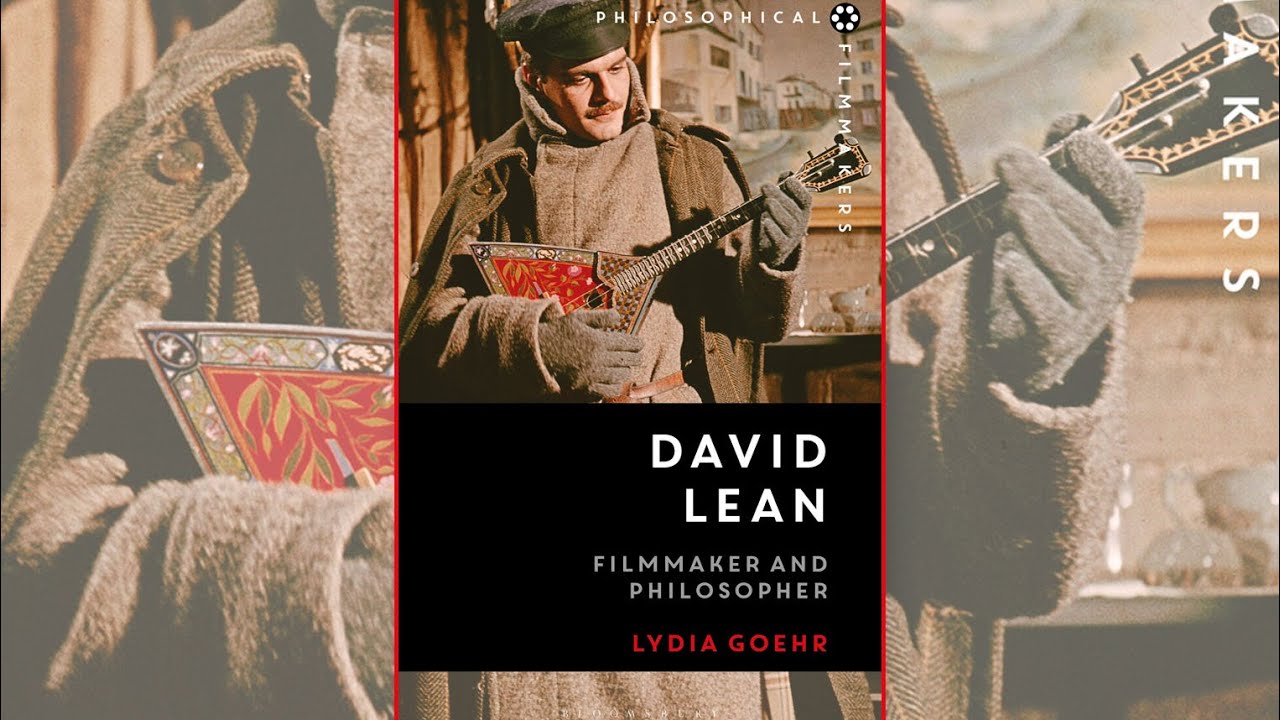
David Lean: Filmmaker and Philosopher
by Lydia Goehr
David Lean's extraordinary films work philosophically through the modern reproductive and transportive technologies of sight and sound: through trains, planes, ships, and automobiles, from one perspective, and through the modern technology of the radio and gramophone, from another.
Lean's musical motifs are known worldwide: Lara's theme in Zhivago; the Colonel Bogey March in Kwai; Estella's motif in Great Expectations; Rosy's motif in Ryan's Daughter; Lawrence's motif for his adventure in Arabia, and of course Rachmaninoff's pounding chords in Brief Encounter. When, however, Lean described his cutting of pictures as akin to how music flows through pictures, what sort of music or musicality had he in mind: a classical or popular music, or a way of using musical form to mix up the meaning and material of his films?
Lydia Goehr's new book tracks the soundscape in Lean's films not only through the musical scores composed for the films, but also, and more, through the technology of radio and gramophone that, at the start of Lean's career, were becoming indispensable household items for the home. The book begins and ends with a motif running from the early more domestic films locally situated in the English home to the later more extensive epics of colony, commonwealth, and empire. The fidelity-infidelity relationship defined by marriage extends to the loyalty-betrayal relationship regarding countries of war and peace-after which this relationship is extended to the witty British manner of making film as a perfected and not so perfected symphonic work of a great cutter's art. Here, as few other books on Lean have emphasized, the influence of Noel Coward on Lean cannot be overestimated.
About the Author
Lydia Goehr is Fred and Fannie Mack Professor of Humanities in the Department of Philosophy at Columbia University. She is currently chair of the Department of Philosophy. Her university awards include: Lenfest Distinguished Columbia Faculty Award (2009/2010). She is a recipient of Mellon, Getty, and Guggenheim Fellowships, and in 1997 was the Visiting Ernest Bloch Professor in the Music Department at the University of California at Berkeley, where she gave a series of lectures on Richard Wagner. In 2024 and 2025, she was a Visiting Professor at École Normale Supérieure in Paris. In 2022-23, she was a Visiting Fellow at the Max Planck Institute (Empirical Aesthetics) in Frankfurt and taught at the Courtauld Institute, London. in 2020, she was a Mellon fellow at the Tate Museum in London and, in 2019, a Visiting Professor at the University of Torino.
About the Speakers
Taylor Carman is a Professor of Philosophy at Barnard College. Carman is the author of Heidegger’s Analytic (2003) and Merleau-Ponty (2008; 2nd ed. forthcoming) and has coedited The Cambridge Companion to Merleau-Ponty (2005). He has published articles on topics in phenomenology and is currently writing a book on Heidegger.
Daniel Herwitz is the Frederick G. L. Huetwell Professor of Comparative Literature, History of Art, Philosophy, and Art & Design. He received the PhD in Philosophy from University of Chicago in 1984, and has been teaching at the University of Michigan since 2002. He is the author of The Star as Icon (Columbia Press, October 2008), Key Concepts in Aesthetics (Continuum Press, 2008), Race and Reconciliation (University of Minnesota Press, 2003), Making Theory/Constructing Art: On the Authority of the Avant-Garde (University of Chicago Press, 1993), and Husain (Tata Press in India, 1987).
Francey Russell is an Assistant Professor of Philosophy at Barnard College. She joined the department in 2019. She works on issues in moral psychology and ethics broadly construed, often overlapping with topics in social philosophy and aesthetics, and drawing from contemporary and historical sources. In terms of figures, she works mostly on Kant and Freud, but also Nietzsche and Cavell.
Benjamin Steege is an Associate Professor of Music at Columbia University. He studies theoretical discourses around music in the nineteenth and twentieth centuries, with particular attention to problems in the history of listening, history of science, phenomenology of music, and film music. He is the author of Helmholtz and the Modern Listener (Cambridge University Press, 2012) and An Unnatural Attitude: Phenomenology in Weimar Musical Thought (University of Chicago Press, 2021). His research has been supported by fellowships from the Max Planck Institute for the History of Science, the Alexander von Humboldt Foundation, the National Endowment for the Humanities, and the Radcliffe Institute for Advanced Study at Harvard University.
https://sofheyman.org/events/celebrat...













Информация по комментариям в разработке