Today we take a walking tour through the streets of Prague's Old Town! The weather today is very windy; apologies for the noise in the microphones.
03:00 Pařížská Street traverses the Jewish Town of Prague, connecting Old Town Square with Čechův Bridge. It is lined with stately townhouses whose façades combine historicist features with the decorative detail of Art Nouveau. Pařížská Street in Prague is the most prestigious boulevard, home to a wide range of luxury boutiques representing the world's most prominent fashion brands.
https://goo.gl/maps/szRUrVPscXz184HC9
07:30 The Old Town Square is the oldest and most important square in historical Prague. It is surrounded by historical buildings such as the Old Town City Hall with the famous Astronomical Clock, the imposing St. Nicholas Church and Church of Our Lady before Tyn, and many houses and palaces of various architectural styles and colorful history. It has been a center of Prague's Old Town since the middle ages when it was a marketplace crossing European merchants' roads. The first houses were built around the Old Town Square in the 12 and 13 centuries. Some present homes still have Romanesque or Gothic foundations, basements, or ground floors. The Old Town City Hall was built in the 14 century and the Church of Our Lady before Tyn a little later. The Old Town Square became Prague Old Town's economic and political center.
https://goo.gl/maps/5p7mgsjJ9zqtHYAC9
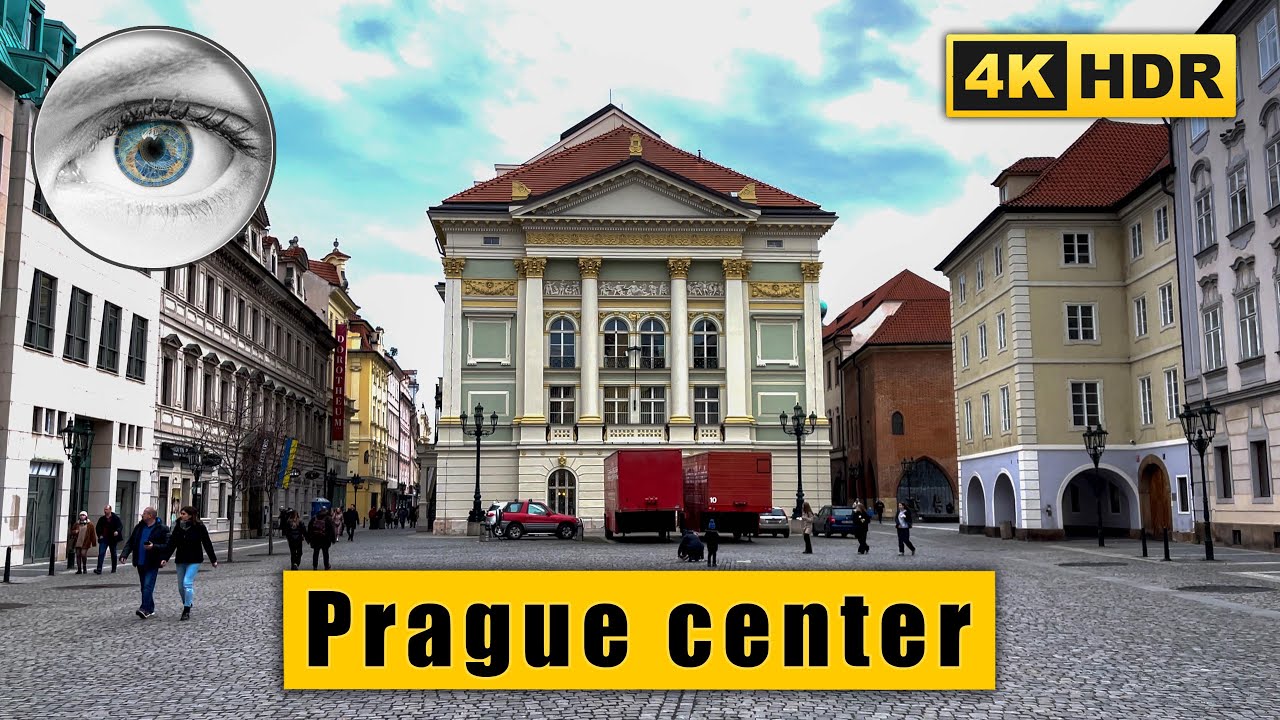
18:50 The Estates Theatre or Stavovské divadlo is a historic theater in Prague, Czech Republic. The Estates Theatre was annexed to the National Theatre in 1948 and currently draws on three artistic ensembles, opera, ballet, and drama, which perform at the Estates Theatre, the National Theatre, and the Kolowrat Theatre [cs] (separate building, Kolowrat Palace). The Theatre was built during the late 18th century in response to Enlightenment thought regarding public access to the Theatre, and theatres themselves demonstrate a nation's cultural standards. The Estates Theatre was designed by Anton Haffenecker and built in a little less than two years for the aristocrat František Antonín Count Nostitz Rieneck. Prague's first standing public Theatre, the Sporck Theatre, operated from 1724 to 1735. The owner of this Theatre, Count Franz Anton von Sporck, permitted the unrestricted use of it to subsidize the commercial venture of the Venetian impresario Antonio Denzio. The next commercial Theatre, the "Kotzentheater" or Divadlo v Kotcích, operated sporadically from 1739–1783 under a series of Italian impresarios. The final closure of the "Kotzentheater" coincided with the opening of Count Nostitz's "Nostitzsches Nationaltheater." The Theatre opened in 1783 with a performance of the tragedy Emilia Galotti by the German playwright Gotthold Ephraim Lessing. The building itself was constructed in a Neoclassical style and remained one of the few European theatres to be preserved in its almost original state to the present day. Its motto, Patriae et Musis "To the Native Land and the Muses"), which is inscribed above the portal, should also be noted as reflecting the original intentions of its creator. The Estates Theatre has undergone several changes in its history. It first acquired the name Royal Theatre of the Estates in 1798 when it was purchased by the Bohemian Estates. With the opening of the Provisional Theatre in 1862, the Czech ensemble left, and the Theatre of the Estates was dedicated to a solely German ensemble. It was renamed Deutsches Landestheater (Provincial German Theatre). Between 1920 and 1948, the Theatre regained the name Theatre of the Estates and became affiliated with the National Theatre. In 1948 the Theatre was renamed the Tyl Theatre (after dramatist J.K. Tyl) and would be known as such until 1990 when, at the end of an eight-year reconstruction project, it became known again as the Estates Theatre. The Estates Theatre was not limited to native participants; many famous European artists were also active. Individuals such as Carl Maria von Weber, Anton Rubinstein, Karl Goldmark, and Gustav Mahler conducted at the Estates Theatre. Other famous names include the actors A.W. Iffland, F. Raimund, J.N. Nestroy, opera singer Angelica Catalani and violin virtuoso Niccolò Paganini. One of the Estates Theatre's many claims to glory is its strong link with Wolfgang Amadeus Mozart, who conducted the world premiere of his opera Don Giovanni here in October 1787. Also, in 1791, Mozart's La Clemenza di Tito was staged in public here for the first time in celebration of the coronation of Emperor Leopold II. It is the only Theatre left standing where Mozart performed.
https://goo.gl/maps/YdRoZzkN5MFyk8hX6
Recorded in 4k 60fps HDR
Perception Philosophy © 2023
18 February 2023
Czech Republic ASMR

Информация по комментариям в разработке