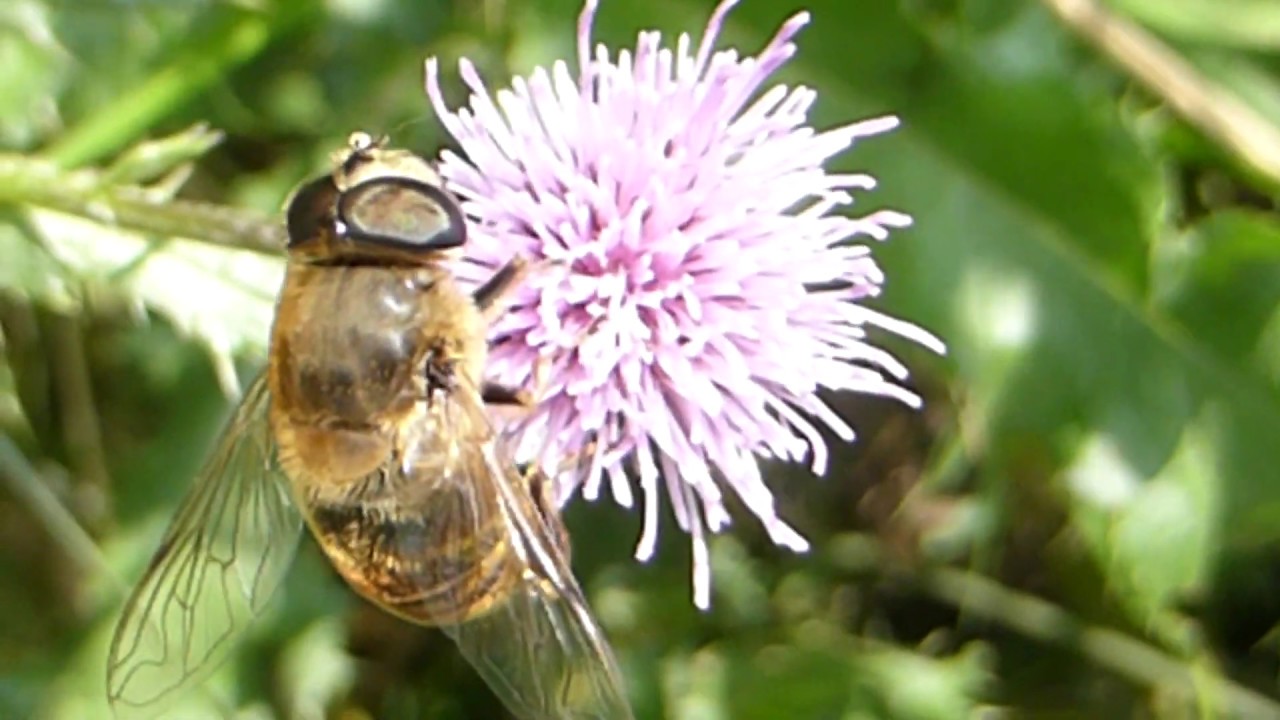
Honey bee mimic - Drone Fly - Eristalis tenax - European hoverfly - Sveifflugur - Dronefly - Flower Fly - Svirreflue - Blomsterflue - Blómfluga - Sveifa - Syrphidae - Býflugu eftirherma - Býflugusveifa - It is always easy to tell males and females apart. Like all other flies the males have much bigger eyes. These eyes almost touch eachother in the middle. Females have much smaller eyes, placed further apart. Auðvelt er að sjá hvort sveifflugur eru karl eða kvenkyns á augunum en það er bil á milli augnana á kvenflugum en augun í karlflugum liggja saman og ekkert bili á milli þeirra.
Life span: Up to one year. Mated females overwinter and lay eggs the following spring. Drone flies look similar to honeybees (hence the 'drone' name), but they lack the narrow waist between the thorax and abdomen. They also have just two wings, where the honey bee has four. The body is brown to black in color, quite hairy, with varying amounts of orange/yellow markings on the side of the second and third abdominal segments. The males have large eyes which meet in the centre, while the females have smaller eyes with a gap in between. The aquatic larvae of droneflies are known as Rat-tailed maggots. They develop in stagnant water, animal faeces and rotting carcasses. The more putrid and foul-smelling it is, the more the larvae seem to like it. Each larva is equipped with an extendible tail called a 'siphon'. This tail, which can extend to about 5cm (2 inches), is used as a snorkel to breath air from the surface of the liquid while the larva feeds below. When they are fully grown, the larvae leave the water to pupate. The pupae are a reddish-brown colour. At the front are some horn-like projections, and the tail often curves up and over the back of the body. See more: http://www.uksafari.com/dronefly.htm
This stocky hoverfly is the commonest 'drone' fly, so called because they mimic bee drones (male hive bees). The orange marks on the abdomen are variable so are not a reliable identification feature, though most specimens have a single pair near to the thorax. It also has a very noticeable dark face stripe and curved rear tibia. See more: http://www.naturespot.org.uk/species/...
The adult fly that emerges from the pupa is harmless. It looks somewhat like a drone honey bee - Apis mellifera, and likely gains some degree of protection from this resemblance to a stinging insect. The adults are called drone flies because of this resemblance. In its natural habitat, E. tenax is more of a curiosity than a problem. Like other hover flies, they are common visitors to flowers, especially in late summer and autumn, and can be significant pollinators. There have occasionally been documented cases of human intestinal Myiasis of the rat-tailed maggot (larva of Eristalis tenax). Infection can be asymptomatic (no symptoms) or can manifest as symptoms ranging from abdominal pain, nausea and vomiting, to anal pruritus. Infection can be caused by ingestion of contaminated food or water but doubts have been expressed that accidentally ingested fly larvae could survive in the gastrointestinal tract. Zumpt proposed an alternative called "rectal myiasis". Flies, attracted to feces, may deposit their eggs or larvae near or into the anus, and the larvae then penetrate further into the rectum. They can survive feeding on feces at this site, as long as the breathing tube reaches towards the anus. See more: https://en.wikipedia.org/wiki/Eristal...
Larva breathes through the long thin tube that extends from its rear end to water surface (thus its common name, ‘rat-tailed maggot. See more: http://bugguide.net/node/view/7183
Sveifflugur eru breytilegar að stærð og gerð. Sumar eru smávaxnar og láta lítið fyrir sér fara á meðan aðrar eru stórar, bústnar og loðnar. Sumar eru með grannan sívalan afturbol, aðrar með egglaga flatvaxinn afturbol. Höfuð er stórt með stórum hvelfdum stundum fínhærðum augum. Fálmarar eru þriggja liða með fína langhærða svipu á stórum þriðja lið. Flestar sveifflugur eru litskrúðugar, dökkar í grunninn en með bletti, belti og rendur sem oftast eru gular, stundum öðru vísi litar. Á minna hærðum tegundum er skelin sjálf lituð en loðnar sveifflugur hafa oftast einlita dökka skel en litaða hæringu. Lesa meira: https://www.ni.is/biota/animalia/arth...
The insect was unharmed in the making of this video.
Unfortunately handheld, with such a macro and a minuscule depth of field the video is shaky and not always on focus.

Информация по комментариям в разработке