In the beginning, before time was measured and before the foundations of the earth were laid, Heaven was a realm of pure glory — radiant, perfect, and filled with the music of creation. Countless angels worshiped before the throne of God, their voices echoing through eternity in songs of holiness. Among them was one who stood out from the rest, an archangel of breathtaking beauty and brilliance: Lucifer, whose name means “light-bearer” or “morning star.” He was adorned with wisdom and splendor, a masterpiece of divine craftsmanship. The book of Ezekiel describes him as being “perfect in beauty,” clothed in precious stones, and anointed as a guardian cherub who walked among the fiery stones of God’s presence.
But within the heart of Lucifer, pride began to take root — subtle at first, yet poisonous. Surrounded by glory, he forgot that his light was a reflection, not his own creation. He gazed upon himself and desired more than the honor given to him. He longed for the throne of the Almighty. The prophet Isaiah reveals his hidden ambition in words that echo through eternity: “I will ascend to heaven; I will exalt my throne above the stars of God; I will sit on the mount of the congregation; I will ascend above the heights of the clouds; I will be like the Most High.” In that moment, Heaven’s harmony was pierced by the first thought of rebellion.
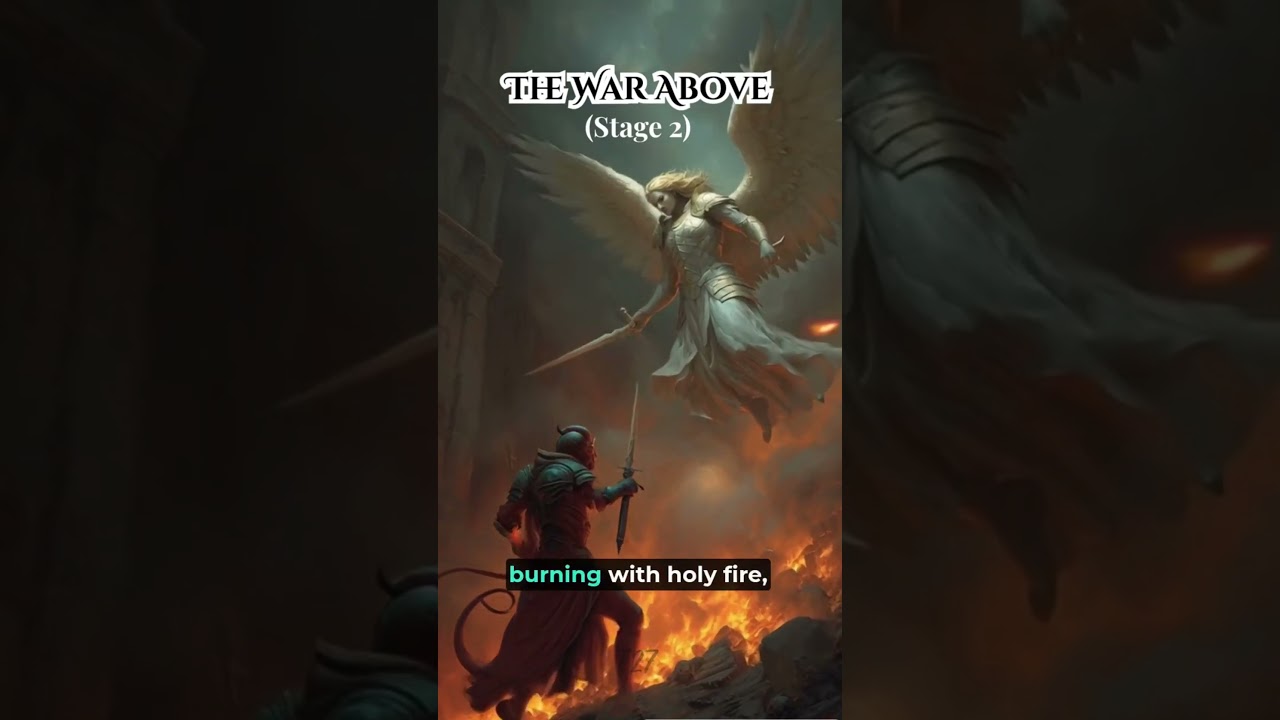
Lucifer’s pride transformed into defiance. No longer content to serve, he sought to rule. The light-bearer became the deceiver. He whispered lies among the angels, convincing many that they, too, could share in his imagined glory. One-third of Heaven’s host believed his deception and joined his revolt. The once-peaceful kingdom of Heaven became a battlefield as rebellion ignited among the stars.
Then came the command from the throne: “Michael, rise.”
The mighty archangel, commander of the heavenly armies, stood against Lucifer and his followers. The heavens shook with the clash of angelic forces — light against darkness, obedience against pride. Revelation 12:7–9 tells us: “There was war in heaven. Michael and his angels fought against the dragon, and the dragon and his angels fought back. But he was not strong enough, and they lost their place in heaven. The great dragon — that ancient serpent called the devil, or Satan — was hurled down to the earth, and his angels with him.”
Defeated, Lucifer was cast out of Heaven. His fall was not gradual but sudden — like lightning flashing from the sky. The splendor that once adorned him was stripped away. His light became darkness, his name changed from Lucifer to Satan, meaning “the adversary.” No longer an angel of glory, he became the embodiment of rebellion and corruption. The heavens mourned the loss of one who had once walked in the light, now transformed into the father of lies.
Banished to the earth, Satan turned his wrath toward the creation of God — humanity. If he could not overthrow God, he would try to destroy what God loved most. In the garden of Eden, he appeared as the serpent, cunning and deceitful. With twisted words he tempted Eve, casting doubt upon the command of God: “Did God really say…?” With that single seed of doubt, mankind’s fall began. Adam and Eve disobeyed, sin entered the world, and the relationship between Creator and creation was fractured. What began as rebellion in Heaven now spread to the human heart.
Yet even then, God’s plan of redemption was already unfolding. For every lie Satan spoke, truth would answer. For every soul he led astray, grace would call them home. The serpent struck humanity with sin, but in time, the Son of God would crush his head.
Throughout history, Satan’s influence wove through kingdoms and empires, through deceit, idolatry, and war. He tempted kings to pride, prophets to despair, and people to forget their Maker. He stood as the accuser before God, pointing out the sins of humankind, hoping to separate them forever from divine mercy. But Heaven’s plan could not be undone. When Jesus Christ came to earth, the battle shifted once more.
In the wilderness, Satan tempted Christ with power, pleasure, and pride — the same weapons that led to his own fall. Yet where Adam failed, Jesus stood firm. With each temptation, He answered with the Word of God, saying, “It is written.” At the cross, Satan believed he had won at last — that by killing the Son of God, he had triumphed over Heaven itself. But the cross became his undoing. In His death and resurrection, Jesus broke the power of sin and conquered the grave. As Colossians 2:15 declares, “Having disarmed the powers and authorities, He made a public spectacle of them, triumphing over them by the cross.”

Информация по комментариям в разработке