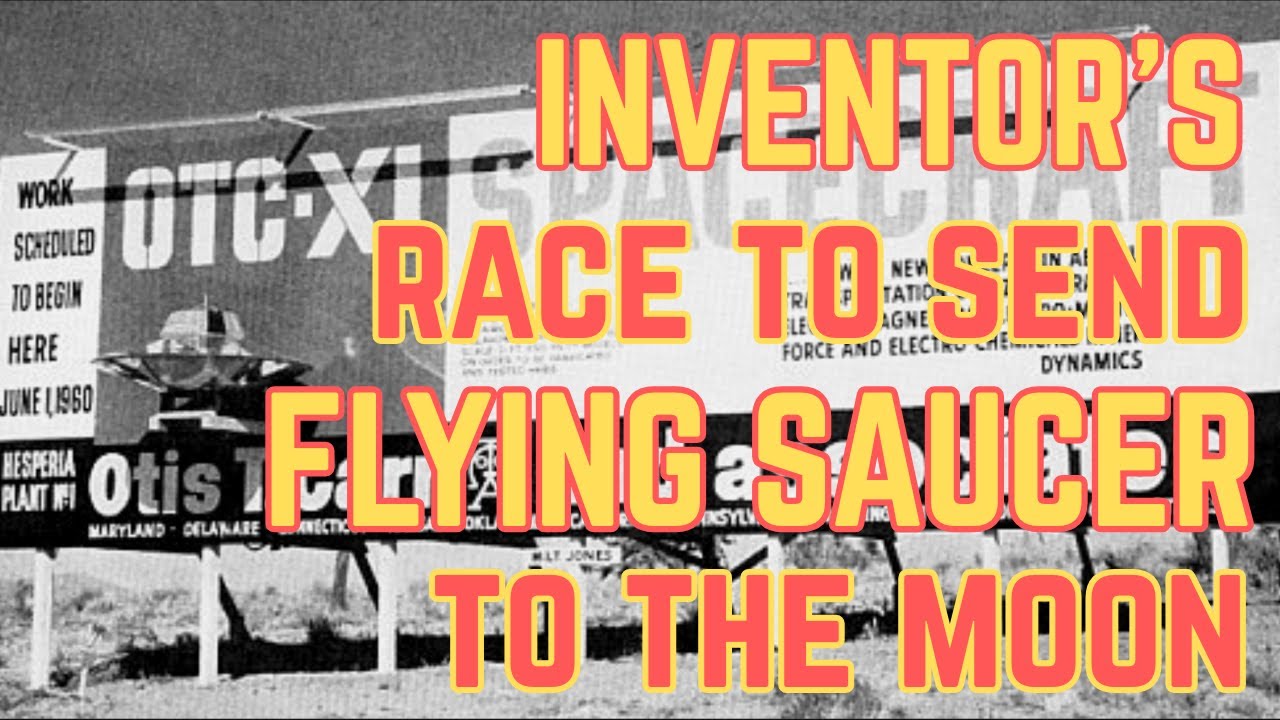
In the 1950s, as America stood at the crossroads of technological triumph and Cold War paranoia, one man dared to dream of a future beyond the stars. His name was Otis T. Carr, an enigmatic inventor from Oklahoma who claimed to have unlocked the secrets of interstellar travel. His invention, the OTC-X1 Flying Saucer, promised to defy gravity, harness cosmic energies, and carry humanity into a new era of exploration. This is the story of Carr’s audacious vision, his rise to fame, and the dramatic fall that left his legacy shrouded in mystery—a tale of ambition, controversy, and the unrelenting pursuit of the impossible.
Otis T. Carr was born in 1904 in Elkins, West Virginia, a small town far removed from the scientific hubs of the era. From an early age, Carr was a dreamer, fascinated by the mysteries of electricity and the tales of inventors like Nikola Tesla, whose work on wireless energy captivated his imagination. With little formal education, he relied on self-study, devouring books on physics and engineering while working odd jobs as a hotel clerk and mechanic.
By the 1940s, Carr had settled in Baltimore, where he claimed to have met Tesla himself, a brief encounter that would shape his life’s mission. Tesla, Carr later said, entrusted him with ideas for revolutionary technologies, including a device that could tap the universe’s hidden energies.The 1950s were a time of boundless possibility and existential fear. The Space Race was heating up, with the Soviet Union’s Sputnik launch in 1957 igniting American ambitions.
At the same time, UFO sightings were sweeping the nation, fueling public fascination with extraterrestrial life. Carr saw an opportunity to bridge these worlds—science and speculation, earthbound technology and cosmic dreams. Inspired by Tesla’s theories of electromagnetic fields, he began developing the OTC-X1, a circular craft he claimed could achieve anti-gravity propulsion. Unlike the rockets of NASA, which relied on brute force, Carr’s saucer promised to glide effortlessly, powered by a mysterious interplay of electricity and magnetism.
The OTC-X1 was unlike anything the world had seen. Carr described it as a 45-foot-diameter disc, resembling the flying saucers of popular lore, with a hull of polished aluminum and a central cabin for passengers. Its propulsion system, he claimed, was based on a “Utron Electric Accumulator,” a device that generated energy by spinning counter-rotating magnetic fields.
Carr said of the Utron, "This is a dimensional product. It was designed with the dimensions of space itself. We say it is truly the geometric form of space, because it is completely round and completely square. It has been proven in scientific laboratories that the very smallest unit of mass matter ever photographed in the electron microscope are square in shape... We have applied this principle into an electrified system, which is the power core of our space vehicle.
To Carr, the OTC-X1 was not just a machine—it was a gateway to the stars, capable of reaching the Moon in hours or even venturing to distant galaxies.
By 1957, Carr had founded OTC Enterprises in Baltimore, a company dedicated to building and commercializing his saucer. He was a charismatic showman, with a knack for drawing crowds and investors. His public lectures, filled with diagrams of spinning magnets and promises of a utopian future, attracted dreamers, engineers, and UFO enthusiasts alike.
Carr claimed the OTC-X1 was nearly complete, with smaller prototype models already demonstrating levitation in his workshop. In one widely reported demonstration, a six-foot model reportedly hovered briefly, powered by what Carr called “electromagnetic propulsion.” Witnesses were awestruck, and newspapers dubbed him the “Tesla of the Space Age,” a moniker that fueled his growing fame.
Carr’s vision extended beyond technology. He spoke of a new era for humanity, where free energy would eliminate poverty and interstellar travel would unite civilizations. His rhetoric resonated with the counterculture of the time, blending science fiction with spiritual optimism. He claimed to have received insights from “higher intelligences,” a nod to the UFO contactee movement that was gaining traction.

Информация по комментариям в разработке