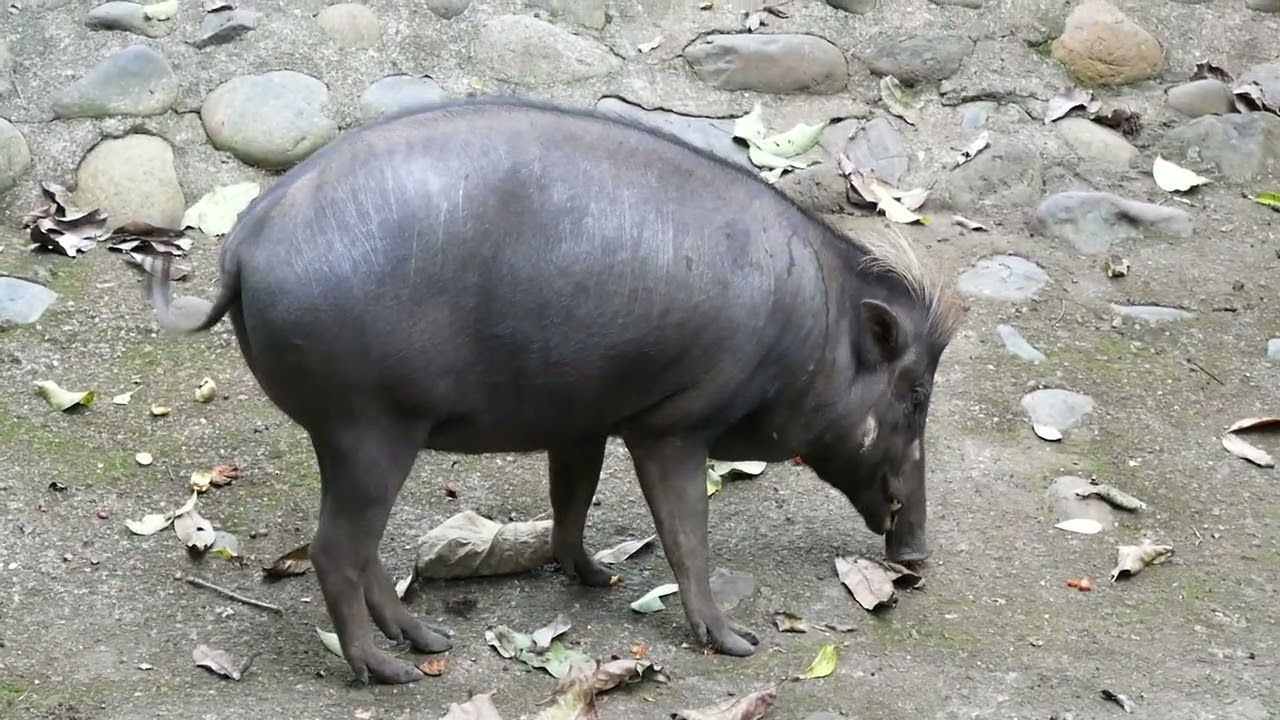
Babirusa—the pig deer: Known as “pig deer” in Indonesia, babirusas come from islands rich in tropical forests. Because of the warm and humid climate, their coat is sparse, short, and light. Their face is covered in bristles, and they don’t sport the warts that some other pig species do. Instead of growing from the sides of the jaw, the babirusas’ tusks grow up through the top of the mouth, curving backward on the top of the nose. The males use these for fighting, locking an opponent’s tusks to stop attacks.
Chances are that when you heard the word pig in the past, you pictured the pink, domestic barnyard variety. Perhaps now you'll think of the wonderful variety of swine in the world, ready to root in the dirt or battle an opponent. There's just no such thing as a plain pig!
HABITAT AND DIET
Wild swine species have adapted to live in a variety of climates and habitats. Red river hogs and babirusas live in rainforests, bush pigs and forest hogs live in forests, and warthogs are at home in the savanna. All make good use of mud wallows to cool off and to protect their skin from parasites and insect bites. They are generally crepuscular or nocturnal, resting during the day in burrows or hollows they make in stands of tall grass or leaf litter.
Pigs and hogs are omnivores: their varied diet can include small reptiles, mammals, and carrion, along with grasses, water plants, and fruit. A good part of each day is spent foraging. All pigs use that tough snout to root in the soil for food items such as leaves, roots, bulbs, insects, and earthworms. An acute sense of smell allows swine to detect an edible root or tuber 10 inches (25 centimeters) below the soil. Because of this behavior, wild swine have become infamous for rooting through and destroying large portions of farmers' crops.
FAMILY LIFE
Wild pigs are generally social, living in close-knit groups called sounders that are made up of adult females (sows) and their offspring, along with an adult male (boar). Young boars may form bachelor herds until they're old enough to mate. Boars are generally solitary, but sows stay with the sounder unless they are rearing young. Sounders can be made up of many generations.
Pigs have excellent senses of smell and hearing and communicate with one another using a variety of grunts, squeaks, and chirrups. Calls are made to keep in touch with the rest of the group or to warn of danger. Alarm calls can include a short grunt, a longer growl, and a loud roar. Pigs also get their message across through body postures, such as raising the crest of hair on the back, cocking the ears, grinding the teeth, or jerking the head up or to the side. Pigs also have scent glands on different areas of the face. They spread their scent by rubbing their face on trees or rocks or by plowing into the earth.
During breeding season, a boar follows a sow and nudges her repeatedly to see if she is receptive. If she is, she lets him know by letting him smell and taste her urine. He then stays with her for several days before moving on to find yet another sow to breed with, fending off other boars with his tusks.
and began domesticating Eurasian wild pigs in Europe, India, China, and Malaysia about 7,000 years ago.
Pygmy hogs are the smallest of all wild pigs. They live in India, in the foothills of the Himalayan Mountains. Little is known about these rare animals, and by the 1960s, they were thought to be extinct because of hunting and loss of habitat. Then, a small number of the tiny pigs was discovered in 1971—good news for pig lovers everywhere! Since their habitat continues to shrink, pygmy hogs are still at critical risk of extinction.
Living on a small island can be difficult for animals: they cannot leave to escape predators, food shortages, or hunters. This has affected swine species such as the Visayan warty pig, found on only two islands in the Philippines, and the Javan warty pig found on only the Indonesian island of Java.
Buru Babirusa
The Babyrousa babyrussa is one of the four species of babirusa. Until 2001, all babirusa species were considered to be conspecific under Babyrousa babyrussa but the discovery of morphological and genetic differences led to their separate classification in more recent times. The Buru Babirusa is found exclusively in the Indonesian islands of Buru, Taliabu, and Mangole. This animal has long and thick, golden-brown colored fur. The tail tuft of the species is also quite well-developed. They inhabit tropical rainforests, natural ponds, and riverbanks in their limited range. They are omnivorous in nature and feed on both plant parts, small vertebrates, and invertebrates. The Buru Babirusa is threatened by habitat loss and poaching and has been listed as a “Vulnerable” species by the IUCN.

Информация по комментариям в разработке