Nasa Astronomers have found the first near-Earth-size planet in the 'habitable zone' around a sun-like star.
Named Kepler 452b, it is the smallest planet to date discovered orbiting in the habitable zone of a G2-type star, like our sun.
Nasa has also found 11 new small habitable zone candidate planets, marking another milestone in the journey to finding another-Earth.
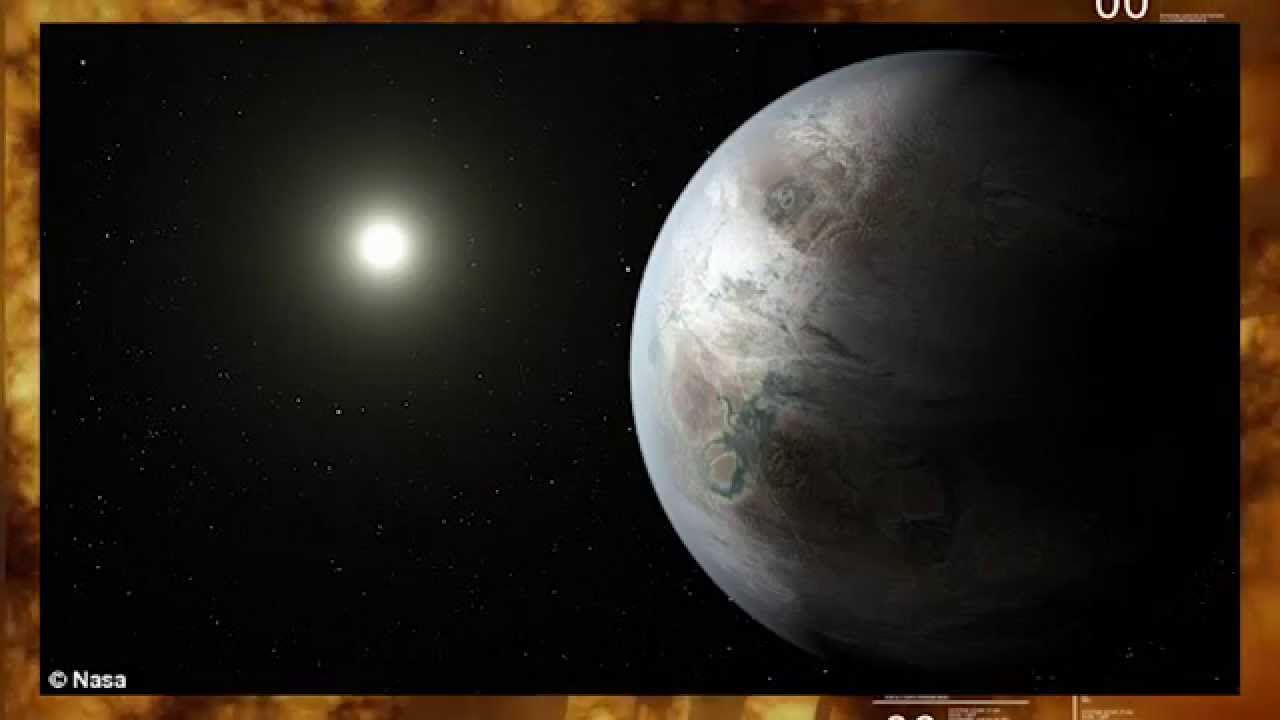
An artist's concept depicts one possible appearance of the planet Kepler 452b, the first near-Earth-size world to be found in the habitable zone of a star that is similar to our sun.
The habitable zone is the area around a star where liquid water could pool on the surface of an orbiting planet.
The confirmation of Kepler 4 52b brings the total number of confirmed planets to 1,030.
'This exciting result brings us one step closer to finding an Earth 2.0,' said John Grunsfeld, associate administrator of Nasa's Science Mission Directorate.
Kepler 452b is 60 per cent larger in diameter than Earth and is considered a super-Earth-size planet.
While its mass and composition are not yet determined, previous research suggests that planets the size of this have a good chance of being rocky.
Kepler 452b is 6 billion years old, 1.5 billion years older than our sun, has the same temperature, and is 20 percent brighter and has a diameter 10 per cent larger.
Kepler 452b is larger than Earth, but its 385-day orbit is only 5 per cent longer.
The planet is 5 per cent farther from its parent star, Kepler 4 52 than Earth is from the sun.
'We can think of it as an older, bigger cousin to Earth, providing an opportunity to understand and reflect upon Earth's evolving environment,' said Jon Jenkins, Kepler data analysis, lead at Nasa's Ames Research Center in Moffett Field California, who led the team that discovered Kepler-452b.
'It's awe-inspiring to consider that this planet has spent 6 billion years in the habitable zone of its star' longer than Earth.
'That's substantial opportunity for life to arise, should all the necessary ingredients and conditions for life exist on this planet.'
To help confirm the finding and better determine the properties of the Kepler 4 52 system, the team conducted ground-based observations.
These measurements were key for the researchers to confirm the
planetary nature of Kepler 4 52b, to refine the size.
Billions of stars in our galaxy have between one and three planets which could potentially support life, astronomers have estimated.
Paul Hertz, director of astro-physics at Nasa, said identifying worlds that could be home to alien life with Kepler would allow future missions to look at them more closely.
He said: 'Future Nasa missions, like the Transiting Exo-planet Survey Satellite and the James Webb Space Telescope, will discover the nearest rocky exo-planets and determine their composition and atmospheric conditions, continuing humankind's quest to find truly Earth-like worlds.'
The 10 reasons why Science Report will keep you updated.
Videos Courtesy: NASA, Reuters, JPL
Find more videos at:
http://www.10reasonswhyshow.com
Follow Us:
OFFICIAL WEB PAGE: http://www.10reasonswhyshow.com
FACEBOOK: / 10reasonswhyshow
TWITTER: / 10reasonsshow
Images Courtesy: NASA, JPL, SETI

Информация по комментариям в разработке