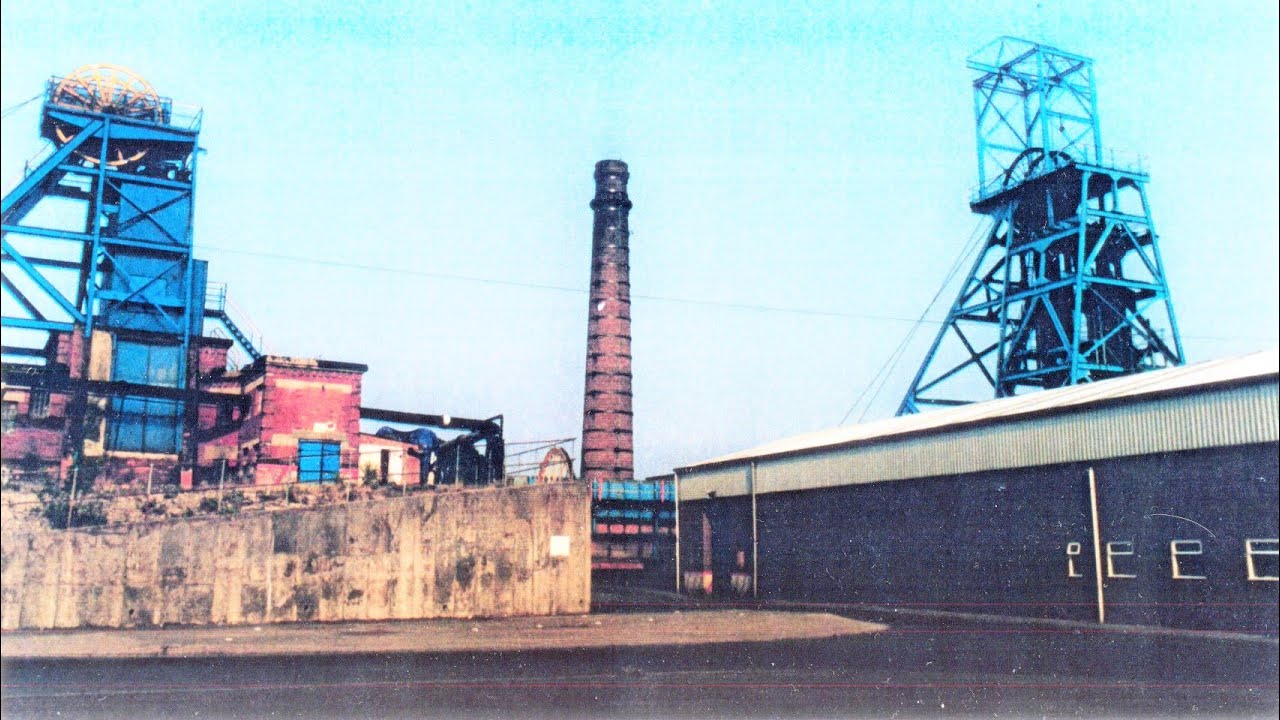
Subscribe to my you tube channel for 284+ more coal mine tributes and counting. Donisthorpe Colliery-Ashby-De-La-Zouch,Leicestershire. The mine was first sunk in 1871 by the colliery owners Checkland and Williams to a depth of 205m (672 feet). In 1890 they deepened mine to 263m (863 feet).
Donisthorpe Colliery was originally 2 pits. The current No.1 Shaft was Donisthorpe Lower Pit and No.2 Shaft was Donisthorpe Upper Pit - both were worked by different Mining Companies !
In 1903 the mines came under the control of the newly formed Donisthorpe Colliery Company Ltd. (which later became part of the Moira Colliery Company combine). Over the next sixteen years the new company introduced a number of changes and improvements. These included installing electricity underground to replace steam and oil powered equipment, while on the surface a new generating plant, steel headframes, new winding gear and improved workshop facilities were built. The company also acquired 50 houses for mine employees and employed 90 horses and ponies underground.
As a result of these changes the mine output was tripled to 300,000 tons per annum.In the 1940's new reserves were being actively sought, in what became the Oakthorpe, South, Newfields and Woodfield sections. To help work these reserves a new pit bottom was constructed.
Following Nationalisation, 1948 to 1952 saw the installation of modern mechanical coal winning equipment and a complete re-organisation of the main underground road transport and winding operations. On the surface the Pit-head baths, Canteen and Medical Centre were built during this period.
In 1951, Donisthorpe won a National Competition for Britain's Best Pit, and during this period broke many Area and National records, with overall output rising to about 750,000 tons per annum. By the mid sixties, output had reached 1,039,018 tons per annum.
In 1966 new workshops, lamproom, rescue room and deputies offices were added to improve surface facilities.
To improve coal handling in 1980 a 2,200m long drift was driven to connect the pit to Rawdon surface. At the same time Donisthorpe pit bottom was reorganised and an 800 tonne vertical bunker installed.
Despite the improvements over the years and the still considerable reserves (22 new faces had recently been created in this mine complex, only one of which had started production) the Mine was deemed uneconomic and scheduled for closure. As all the faces were good and level, with plenty of room the miners could not understand why the pit was being closed!
No.1 Pit
Winder: At time of closure an electric winder, working a 300m (~1,000 ft.) shaft. It wound 2, double deck cages and had a top speed of 9m (30ft.) per second.
On inspection runs, the winder ran down with men on the top of the cage at 0.7m (2-3 ft.) per second, but up at 9m (30ft.) per second. The shaft inspector doubled up as the boilerman!
The original pit bottom was at 183m (600 ft.), where pony stables were located. Until 1978 some time sheets dating from 1924-26 were still there, these were found at the time the electric winder was installed - replacing a steam winder (horizontal twin cylinder [or duplex], rebuilt by Worsley Mesnes Ironworks, Wigan 1915/16, 26" x 54", possibly dating from 1880's - removed to the NCB's National Mining Museum, Lound Hall in 1978. (This musuem closed in 1989, the engine may now be at Caphouse Colliery, or scrapped).
At the time of closure Donisthorpe was only one of two mines in Britain to still retain and use a steam winding engine (on the Number 2 Pit). No.2 Pit Bank
Bankside Buildings: The buildings date from 1919, although the headframe was 1942.
Fan taken out of commission about 1978/80 - this was the Upcast shaft.
Boilers: Steam was provided by one of four Lancashire type boilers with mechanical chain grate stokers, coal hopper fed from above, ash fell onto another chain conveyor to be removed from the boiler, where it fell down a chute onto a conveyor running along the front of the boilers (under the floor). From here it was conveyed out to the end of the boiler complex, and discharged into an old mine tub for disposal.
The boilers were only covered at the firing end - the cover building actually being the coal hopper. The boilers were on brick supports, open to the elements, but lagged, at the top. At the rear of the boilers were the Superheater boxes, behind them the Chimney.Sunk in 1871 and sadly closed in 1991.









Информация по комментариям в разработке