Before Le Corbusier and the Bauhaus, modernism took the stage quite literally.
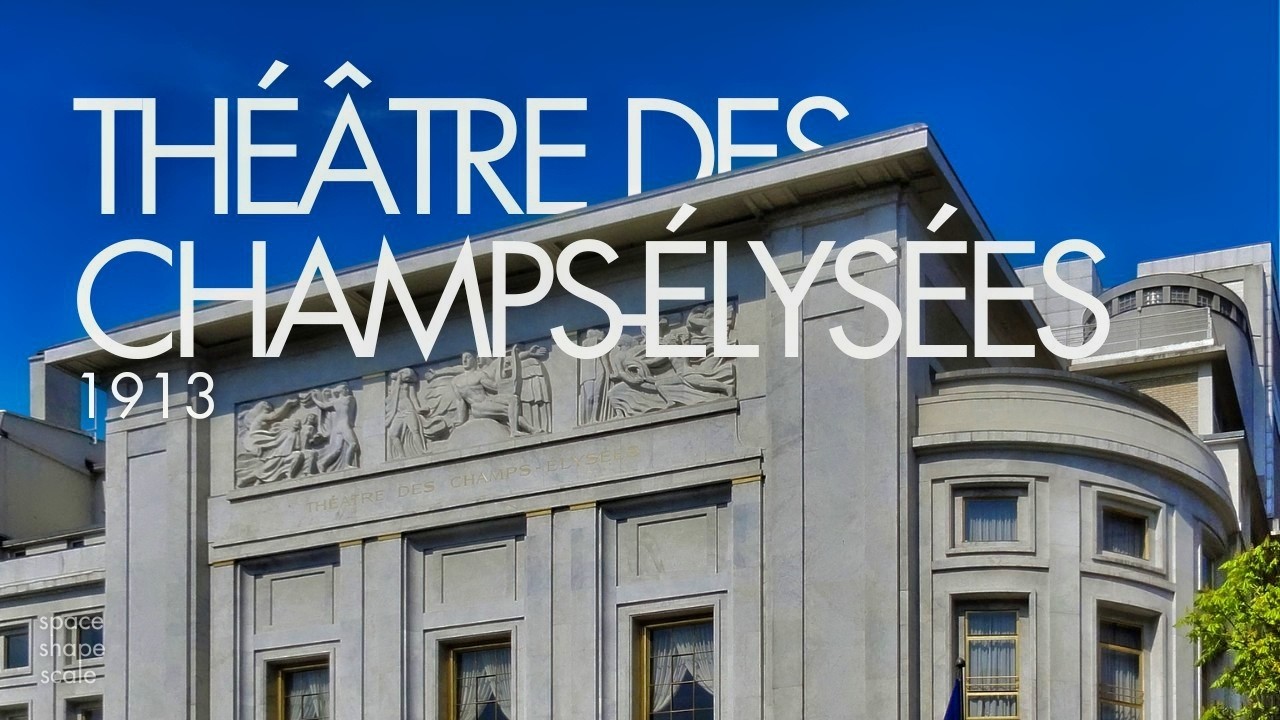
Opened in 1913 on Paris’s chic Avenue Montaigne, the Théâtre des Champs-Élysées stands as one of the most radical and elegant statements of early 20th-century architecture. Designed by Auguste Perret, with sculptural and artistic contributions from Antoine Bourdelle and Maurice Denis, it was more than a building: it was a manifesto built in concrete.
This was the first major Parisian monument constructed entirely with reinforced concrete, a material still widely viewed as crude and purely utilitarian. Perret’s mastery transformed it into something altogether new a refined structural skeleton clad in minimalist, classically proportioned façades. The theater’s dignified symmetry hinted at neoclassical temples, yet its sheer surfaces, exposed concrete cornices, and absence of historicist ornament made it unmistakably modern.
A technical and aesthetic revolution
Perret didn’t just use concrete for its structural possibilities he elevated it to an aesthetic principle.
Columns and beams were left visibly expressed, articulating the true skeleton of the building in a way that anticipated the honesty of later modernists like Mies van der Rohe.
Light, airy interiors were achieved without heavy load-bearing walls, a revelation at a time when most Parisians still equated grandeur with stone masonry.
The careful proportions and modular grid created an almost musical rhythm in the façades, proving that modern construction could uphold classical harmony.
By doing so, Perret opened the door for concrete to become not just the hidden bones of architecture, but a visible, dignified skin. This single building helped rehabilitate concrete from a “cheap industrial expedient” into the primary medium for modern architectural poetry.
Corbusier’s first ‘class’ in concrete modernism
Few realize that Charles-Édouard Jeanneret (later known as Le Corbusier) worked in Perret’s Paris office from 1908 to 1910. It was here that the young Swiss would learn the structural and aesthetic possibilities of reinforced concrete firsthand lessons that would echo across his entire career, from the pilotis of the Villa Savoye to the monumental béton brut of Chandigarh.
Perret taught him that structure is beauty, and that material honesty mattered more than superficial ornament.
Through Perret’s mentorship, Corbusier absorbed the logic of modular repetition and the expressive clarity of beams, slabs, and thin piers.
Later, when Corbusier wrote “Architecture is the masterly, correct, and magnificent play of masses brought together in light,” he was, in many ways, distilling principles first encountered under Perret.
In this way, the Théâtre des Champs-Élysées stands as the ultimate “classroom” where one of modernism’s greatest thinkers first grasped the architectural poetry of concrete.
A cultural stage for modern rebellion
The theater wasn’t just an architectural experiment it was a crucible for cultural upheaval. When it opened in 1913, it quickly became known not only for its restrained exterior but for the artistic ferment it hosted inside. Most famously, it premiered Stravinsky’s “The Rite of Spring,” the ballet whose jagged rhythms and savage choreography by Nijinsky sparked an uproar that became legendary.
The clash of new art, new music, and new architecture at the Théâtre des Champs-Élysées symbolized the collision between 19th-century tradition and 20th-century modernity.
Subscribe & keep exploring
At Space Shape and Scale, we trace how the world’s most visionary minds from Gaudí’s swirling cathedrals to Wright’s organic prairies, Loos’s minimalist townhouses, and here Perret’s graceful concrete theaters reshaped how we build, live, and dream.
Join us each week as we reveal how space, shape, and scale carry the deepest hopes of their time and challenge us to imagine new futures.
Hashtags for reach & discovery
#AugustePerret #TheatreDesChampsElysees #ReinforcedConcrete #ModernArchitecture #LeCorbusier #EarlyModernism #ParisArchitecture #ArchitecturalHistory #StructuralExpression #SpaceShapeScale
TIMELINE OF INFLUENTIAL ARCHITECTS
Joseph Paxton (1803) – Victorian Engineering / Proto-Modernism
Otto Wagner (1841) – Vienna Secession
Lluís Domènech i Montaner (1850) – Catalan Modernisme
Antoni Gaudí (1852) – Catalan Modernisme
Louis Sullivan (1856) – Prairie School / Functionalism
Josep Puig i Cadafalch (1867) – Catalan Modernisme
Frank Lloyd Wright (1867) – Prairie School / Organic Architecture
Charles Rennie Mackintosh (1868) – Art Nouveau / Arts and Crafts
Peter Behrens (1868) – Industrial Modernism
Giacomo Mattè-Trucco (1869) – Industrial Architecture
George Grant Elmslie (1869) – Prairie School
Adolf Loos (1870) – Rationalism / Early Modernism
Auguste Perret (1874) – Concrete Modernism
Antonin Nechodoma (1877) – Caribbean Prairie Style / NeoGothic
Walter Gropius (1883) – Bauhaus / Modernism
Le Corbusier (1887) – International Style / Modernism

Информация по комментариям в разработке